एक subject. हर board का code. CBSE, ICSE, UP, Maharashtra, Karnataka — 24 boards, सब mapped.
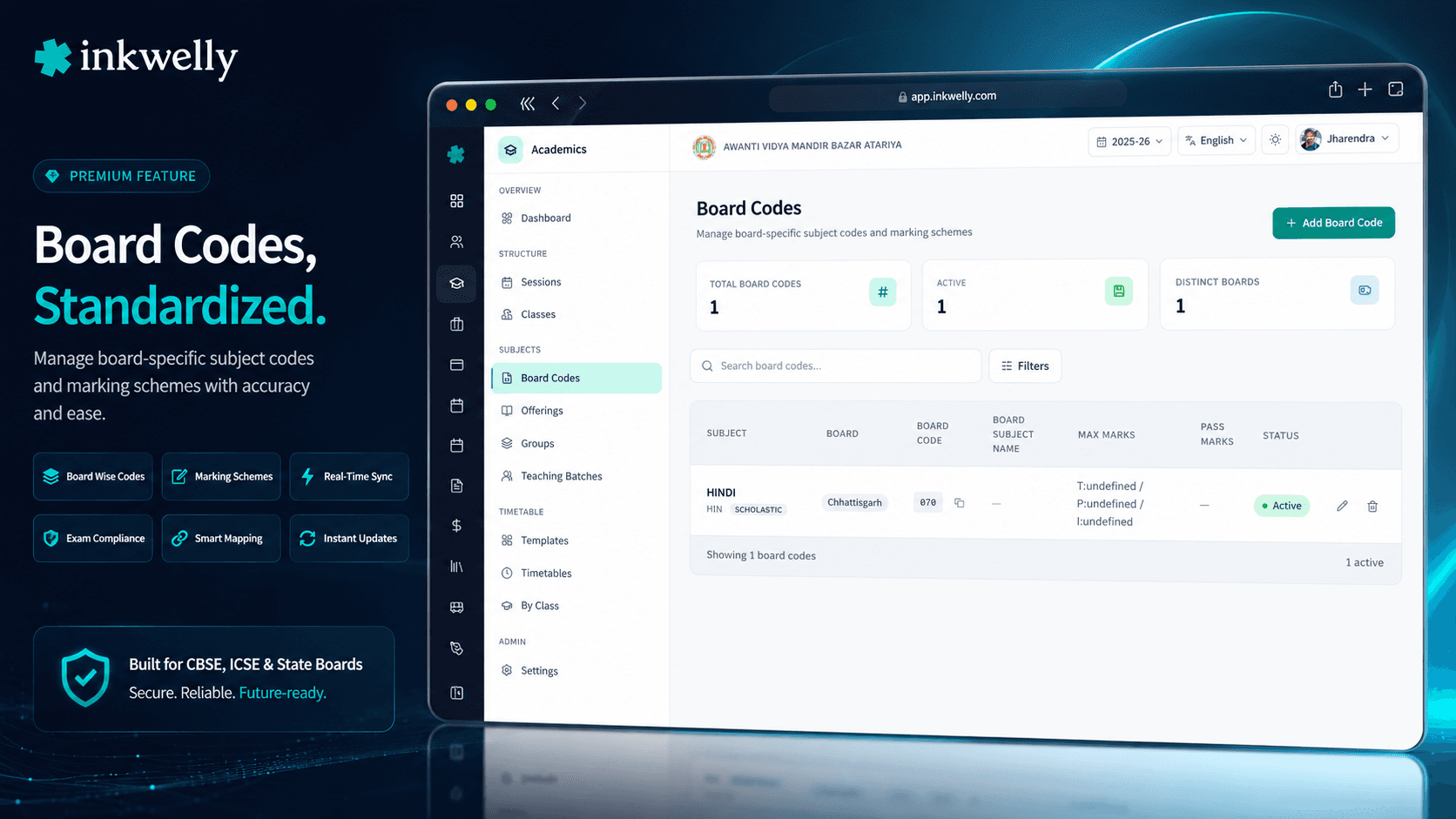
Board Subject Codes आपके school की internal subject list को board-ready records में बदलता है। Mathematics, Science या Hindi — हर subject पर official CBSE code (041), ICSE paper number, IB diploma group, Maharashtra HSC code या 24 supported boards में से कोई भी attach करें। हर mapping अपनी theory, practical aur internal max marks, pass marks, weightage split (100 percent sum करनी चाहिए) aur board-specific JSON config carry करता है — [Examinations module](/modules/examinations) aur report card generator board के verifying officer के expectation के मुताबिक output देते हैं।
हर Indian school को board codes क्यों चाहिए — और ज़्यादातर ERPs इसे afterthought की तरह ship क्यों करते हैं
February का दूसरा हफ्ता, Lucknow के एक CBSE day school में। Exam coordinator Class 10 Pre-Board papers prepare कर रहे हैं। CBSE marksheet template को Mathematics के लिए code 041, Science के लिए 086, Social Science के लिए 087, Hindi Course-A के लिए 184 चाहिए। School की internal subject list इन्हें 'Maths', 'Sci', 'SST', 'Hindi-A' कहती है। Mismatched codes की marksheet regional CBSE office पर reject हो जाती है। Exam coordinator report card spreadsheet की हर Mathematics row में 041 hand-type कर रहे हैं। Class 10 की 4 sections, हर एक में 30+ students, 6 subjects — 720 cells fill करने हैं, 720 chances कि code में typo हो।
इसी बीच school कुछ Class 12 ICSE Commerce sections भी run करता है (local State Board Class 10 से आगे Commerce offer नहीं करता)। ICSE codes अलग हैं। Accountancy ACT है, CBSE की तरह 055 नहीं। Business Studies BST है, 054 नहीं। Exam coordinator के पास ICSE codes की दूसरी spreadsheet है aur तीसरी track करती है कि किस section में किस student का किस board में enrollment है। Error की probability compound होती है।
ज़्यादातर school ERPs में यह पूरा landscape invisible है। 'Subject' एक single name field है। कोई slot नहीं है कि सामे Mathematics subject पर CBSE code, ICSE paper code, Maharashtra HSC code aur Cambridge IGCSE syllabus number attach कर सकें। Exam template में free-text field है जहाँ operator एक बार '041' type कर प्रार्थना करता है।
हमने Board Subject Codes को structural बनाने के लिए build किया। आपके school में एक Mathematics subject। उसके नीचे multiple board mappings — CBSE 041, ICSE Maths Paper 1, ISC Mathematics, Maharashtra HSC Mathematics, IB DP Mathematics AA HL। हर mapping अपनी marking scheme carry करती है। Exam module हर student के लिए सही mapping read करता है (वो किस board में enrolled है उसके आधार पर)। Marksheets board-specific codes automatic emit करती हैं। CBSE renewal officers को जो चाहिए वो दिखता है; ICSE inspectors को जो चाहिए वो; State Board verification officers को उनका format। Same subject। One source of truth।
Board code mapping कैसे काम करती है
Academics → Subjects → Board Codes खोलें। Aggregated list current session में हर subject offering aur उससे attached हर board mapping show करती है।
Add Board Code click करें। Dialog पाँच tabs के साथ खुलता है — Basic, Max Marks, Pass Marks, Weightages, Config — क्योंकि form में एक screen पर fit होने से ज़्यादा fields हैं।
Tab 1 — Basic. Subject offerings से Subject pick करें (e.g., Mathematics)। 24 options के grouped dropdown से Board pick करें: Central Boards (CBSE, ICSE, ISC), State Boards North (UP, Rajasthan, Haryana, Punjab), State Boards South (Karnataka, Tamil Nadu, Kerala, Andhra Pradesh, Telangana), State Boards East (West Bengal, Bihar, Odisha, Assam, Jharkhand), State Boards West & Central (Maharashtra, Gujarat, MP, Chhattisgarh), International Boards (IB, Cambridge), Other। Board Code type करें (1–20 characters; auto-uppercased)। Optional Board Subject Name अगर board का official name internal से अलग है (e.g., 'Mathematics (Standard)' for CBSE 041)। Active toggle।
Tab 2 — Max Marks. Theory max marks (e.g., 80 for CBSE Class 10 Maths)। Practical max marks (e.g., 0 for Maths, 30 for Science)। Internal max marks (e.g., 20 for CBSE internal assessment)। Dialog live Total Max Marks count दिखाता है जब तीनों में से कोई set हो — typically 100 for CBSE main subjects, 70/100/200 for various IB and State Board combinations।
Tab 3 — Pass Marks. Theory pass marks (e.g., 27, CBSE Class 10 का standard 33 percent threshold)। Practical pass marks (e.g., 9)। Overall pass marks (e.g., 33)। Validators API call से पहले 'pass marks > max marks' block करते हैं। Guidance callout reminds करता है कि pass marks typically max marks का 30–35 percent होने चाहिए।
Tab 4 — Weightages. Theory weightage percent। Practical weightage percent। Internal weightage percent। तीनों को 100 percent sum करना चाहिए — dialog live total दिखाता है valid पर green checkmark, off पर red error। CBSE Class 10 typical: 80 + 0 + 20 = 100। CBSE Science: 60 + 30 + 10 = 100। IB DP: 50 + 30 + 20 = 100।
Tab 5 — Config. Board-specific rules के लिए free-form JSON textarea। ICSE 'Best of 5' subject selection, Kerala grade-only assessment patterns, CBSE internal assessment sub-components, IB DP IA / EE flags, Cambridge syllabus version pinning के लिए use होता है। Save से पहले JSON syntax validate करता है।
सभी 24 supported boards — dialog जैसे present करता है वैसे grouped
- Central Boards — CBSE (Central Board of Secondary Education), ICSE (Indian Certificate of Secondary Education, Class 10), ISC (Indian School Certificate, Class 12)।
- State Boards — North — UP Board (Uttar Pradesh Madhyamik Shiksha Parishad), Rajasthan Board, Haryana Board, Punjab Board।
- State Boards — South — Karnataka Board (KSEEB), Tamil Nadu Board (Matric / HSC), Kerala Board (DHSE), Andhra Pradesh Board, Telangana Board (BIE)।
- State Boards — East — West Bengal Board (Madhyamik / HS), Bihar Board (BSEB), Odisha Board (BSE / CHSE), Assam Board (SEBA), Jharkhand Board (JAC)।
- State Boards — West & Central — Maharashtra Board (SSC / HSC), Gujarat Board (GSEB), MP Board (Madhya Pradesh Mandal), Chhattisgarh Board (CGBSE)।
- International Boards — International Baccalaureate (IB — PYP, MYP, DP), Cambridge International (CAIE — IGCSE, AS / A Level)।
- Other — एक catch-all उन boards के लिए जो list में नहीं (NIOS, foreign curricula, custom homeschool boards)।
एक subject, multiple board codes — multi-board school अब finally work करती है
Bangalore का एक mid-sized school CBSE Classes 1–10 run करता है, फिर Class 11/12 में तीन streams offer करता है: CBSE Science, ISC Commerce, aur IB DP। Mathematics सब तीनों streams में padhayee जाती है — but हर board का अपना code, paper structure, assessment pattern है।
Inkwelly में org-level subject library में एक Mathematics subject create करें। फिर उसके नीचे तीन board codes attach करें: CBSE 041 (Mathematics Standard, 80+20 max marks, 100 percent theory weightage); ISC Mathematics Paper 1 (100 max marks, 80 percent theory + 20 percent project); IB DP Mathematics AA HL (240 max marks, 80 percent external + 20 percent IA)। हर Class 12 student एक board (CBSE, ISC, IB) के लिए enroll होता है, Examinations module automatically student के enrollment के आधार पर right code, marking scheme, report card template pick करता है। Exam coordinator spreadsheets switch नहीं करते।
Weightages 100 percent sum करनी चाहिए — validator enforce करता है
Board-code form का weightage tab सबसे error-prone part है, क्योंकि operators routinely 50 + 50 + 10 = 110 percent या 70 + 30 = 100 (internal 20 percent component भूल कर) enter करते हैं। Inkwelly constraint live enforce करता है।
Theory, practical, internal weightages type करते ही dialog running total display करता है। Total 100 percent (0.01 floating-point tolerance के अंदर) हो तो green callout: 'Total: 100 percent — looks good'. नहीं हो तो red: 'Total: 95 percent (must equal 100 percent)'. Save block होता है। API layer पर भी same validation — custom integration से malformed call भी closed fail होता है। Common patterns clean ship करते हैं: CBSE Class 10 Maths (80 + 0 + 20), CBSE Science (60 + 30 + 10), Karnataka SSLC (80 + 20), Maharashtra HSC Science with practicals (50 + 30 + 20)।
Theory + Practical + Internal — three-axis CBSE / ICSE pattern
Indian boards subjects को तीन axes पर score करते हैं: external theory paper (March का बड़ा board exam), external practical / oral examination (often outside examiner supervised), aur internal assessment (year-round in-school continuous evaluation)। CBSE Class 10 Mathematics: 80 theory + 0 practical + 20 internal। CBSE Class 10 Science: 60 theory + 30 practical + 10 internal। ICSE Class 10 Physics: 80 theory + 20 practical (no internal)। हर board, हर subject, हर level का अपना split है।
Max Marks tab तीनों numbers separately लेता है, aur live total sum display करता है। Save के बाद, Examinations module इन values को read करता है aur right number of assessment slots auto-create करता है: एक theory के लिए, एक practical के लिए, एक या कई internal के लिए। Teachers slots के खिलाफ़ marks enter करते हैं। Marksheet generator board के prescribed format में emit करता है — CBSE में internal bottom पर; ICSE में project-work tag के रूप में; UP Board में result sheet पर separate column।
Config JSON — one-off board rules के लिए escape valve
ज़्यादातर board mappings को सिर्फ basic fields चाहिए। कुछ को ज़्यादा। Config tab एक JSON textarea है जो school को standard fields से not-expressible rules capture करने देता है:
- ICSE Best-of-5 — Class 10 ICSE marksheet best 5 subjects out of 6 plus English aggregate करती है; encoded as
{"selectionRule": "BEST_OF_5_PLUS_ENGLISH"}। - CBSE internal assessment sub-components — internal 20 percent 5 components (Periodic Test, Multiple Assessment, Portfolio, Subject Enrichment, Notebook) में split; encoded as
{"internalSubComponents": [...]}। - Kerala grade-only assessment — कुछ Kerala HSE subjects sirf grades emit करते हैं, no numeric marks; encoded as
{"gradingSystem": "GRADE_ONLY", "gradeScale": "A_PLUS_TO_E"}। - IB Diploma IA / EE flags — IB DP subjects जो Internal Assessment aur Extended Essay components include करते हैं flag as
{"hasIA": true, "hasEE": true, "iaWeightage": 20}। - Cambridge syllabus version pinning — IGCSE syllabus codes हर 3–5 साल में बदलते हैं; active version pin with
{"syllabusYear": 2026, "paperCount": 2}।
Textarea save से पहले JSON syntax validate करता है। Invalid JSON 'Invalid JSON format' return करता है; user fix करके resubmit करता है। Inkwelly का exam module ये keys read करता है जब assessments aur marksheets generate करता है — school code नहीं likhता, sirf JSON config।
“Hum CBSE main school chala rahe hain, aur Class 11/12 mein ISC bhi offer karte hain Commerce ke liye। Pehle har board ki marksheet alag-alag Excel template mein bharte the, codes haath se type karte the। Inkwelly mein ek baar Mathematics subject create kiya, fir CBSE 041, ISC Mathematics dono mappings attach kar diye। Ab marksheet generate karte hi sahi code automatic aata hai — typo ka chance khatam।”
Real-world scenarios जिनमें board codes काम आते हैं
1. CBSE Pre-Board to final marksheet pipeline. Class 10 February 2026 में pre-boards start करता है। School के पास Mathematics (CBSE 041), Science (CBSE 086), Social Science (CBSE 087), Hindi A (CBSE 002), English (CBSE 184), एक Skill subject (CBSE 165 IT) हैं। छह codes system में हैं। Pre-board marks right scheme के पिछे enter, marksheets right codes के साथ emit, CBSE Region 7 (Lucknow) first submission पर accept — no resubmission cycle।
2. CBSE के साथ ISC Class 12 Commerce stream. Bangalore CBSE school 2026 में ISC Class 11/12 Commerce stream add करता है। Office assistant ISC Accountancy, Business Studies, Economics, Mathematics, English, plus optional Commercial Maths या Computer Applications के लिए board codes create करती है। हर code अपना theory + project weightage carry करता है। Class 11 students ISC के लिए enroll, system उनके लिए ISC codes read, while sibling CBSE students CBSE codes पर continue — same school, two boards, no spreadsheet juggling।
3. IB DP launch. Pune school 2026 में IB DP launch करता है। IB DP में 6 subject groups हैं, हर एक में HL (Higher Level, 240 max marks) aur SL (Standard Level, 70 max marks) variants। Inkwelly per-mapping max marks से दोनों accept करता है; Config tab IA percentage aur EE flag per subject track करता है। IB regional office Inkwelly-generated diploma-format marksheets देखता है जो authorisation review first submission पर pass करता है।
4. State Board mid-year switch. Pune school जो 8 साल SSC Maharashtra Board run कर रहा है नई session से CBSE पर convert करने का decide करता है। Existing students Maharashtra codes पर year complete करते हैं; 2026-27 में new admissions CBSE codes पर enroll होते हैं। Both code sets एक transition year coexist करते हैं। Principal को choose नहीं करना पड़ता; data model दोनों carry करता है।
5. CBSE 2-year board code revision. CBSE एक subject का code mid-year update करती है (rare but happens)। Office assistant new code को same subject के नीचे new mapping के रूप में add करती है, old को inactive mark करती है। Marksheets जो उस date के बाद generate होते हैं new code pick करते हैं। Marksheets जो change से पहले generate हुए published archive में old code के साथ रहते हैं — history exactly preserved।
अपने school की actual subject list पर board code mapping देखें
30-minute walkthrough — हम आपकी real subject list के साथ CBSE / ICSE / State Board codes call के दौरान set up करेंगे, aur दिखाएँगे कैसे marksheets aur exam slots mappings से auto-populate होते हैं।
Limits, safety aur small print
Board code length 1–20 characters. Auto-uppercased (041 stays 041; phy-01 becomes PHY-01)। Validator empty या over-20-char codes reject करता है। Special characters allow हैं (ज़्यादातर boards letters, numbers, hyphens use करते हैं; some IB codes slashes भी)।
Edit mode में subject aur board immutable हैं. एक बार board code create होने के बाद, marks, weightages, config change कर सकते हैं but subject या board नहीं। Re-link करने के लिए existing mapping delete करके new create करें — audit log दोनों events capture करता है।
Per (subject, board) pair uniqueness. एक subject same board के लिए दो simultaneous board codes carry नहीं कर सकता (e.g., Mathematics के लिए दो CBSE codes)। Validator BOARD_SUBJECT_CODE_ALREADY_EXISTS return करता है। Replace करने के लिए, old mapping deactivate (Active off) करके new add करें — दोनों rows audit के लिए database में stay, sirf active current operations drive करती है।
Pass marks max marks से ज़्यादा नहीं हो सकते. Theory pass ≤ Theory max। Practical pass ≤ Practical max। Dialog save block करता है अगर violation हो; API re-validate करता है — integrations से malformed config slip नहीं होता।
Weightage 100 percent equal होनी चाहिए. Any weightage set करने पर, तीनों values 100 percent (0.01 floating-point tolerance के अंदर) sum करने चाहिए। Live UI feedback plus API-layer enforcement।
Config JSON parse होना चाहिए. Config tab में invalid JSON save time पर reject। Textarea readability के लिए monospaced; multi-line indentation preserved।
Session-scoped storage. Board code mappings per academic session live करती हैं। Past session पर switch उस वक्त active codes दिखाता है — old marksheet re-generate या original board code के साथ old transfer certificate re-issue के लिए useful।
हर change पर audit log. Create, update, deactivate, delete — हर mutation user, timestamp, IP, before-value, after-value audit log में write करती है। Board verification audits के लिए exportable।
Role-gated access. Board code creation aur editing default में principal, school admin aur exam coordinator roles तक gated। Class teachers aur accountants Board Codes page नहीं देखते। School IAM settings से per-role permissions configure करें।
Multi-tenant strict isolation. Board codes आपके school तक scoped हैं। Multi-school trust admin org dashboard में schools में board code adoption compare कर सकता है but एक school के codes दूसरे के view से mutate नहीं कर सकता। Cross-tenant writes never possible — API guard layer पर enforced।
किस मॉड्यूल का हिस्सा
1 moduleअक्सर पूछे गए सवाल
8 सवालInkwelly out of the box कितने boards support करता है?
चौबीस। तीन Central Boards (CBSE, ICSE, ISC), चार North State Boards (UP, Rajasthan, Haryana, Punjab), पाँच South State Boards (Karnataka, Tamil Nadu, Kerala, Andhra Pradesh, Telangana), पाँच East State Boards (West Bengal, Bihar, Odisha, Assam, Jharkhand), चार West & Central State Boards (Maharashtra, Gujarat, MP, Chhattisgarh), दो International Boards (IB, Cambridge), plus Other category NIOS aur custom curricula के लिए।
क्या एक subject एक साथ multiple boards के codes carry कर सकता है?
हाँ — यही इस feature का पूरा कारण है। School जो CBSE Classes 1–10 plus ICSE Class 11/12 Commerce plus IB DP Class 11/12 run करता है वो Mathematics subject पर तीन board mappings attach करता है: CBSE 041, ISC Mathematics Paper 1, IB DP Mathematics AA HL। हर Class 12 student एक board के लिए enrolled होता है, aur Examinations module enrollment के आधार पर right code aur marking scheme automatic pick करता है।
अगर weightages 100 percent sum नहीं करते तो क्या होता है?
Dialog save block करता है aur red callout में actual total दिखाता है: 'Total: 95 percent (must equal 100 percent)'. API server-side भी re-validate करता है, इसलिए custom integration या import script से malformed call भी closed fail होता है। Common patterns clean ship करते हैं: CBSE Class 10 Mathematics (80 + 0 + 20), CBSE Science (60 + 30 + 10), Karnataka SSLC (80 + 20), IB DP (50 + 30 + 20)।
अगर board mid-session revision publish करे तो board code update कर सकते हैं?
हाँ। Boards occasionally codes mid-cycle update करते हैं (CBSE 2019 में Mathematics के लिए 'Standard' vs 'Basic' introduce किया)। New code को same subject के नीचे new mapping के रूप में add करें, old को inactive mark करें। Change के बाद generated marksheets new code pick करते हैं; published archive के marksheets old code के साथ रहते हैं ताकि historic records exactly issued जैसे रहें। दोनों rows database में full audit log के साथ stay।
Config tab JSON किसलिए use होता है?
Board-specific rules जिन्हें standard fields express नहीं कर सकते। ICSE Best-of-5 subject selection rule, CBSE internal assessment sub-component split, Kerala grade-only assessment patterns, IB DP IA / EE flags, Cambridge syllabus version pinning। Textarea save से पहले JSON syntax validate करता है — invalid rejected, valid Examinations module द्वारा read होता है assessments aur marksheets generate करते वक्त।
नई session पर switch करने पर board codes preserve होते हैं क्या?
हाँ — board codes session-scoped हैं। 2024-25 session अपने 2024-25 codes rakhti है; नई 2025-26 session codes carry forward कर सकती है (default), या जहाँ boards revisions publish किए हैं update कर सकते हैं। जब CBSE renewal 3 साल पुराना marksheet माँगती है, उस session पर switch करना exact code दिखाता है जो उस वक्त active था। No history rewriting, no migration।
Board codes कौन create या edit कर सकता है?
Default में, principal, school admin aur exam coordinator roles। Class teachers aur accountants Board Codes page नहीं देख सकते। School IAM settings से configurable — जैसे senior subject coordinator को sirf अपने subject area के board code edit rights दे सकते हैं full school-admin access दिए बिना। हर change audit-logged regardless of role।
क्या marksheet generator automatically right board code pick करता है?
हाँ। Examinations module student के enrolled board (admission के दौरान set) को read करता है aur student के हर subject के लिए matching board code mapping pull करता है। Marksheet template code, board की preferred subject name, aur per-board right max-marks / pass-marks / weightage split emit करता है। Same class section में different students different boards पर हो सकते हैं — हर एक correct marksheet गेट करता है, no manual code entry।
आपको ये भी पसंद आ सकता है
3 लेखInkwelly आपके स्कूल पर — खुद देखें
30 मिनट का डेमो। आपके मौजूदा ERP को आपके साथ खोलकर, कॉल पर ही आपका डेटा Inkwelly में लोड करते हैं। कॉल ख़त्म होते-होते एक तय तारीख़ का गो-लाइव प्लान आपके हाथ में।