How to choose the right Edunext alternative for your school right
Switching from Edunext is rarely about the software being bad — it is about fit, especially the parent experience and support a school wants today. This neutral 2026 guide helps Indian schools decide when an alternative makes sense, what a strong one must do, what it really costs, and how to migrate mid-session without losing data or a school year.
A CBSE school in Lucknow has run Edunext for years, and the office knows its way around it. But parents keep saying they miss fee and attendance updates, the app feels dated to younger staff, and support is slow to respond on result day. Nothing has collapsed — the school just wants a cleaner parent experience and quicker help when it matters most. The question is no longer whether the software works; it is whether it gives parents and teachers the modern, reliable experience they now expect. That question — fit and experience, not failure — is what starts the search for an alternative.
Here is the thesis of this guide: switching from Edunext is rarely about whether the software is good or bad — it is about fit. A school choosing an alternative should not chase the longest feature list; it should match the tool to the jobs it runs every day, the experience its parents and teachers expect, and how painlessly it can move its data across without losing a session.
Why schools look for an Edunext alternative
Edunext is an established school ERP with a strong base among CBSE schools, so the reasons schools evaluate alternatives are usually about experience — parent communication, a modern app, and faster support — rather than missing modules. Parents and teachers now expect software to feel current and to keep them informed without chasing. These are the reasons schools most commonly cite:
Common reasons schools evaluate alternatives
- Parent communication: faster, clearer updates to parents on fees, attendance, and results, in English and Hindi.
- A modern app: a clean, fast experience for teachers and parents on a mid-range phone, not a dated interface.
- Support response time: quick India-hours help at fee-collection and result time, not a slow ticket queue.
- Pricing and renewals: a renewal or add-on quote that grew faster than the school expected.
- Data ownership and export: a clean export of your own students, fees, and marks, with data kept on Indian servers.
- One system, not many logins: fees, attendance, exams, transport, and communication in a single place.
- Board reporting: CBSE, ICSE, or state report cards and registers matching your exact format without manual rework.
- Onboarding speed: going live in weeks, with real help moving existing data across.
What a strong alternative must do
Before comparing names, be clear about what 'better' means for your school. A strong alternative is not the one with the most features — it is the one your office, teachers, and parents take to easily, that keeps everyone informed without anyone chasing, in your languages, on the phones they carry. It should keep fees, attendance, exams, and parent communication in one place; produce your board's reports without rework; respond fast when you need help; and let you bring your existing data across cleanly. The best alternative is the one parents actually notice for the right reasons — because they finally hear from the school on time.
How to evaluate an Edunext alternative
Don't compare brochures. Run every shortlisted tool through this test:
- List your five daily jobs first. Collect fees, mark attendance, send a notice, enter marks, generate a report — judge each tool only on the tasks you actually repeat.
- Test what the parent receives. Mark a child absent and pay a fee in the demo, and see exactly what lands on the parent's phone, how fast, and in which language.
- Run it on your own data, live. Ask the vendor to load a sample of your real students and fee structure, not a polished sample school.
- Test the app on a cheap phone. Most parents and teachers are on mid-range Androids — check it is fast and readable in Hindi, not just English.
- Ask exactly how migration works. Who moves your students, fee history, and marks across, how long it takes, and what could break mid-session. Get it in writing.
- Ask where your data is stored and who owns it. Under the DPDP Act, demand Indian servers, a clean export anytime, and clarity on access.
- Test support before you buy. Send a question during the trial and time the reply. The speed you get as a prospect is the best you'll get as a customer.
The alternatives you'll run into
When schools weigh up Edunext, the names that come up are the other established Indian school ERPs — Entab, Vidyalaya, MyClassboard, Fedena, Teachmint, and Campus 365 among them — plus newer all-in-one platforms like Inkwelly. Broadly, you are choosing between tools where communication is an add-on and platforms where keeping parents informed is built into the core. Neither is automatically right. A school happy with its current parent experience may not need to move; a school whose parents feel out of the loop is usually better served by a platform where communication is central. Match the tool to the experience your parents and teachers expect.
Pricing reality
For most Indian schools, school software costs roughly ₹100–₹500 per student per year, or a flat annual fee from around ₹12,000 for a small school to several lakhs for a large multi-branch trust. The bite is often the add-ons — a parent app, WhatsApp or SMS credits, a payment gateway, and 'premium' modules billed separately — and the renewal. Communication especially can carry per-message charges that add up. When comparing alternatives, insist on the all-in annual cost for your exact student count, every feature you'll use included, and ask the renewal price, not just year one. A low first-year quote that jumps later is a common reason schools switch again. The honest comparison is total cost over three years, in writing.
Where Inkwelly fits
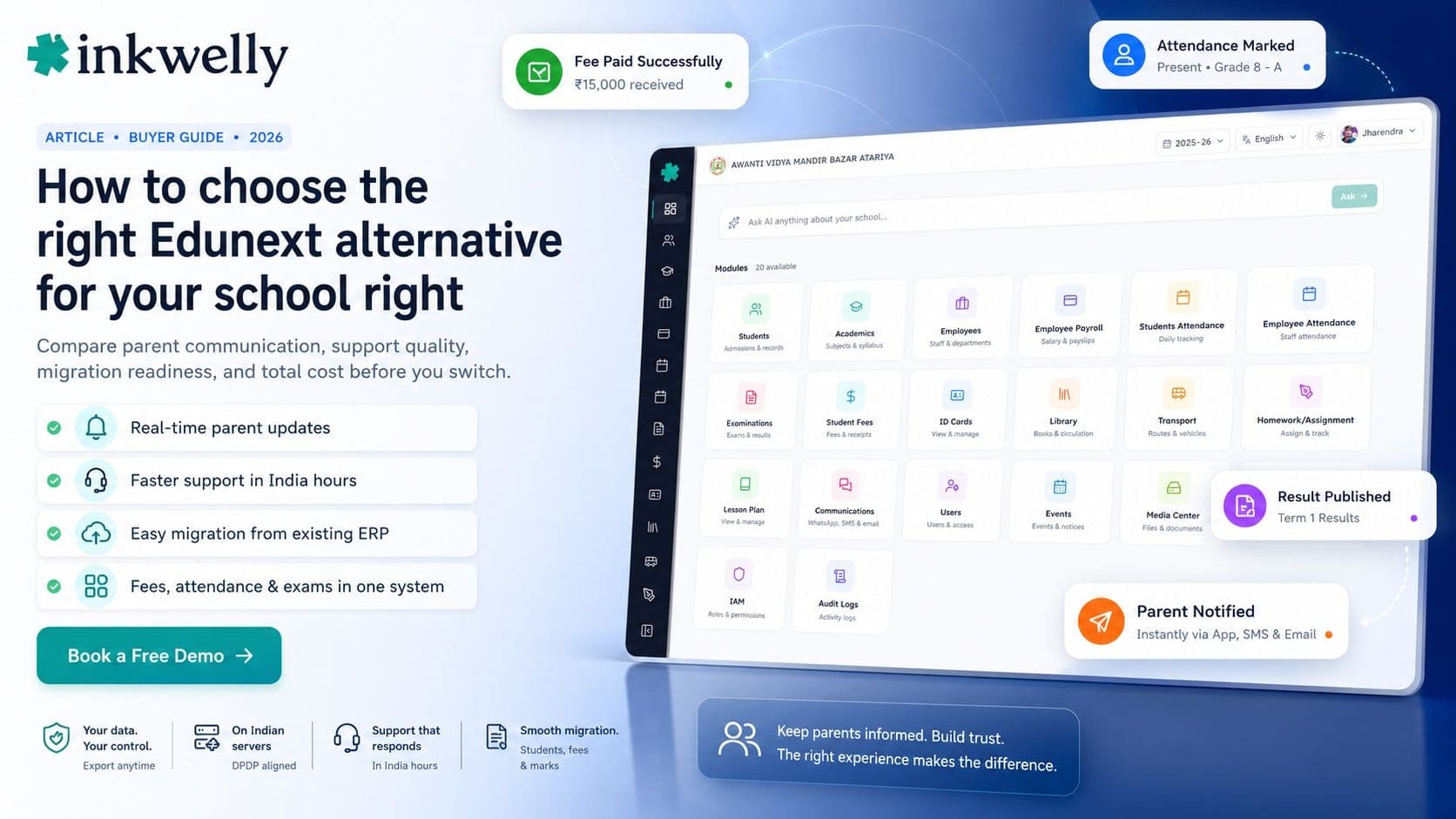
Inkwelly is an operations-first, all-in-one school ERP where keeping parents informed is built in, not bolted on. Fee collection, attendance, exams and report cards, payroll, transport, and parent communication live in one system — so a fee paid or a child marked absent reaches the parent the same minute, in English or Hindi, on a cheap phone. We help schools migrate their existing students, fee history, and marks across, your data stays exportable and on Indian servers, and support answers in India hours when results and fees are due. We're honest about fit: if your parents are already happy with how they hear from the school, you may not need to move. If they feel out of the loop, that is exactly what we built for. For the full buyer view, read how to choose a school ERP and our take on Fedena and Entab alternatives.
“Parents judge a school by how well it keeps them informed. The right alternative is the one that reaches them on time, every time, in their language.”
How to switch without breaking the year
Switch at a natural break — a term or session boundary — and run a two-week parallel pilot with one class before going school-wide. Migrate master data first (students, classes, fee structure), reconcile it against your current system, then move live operations. Keep the old system read-only for one term as a safety net. Ask your shortlisted alternative to commit, in writing, to a migration plan and a go-live date. Done this way, switching costs a fortnight of care, not a lost session — and the right alternative pays it back the first time every parent hears about a fee or a result the moment it happens.
See an alternative that keeps your parents informed
Book a free demo — mark a fee and an absence live, and see exactly what the parent receives.
Frequently asked
7 questionsWhat is the best Edunext alternative for Indian schools?
There is no single best — it depends on your need. If your main gap is parent communication and a modern experience, look for an operations-first ERP where keeping parents informed is built into the core, not a paid add-on. Shortlist two or three, run each on your own data, and judge them on your five daily tasks and what the parent actually receives.
Why do schools switch from Edunext?
Usually for experience rather than missing features — better parent communication, a more modern app, faster support at result and fee time, and fair renewal pricing. It reflects parents and teachers now expecting software to feel current and keep them informed, not the software being bad.
Can I move my data from Edunext to another school ERP?
Yes, a good alternative will import your students, fee history, paid receipts, and marks. Before signing, ask exactly who does the migration, how long it takes, and what happens to part-paid fees mid-session. Insist on a clean export of your own data and an Indian-server commitment under the DPDP Act.
How much does an Edunext alternative cost?
Most school software runs about ₹100–₹500 per student per year, or a flat fee from around ₹12,000 for small schools to several lakhs for large groups. Watch the renewal and add-ons — parent app, WhatsApp/SMS, payment gateway — and ask for the all-in annual cost for your size, not just year one.
Which school ERP has the best parent communication?
The best ones build communication into the core — so a fee paid, an absence, or a result reaches the parent automatically, the same minute, in English or Hindi. Don't judge it from a slide; in the demo, mark a fee and an absence and see exactly what lands on the parent's phone, how fast, and whether there are per-message charges.
When is the best time to switch school ERP?
At a natural break — a term or session boundary — so balances and records carry over cleanly. Run a two-week parallel pilot with one class first, migrate and reconcile master data, then move live operations. Keep the old system read-only for a term as a safety net.
Will switching disrupt the current school year?
Not if you plan it. Switch at a term or session boundary, pilot with one class for two weeks, migrate and reconcile master data before going live, and keep the old system read-only for a term. Done this way, switching costs a fortnight of care, not a lost session.
You might also like
4 readsSee Inkwelly on your school
30-minute demo. We open your current ERP with you and load your data into Inkwelly on the call. Dated go-live plan by the end of it.