School Management Software Price in India Explained
Most schools pay far more than they need to — or far less and get burned. Here is what school management software actually costs in India in 2026, how vendors structure their pricing, and what to watch before you sign.
The principal of a 600-student CBSE school in Kanpur called three vendors last January. The first quoted ₹12,000 flat for the year. The second quoted ₹18 per student per month — which worked out to ₹1.3 lakh. The third sent a 14-line Excel sheet listing add-on charges for every module. All three were selling school management software. She had no idea what was fair, and none of the vendors offered to explain the gap. That confusion is not accidental. School ERP pricing in India has no industry standard, and the range from cheapest to most expensive is wider than in almost any other business software category.
The sticker price is rarely the real price. Most school ERPs in India are priced cheaply at the base level, then add charges for SMS alerts, WhatsApp notifications, payment gateway integration, extra modules, and per-transaction fees. Once you understand the three main pricing models and four hidden costs, comparing vendors becomes straightforward — and you stop getting surprised after you sign.
School ERP vendors in India use three primary pricing structures — and sometimes a mix of all three. Understanding which model you are looking at is the first step to an honest comparison.
- Per-student, per-month (SaaS model): Typically ₹5–₹50/student/month. A 500-student school paying ₹15/student/month pays ₹90,000/year. Common with newer cloud-first vendors; cost scales fast if admissions grow.
- Flat annual licence: A fixed yearly fee regardless of student count — common range ₹12,000–₹2,50,000/year. Good for large schools; poor value for small ones if the base price is anchored high.
- Per-module pricing: Core platform is low-cost or free; each module (fee management, transport, payroll) is charged separately. True cost only emerges after you list every module you actually need.
- One-time perpetual licence + AMC: Common in older on-premise vendors. High upfront cost (₹50,000–₹5 lakh) plus 15–20% annual maintenance charge. Difficult and expensive to migrate away from.
- Per-transaction fee on payments: Many vendors charge ₹1–₹3 per fee transaction on top of Razorpay or PayU gateway charges (around 1.5–2% MDR). On 2,000 transactions/year, this adds ₹2,000–₹6,000 quietly.
- SMS and WhatsApp charges: Attendance alerts, fee reminders, and notices are often billed per message — ₹0.20–₹0.45 per SMS. At 500 parents receiving 5 messages/month, that is ₹6,000–₹13,500/year extra.
- Implementation and data-migration fee: A one-time charge of ₹5,000–₹50,000 for setup, staff training, and historical data import — often absent from the headline quote.
- Branded parent app: If you want the app under your school name, expect ₹10,000–₹30,000 extra from most vendors.
The real price gap in India is not between vendors — it is between schools that read the fine print and schools that do not. Most vendor websites show only the base price. The full-cost picture arrives in the contract, which appears after two demo calls. For a mid-size school (500–1,000 students), total annual spend including all add-ons typically lands in the ₹60,000–₹1,50,000 band. Large schools (1,500+ students) often pay ₹1.5 lakh–₹4 lakh. Budget schools paying flat fees under ₹20,000/year are usually getting a limited feature set: no WhatsApp integration, no online payment gateway, and no mobile app.
Before you commit to any vendor, run these five checks:
-
Ask for the all-in quote. Tell the vendor: give me a final price for 600 students with fee collection, attendance, WhatsApp alerts, transport, and payroll, including SMS packs, gateway integration, training, and the first year of support. If the quote shifts three times before you sign, the pricing is not honest.
-
Calculate cost per feature, not cost per module name. Two vendors both claim fee management. Ask each: does it include UPI and Razorpay integration? Online payment link sharing? Sibling and staff concessions? Installment tracking? The cheapest module is often the most stripped.
-
Check the gateway fee stack. Your school pays: (a) the payment gateway MDR (typically 0.9–2% depending on card type or UPI), (b) any vendor per-transaction fee, and (c) GST on both. For a school collecting ₹50 lakh/year in fees online, a 2% gateway cost is ₹1 lakh/year — larger than the software licence itself.
-
Test the upgrade path. Ask what happens when you enrol 200 more students next year. Is the jump automatic or does it require a new contract negotiation? Per-student SaaS vendors are usually clean here; flat-fee vendors sometimes re-negotiate at renewal.
-
Read the exit clause. Can you export your complete student database, fee history, and attendance records in standard CSV or Excel format on the day you leave? A vendor that controls your data is effectively charging a hostage premium.
The Indian school ERP market has dozens of active vendors at every price point. Names you will run into include Fedena, Entab (CampusCare), Teachmint, Vidyalaya, MyClassboard, Campus 365, and Edunext — each with a different pricing philosophy. Fedena and Entab are among the older, established players; newer cloud-first vendors tend to undercut them on base price but sometimes compensate through add-on charges. No single vendor is cheapest for every school size — the right fit depends on student count, modules needed, and staff time available for setup and support.
Here is what schools in India should budget in 2026, by size:
Small schools (up to 500 students): ₹15,000–₹50,000/year for a reasonably full-featured cloud ERP. Below ₹15,000, expect only 2–3 modules.
Mid-size schools (500–1,500 students): ₹50,000–₹1,50,000/year all-in. This is where pricing variation is highest — always compare at least three vendors with an all-in quote.
Large schools (1,500+ students): ₹1,50,000–₹4,00,000/year. At this scale, per-student SaaS often costs more than a flat enterprise plan.
Budget an additional ₹15,000–₹50,000 for implementation and first-year onboarding. Remote-only training is cheaper but carries a higher dropout risk; insist on at least two live sessions.
Online fee collection adds payment gateway charges — roughly ₹5,000–₹25,000/year for a 500-student school collecting ₹25–₹50 lakh annually. This is a pass-through cost paid to the payment provider, not the ERP vendor.
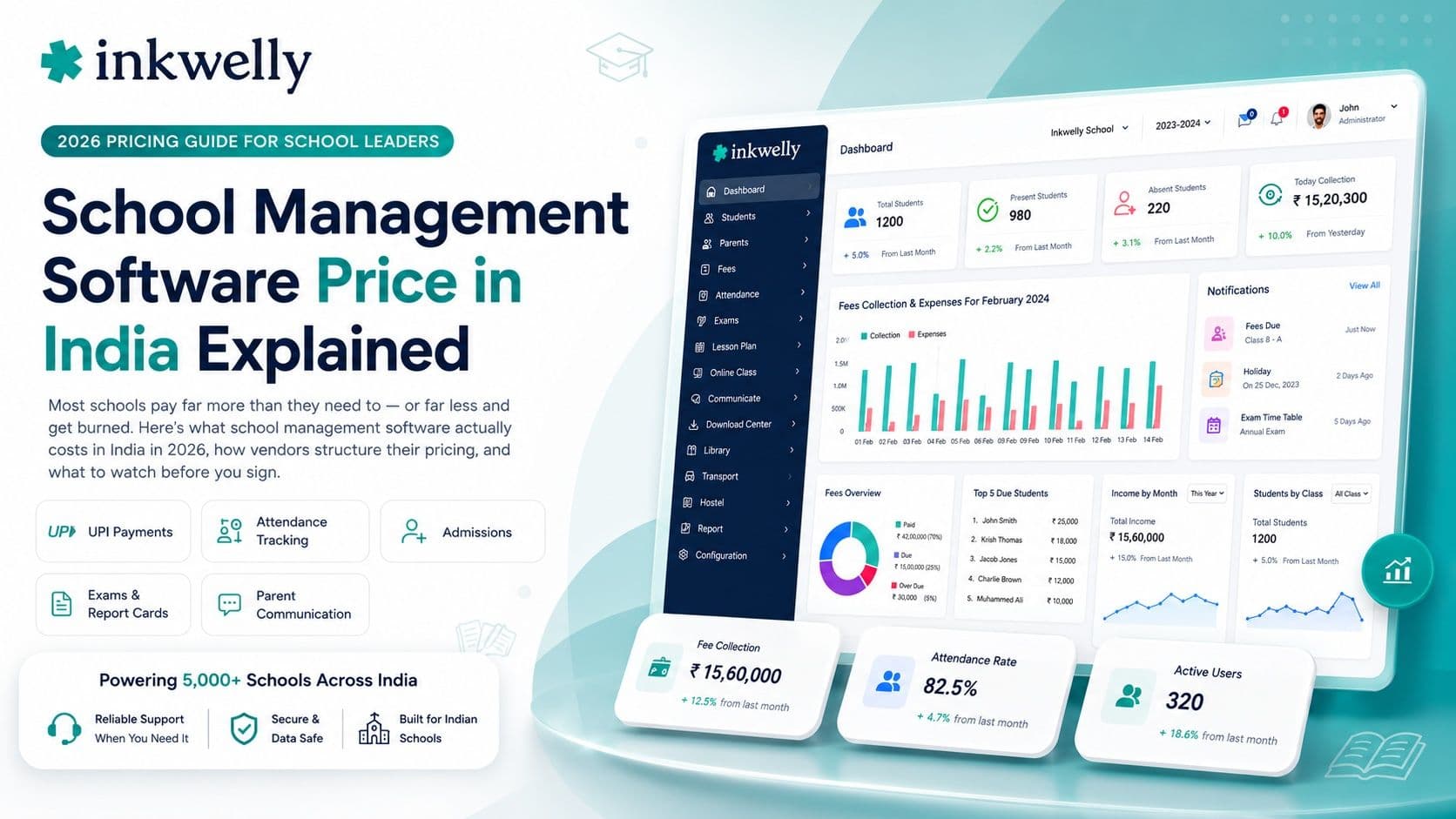
Inkwelly is a cloud-based school management platform built for Indian schools across CBSE, ICSE, state boards, and international schools. It is priced per school rather than per student, so your annual cost does not climb every time admissions go well. All core modules — fees, attendance, academics, timetable, transport, payroll, and communications — are included in a single subscription with no per-module add-on pricing. WhatsApp and SMS alerts are bundled rather than billed per message. The fee module connects directly to Razorpay for UPI, cards, and net banking with no vendor transaction fee layered on top of the gateway MDR.
“The real cost of a school ERP is rarely on the pricing page — it is in every SMS, every transaction, and every module you needed but did not know was extra.”
Price-shopping a school ERP without a full cost breakdown is like comparing two cars by fuel cost alone, ignoring insurance, servicing, and tyres. Get the all-in quote, model the gateway fee against your real collections volume, and confirm the exit clause before you commit. The Indian market has enough options at every price point that you should not have to accept opaque pricing. Take three live demos and ask each vendor the five questions above — the answers reveal more than any pricing page.
Find out what Inkwelly costs for your school
Frequently asked
7 questionsWhat is the average price of school management software in India?
In 2026, Indian schools pay ₹15,000–₹4,00,000/year depending on school size and features. Most mid-size CBSE schools (500–1,000 students) land in the ₹50,000–₹1,50,000/year band once all add-ons are included. Small schools (up to 500 students) can find solid cloud options for ₹15,000–₹50,000/year.
Is per-student pricing or flat-fee pricing better for schools?
Flat-fee is usually better for large schools; per-student SaaS is cheaper for small ones. For a 300-student school, ₹15/student/month equals ₹54,000/year — comparable to many flat-fee plans. Model both structures against your actual student count and check whether fees apply per active student or per enrolled seat.
Are there hidden charges in school ERP software?
Yes. The most common ones are: per-SMS or per-WhatsApp message fees, per-transaction charges on online fee collection, module add-on costs, implementation and data-migration fees, and branded-app charges. Always ask for a written all-in quote before signing.
What are payment gateway charges for school fee collection?
Payment gateways like Razorpay, PayU, and Paytm charge 0.9–2% MDR per transaction. For a school collecting ₹30 lakh/year online, this is ₹27,000–₹60,000/year in gateway fees — paid to the payment provider, not the ERP vendor. GST applies on the gateway fee too. Check whether your ERP also layers a second per-transaction charge on top.
Can I get free school management software in India?
Some vendors offer free plans for up to 50–100 students, useful for small coaching centres. Full-feature free plans for schools with 200+ students do not realistically exist — the vendor monetises through SMS charges, transaction fees, or upgrade pressure. A paid ₹15,000/year plan with transparent pricing is a safer choice than a free platform with opaque add-ons.
How much does Fedena or Entab school ERP cost in India?
Fedena's cloud pricing is generally ₹30,000–₹60,000+/year for Indian schools, varying by student count and modules. Entab (CampusCare) is in a similar or higher range, especially for large schools. Both are established platforms with broad feature sets; newer cloud-first platforms often undercut them on base price.
How do I fairly compare school ERP costs across vendors?
Ask every vendor for an all-in quote covering: annual licence, SMS/WhatsApp packs, gateway integration fee, implementation, training, and year-one support. Build a simple spreadsheet: base price plus communication charges plus gateway fees plus implementation equals true year-one cost. Repeat for year two without the one-time costs. The vendor that wins on sticker price often loses on the full-cost view.
You might also like
4 readsSee Inkwelly on your school
30-minute demo. We open your current ERP with you and load your data into Inkwelly on the call. Dated go-live plan by the end of it.