How to choose the best school management software in India best
There is no single 'best' school ERP — only the one that fits your board, your size and how your parents actually pay. This 2026 guide covers what a complete school management system does, the India must-haves, real pricing, and a simple way to choose.
'Best' depends on your school, not a Top-10 list
Search for the best school management software in India and you will drown in 'Top 10' and 'Top 20' lists, most of them ranking whoever paid for the slot. None of them know your school. A 300-student CBSE day school in Kanpur, a 3,000-student residential ICSE school in Dehradun, and a budget state-board school in a Tier-3 town need very different things — and the 'best' for one is the wrong choice for another.
So this guide does not hand you a ranking. It hands you the questions that tell you which school management software is best for your school: what a complete system should do, what it should cost, and how to decide in two weeks instead of two terms.
What 'best' actually means
The best school management software is the one that runs your whole school in one place, fits your board and your fee year, works on the cheap phones your parents actually use, and collects fees with the least staff effort — at a price that makes sense for your size. Features are easy to list; fit is what you are really buying. Everything below is about testing for fit.
What a complete school management system covers
A school management software — often called a school ERP — replaces the dozen separate registers, Excel sheets and WhatsApp groups a school runs on with one connected system. A complete one covers the whole school year, not just one corner of it. When you evaluate options, check how many of these it genuinely does well, because every gap means you will be back to Excel for that piece.
The modules a complete school ERP should include
- Admissions — online enquiry-to-enrolment, with forms parents fill from home
- Student information — one profile per child: records, documents, history and transfers
- Fee management — structures, online UPI and card collection, receipts, reports and reconciliation
- Attendance — daily student and staff attendance, with parent alerts for absences
- Academics, exams and report cards — marks entry, grading and board-style marksheets
- Timetable — class and teacher scheduling without clashes
- Transport — routes, stops, vehicles and parent notifications
- Communication — WhatsApp, SMS, email and a parent app in one place
- Payroll — staff salaries, TDS, EPF, ESI and payslips
- Library — book issue, return and catalogue
What separates a great Indian school ERP from a generic one
Plenty of software can store student records. Far less of it is built for how an Indian school actually runs. This is where most generic or imported tools fall down, and where your real shortlist forms.
The India must-haves
- UPI, card and net banking, with WhatsApp payment links and auto-receipts — because this is how Indian parents actually pay
- Built for Indian boards — CBSE, ICSE/ISC, IGCSE/IB and every state board, with their fee cycles, exam patterns and marksheet formats
- RTE and government-reimbursement handling without keeping a separate register
- Hindi and regional-language support for parent-facing content, not English-only
- A mobile-first parent app that works on a basic Android over patchy data
- Data stored in India and handled in line with the DPDP Act
- Scales with you — from a few hundred to several thousand students without re-buying
How to choose: a five-test demo
Whatever shortlist you build, put each option through the same short demo test. It cuts through feature lists and sales talk faster than any brochure:
- Pay a live fee to your own phone. Send a payment link, pay 1 rupee by UPI, and watch the receipt arrive and the student's ledger update on its own. Fees are where a school feels its software every single day.
- Open the parent app on a cheap phone. If it is slow or confusing on a basic Android over mobile data, your parents will not use it.
- Make them set up your real data. Your board, your fee structure, your classes — in the demo, not a polished sample.
- Get the all-in annual price. Software plus the payment-gateway charge, for your actual student count, with nothing hidden behind add-ons.
- Test support and data export. Send a weekend question, and ask how you would get all your data out later. Both answers predict your next three years.
The kinds of options in the Indian market
The market splits into a few groups. Modern cloud, all-in-one ERPs run the whole school from any phone — Inkwelly sits here. Established legacy ERPs like Fedena and Entab have long track records and deep feature lists. Mobile-first platforms such as Teachmint started from the classroom and grew outward. There are fee-only tools that collect money but do not run the rest of the school, and regional all-in-one players such as Vidyalaya, MyClassboard, Campus 365 and Edunext. None is automatically 'best' — the right group depends on whether you want one connected system or a point tool, and the right product within it is whichever passes the five-test demo for your school.
What it should cost
Pricing in India usually takes one of two shapes: per-student plans of roughly 20 to 80 rupees per student per year for a full ERP, or flat annual plans that commonly run from about 15,000 rupees for a small school into the low lakhs for large or multi-campus institutions. The real number depends on how many modules you switch on and your student count. One rule holds across all of them: always add the payment-gateway charge on online fees to the software price before you compare, because that is the true annual cost.
Where Inkwelly fits
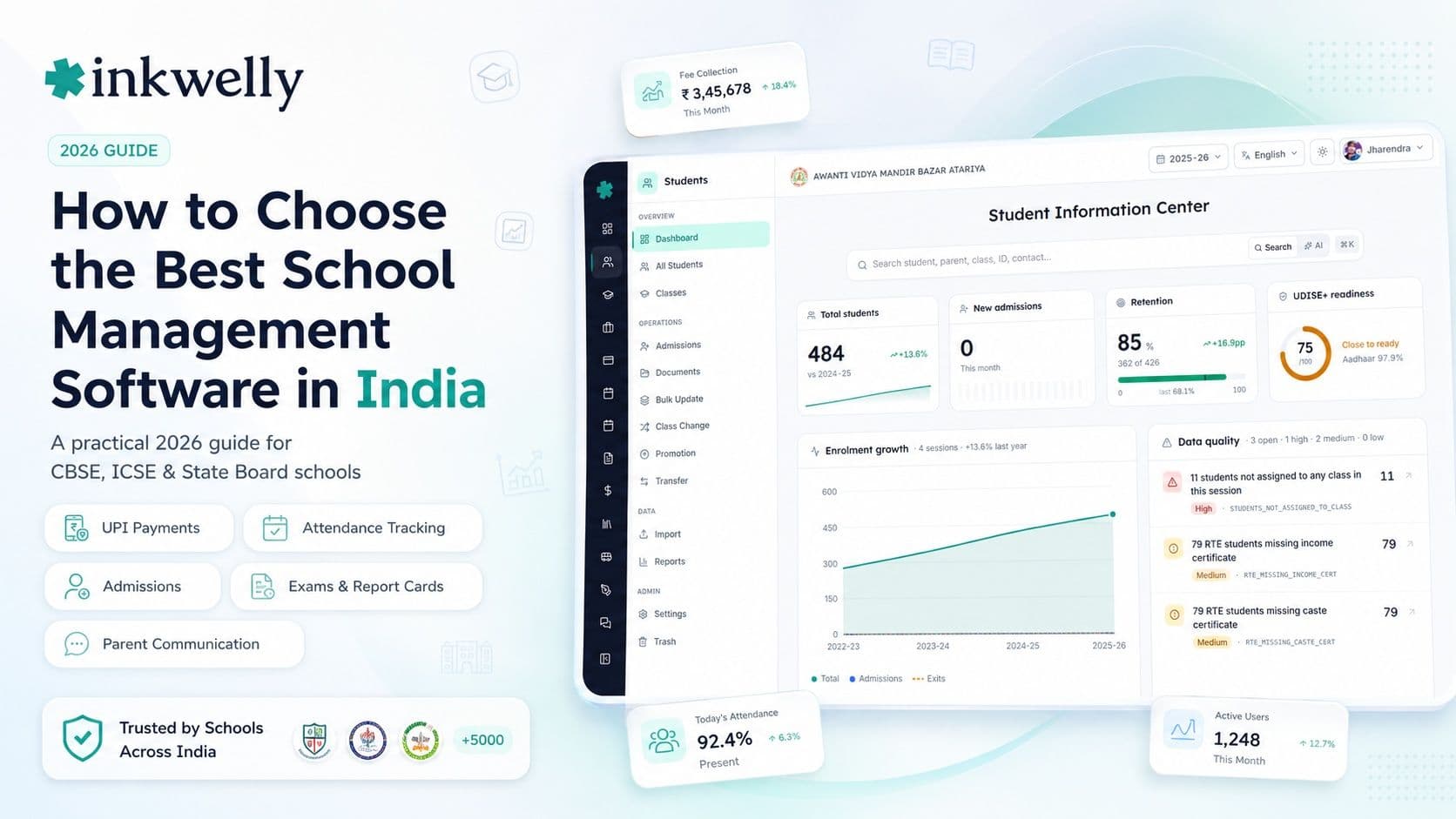
Inkwelly is a modern, cloud, mobile-first school ERP built for Indian schools across CBSE, ICSE and state boards. It runs the whole school in one place — fees with UPI and WhatsApp payment links, admissions, attendance, exams and report cards, timetable, transport, payroll and a parent app — with data stored in India. It is one option to hold against the five-test demo above; the discipline this guide asks for is that you test every shortlist the same way, including this one, and pick on fit rather than on a Top-10 ranking.
“The best school software is not the one with the most features. It is the one your office actually uses every day, and your parents never complain about. Buy for daily use, not for the demo.”
How to decide in two weeks
Decide what hurts most today — usually fee collection and parent communication — and weight your evaluation toward that. Shortlist two or three options across the groups above. Run each through the five-test demo with your own board and fee structure. Add the gateway charge to every price. Then choose the one your office found easiest, not the one with the glossiest slides. Switch with the next fee cycle. A school that buys for fit rarely regrets it.
See a full school ERP on your own data
A 20-minute walkthrough across fees, admissions, attendance, exams and the parent app — set up with your board and a live payment to your phone. No slide deck.
Frequently asked
7 questionsWhat is the best school management software in India?
There is no single best — it depends on your board, size and how your parents pay. The best for your school is whichever runs your whole school in one place, supports your board's fees and exams, works on a basic parent phone, and passes a live-payment demo test. Shortlist two or three options and test each with your own data.
How much does school management software cost in India?
Full-ERP pricing is usually about 20 to 80 rupees per student per year, or flat annual plans from roughly 15,000 rupees for a small school upward, depending on modules and size. Always add the payment-gateway charge on online fees to the software price to get the real annual cost.
What features should a school ERP have?
A complete school ERP covers admissions, student information, fee management, attendance, academics and report cards, timetable, transport, communication, payroll and library — with an Indian-board fit, UPI and WhatsApp, and a parent app. Check how many of these it does genuinely well, not just lists on a page.
Is there school management software made for CBSE, ICSE and state boards?
Yes. Good Indian school ERPs are board-aware: they handle CBSE, ICSE/ISC, IGCSE/IB and state-board fee cycles, exam patterns and marksheet formats, configured per school. Confirm your specific board's report-card format in the demo.
Can a small school afford school management software?
Yes. Many systems price per student or offer small-school plans, and most schools start with just the fees and communication modules — which usually pay for themselves through faster collection and saved staff time within a cycle or two.
Cloud or on-premise — which is better for schools?
For almost every Indian school, cloud is better: nothing to install, automatic updates, access from any phone, and data backed up off-site. On-premise made sense a decade ago; today it mostly means more cost and risk for the school.
Can we switch from our current school ERP?
Yes. Students, fees and pending dues are structured data that import cleanly, so you can switch mid-session with the next fee cycle. Ask your current vendor how to export your full data, and the new one how they import it.
You might also like
3 readsSee Inkwelly on your school
30-minute demo. We open your current ERP with you and load your data into Inkwelly on the call. Dated go-live plan by the end of it.