Choosing online admission software that turns enquiries into enrolled students enrolled
Most schools lose admissions not to a better school but to a slower follow-up. This is an honest 2026 buyer guide to online admission software for Indian schools — what the enquiry-to-enrollment funnel should actually do, what to check in a demo, real pricing, and how the leading options compare.
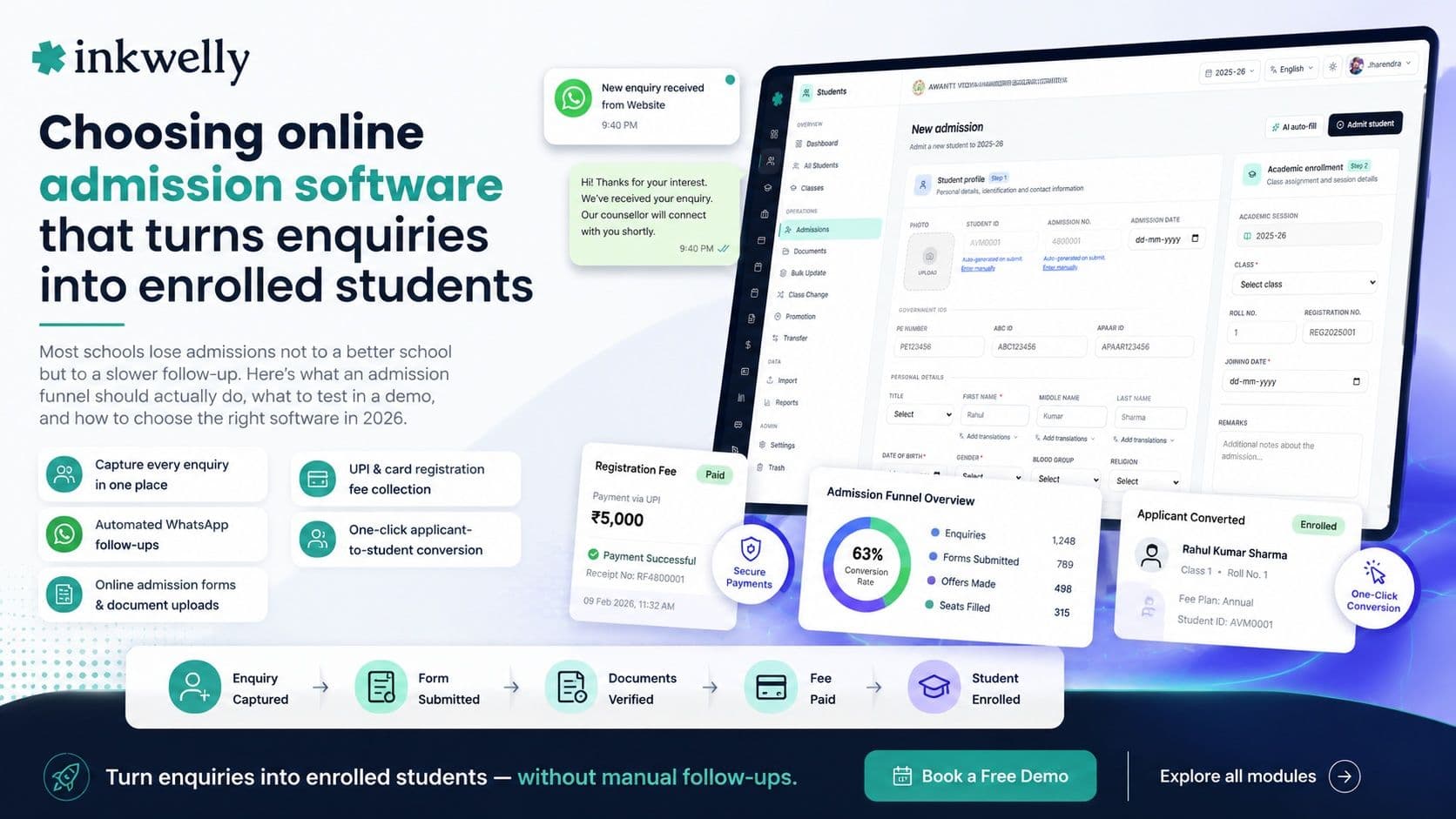
It is the second week of February. A parent fills your admission enquiry form at 9:40 p.m. after seeing your hoarding near the metro. By the time the front desk opens the WhatsApp the next morning, that parent has already booked a slot at the school two kilometres away — the one that sent an automatic reply within a minute and a payment link by lunch. The seat you lost was not lost on quality. It was lost on speed. Across most Indian schools the admission season is run on a paper register, a shared phone number, and three people who each think someone else followed up.
Here is the claim this guide defends: online admission software is worth buying only if it shortens the time between an enquiry and a confirmed seat. Form-builders and prospectus PDFs are easy; the hard, valuable part is the funnel — capturing every enquiry, never dropping a follow-up, and carrying that data straight into the student record without anyone re-typing it.
What online admission software actually has to do
Strip away the marketing and an admission system for an Indian school is a funnel with five real jobs: capture, qualify, follow up, collect, and convert. A tool that does the first and the last but leaks in the middle is the one schools regret. Before you look at any vendor, get clear on what the full funnel includes.
- Capture every enquiry from every source — the website form, a walk-in at the front desk, a missed call, a WhatsApp message, and a referral — into one list, not five.
- A mobile-first online application form a parent can finish on a phone in under five minutes, with document upload (birth certificate, Aadhaar, previous marksheet, photo) and no app to download.
- Stage tracking that shows exactly where each applicant is: New enquiry, Form submitted, Documents pending, Interaction/test scheduled, Offered, Fee paid, Enrolled.
- Automatic acknowledgement and reminders — the parent gets an instant reply, and the staff member gets a nudge when a follow-up is overdue.
- An online registration-fee payment with a UPI or card link, and a proper receipt — not a screenshot of a Google Pay confirmation.
- Entrance test or interaction scheduling with slot booking, so parents pick a time instead of the office playing phone-tag.
- Merit or selection lists and waitlist handling, with the ability to publish results and notify shortlisted parents in one action.
- One-click conversion of an admitted applicant into a student record — class, section, roll number, fee plan — with zero re-typing.
- A simple funnel report: enquiries received, forms submitted, offers made, seats filled, and the conversion rate at every stage, by class and by source.
- Role-based access so the front desk, the admission counsellor, and the principal each see what they should — and nothing they should not.
What separates a great admission system from a generic form
In India the difference shows up in the messy middle, not the polished form. A generic form-builder collects data and stops. A real admission system chases the parent for you, keeps the office honest about who has not been called back, and proves at the end of the season exactly which marketing spend produced seats. The bar that matters here is specific to how Indian admissions actually run.
- WhatsApp is where parents reply. Email open rates for Indian school admissions sit well below 20%, while a WhatsApp message is usually read within minutes — the system must reach parents where they already are.
- Follow-up has to be automatic. Manual reminders are the first thing to collapse in a 200-enquiry season; the software should nudge the counsellor and the parent without anyone remembering to.
- Source attribution must be honest. If you cannot see whether seats came from the hoarding, a referral, or Google, you cannot decide next year's budget.
- It has to flow into fees and the student record. An admission that needs to be re-entered into the fee module is an admission half-done — and a place where data goes wrong.
How to choose: the admission-software demo test
Do not watch a slideshow. Hand the salesperson a real February scenario and make the product prove it in front of you. Run these eight checks in the demo and you will separate a funnel from a form in twenty minutes.
-
Submit a form on a real phone. Open the application form on your own phone, fill it as a parent would, and upload a photo of a birth certificate. If it is slow, asks you to install an app, or breaks on upload, parents will abandon it.
-
Make an enquiry vanish, then find it. Add a walk-in enquiry by hand and a website enquiry, and confirm both land in the same list with a clear source tag. Two lists means dropped leads.
-
Trigger the automatic reply. Submit an enquiry and check that the parent gets an instant WhatsApp or SMS acknowledgement and that a follow-up task appears for staff. Ask to see what happens when nobody acts for two days.
-
Move an applicant through every stage. Walk one applicant from New enquiry to Enrolled and watch the stages, timestamps, and who-did-what. A vague status field is a red flag.
-
Collect a registration fee live. Generate a UPI/card payment link, pay ₹1, and confirm a numbered receipt is issued and the applicant is marked Paid automatically.
-
Publish a merit list. Shortlist three applicants, publish a selection list, and notify them in one action. Check waitlist handling too.
-
Convert to a student. Turn an admitted applicant into a full student record and confirm the fee plan, class, and section carry over without re-typing.
-
Pull the funnel report. Ask for enquiries, forms, offers, and conversion rate by class and by source — for a date range. If the vendor has to build it for you, it does not exist.
The options you will run into
Most schools shopping for admission software are really shopping for one module inside a larger ERP, so the names that come up are the same school-software companies you will meet everywhere. The kinds of options you will run into include Teachmint, Vidyalaya, Fedena, Entab, MyClassboard, Campus 365, and Edunext, alongside admission-specialist tools and standalone form-builders. Some are full school ERPs with an admission module bolted on; some are admission-and-enquiry CRMs that do the funnel well but hand you off when the student is enrolled. The split that matters: a standalone admission tool that does not flow into your fees and student records will save you the enquiry season and cost you twice at conversion.
What it actually costs in India
Admission software in India is rarely priced on its own — it is bundled into the per-student ERP rate, which generally runs ₹12–40 per student per month, or roughly ₹50,000 to over ₹1,00,000 a year for a typical school, depending on student count and modules. Admission-specialist CRMs sometimes price per seat or per admission cycle instead. Two costs are easy to miss. First, the payment gateway: collecting a registration fee online carries an MDR of roughly 1.5–2% on cards and net banking, while UPI is effectively free — ask who absorbs it. Second, setup and migration: importing last year's enquiries, configuring stages, and training the front desk is real work, and a vendor who waves it away has not done it before. The honest number to budget is the annual subscription plus a one-time onboarding cost, not the per-student sticker alone.
Where Inkwelly fits
Inkwelly was built admission-season-first for Indian schools, so the funnel and the rest of the school are one system, not two. Enquiries from your website, the front desk, and WhatsApp land in a single list; applicants move through clear stages with automatic acknowledgements and follow-up nudges; registration fees collect over UPI and cards with a proper numbered receipt; and an admitted applicant becomes a full student in one click, fee plan and all. The admission funnel lives inside the Student Information module, parent messaging runs through Communications, and the moment a seat is confirmed it flows into fees with nothing re-typed. If you are still weighing the broader decision, our school ERP buyer's checklist covers the rest.
“Schools rarely lose an admission to a better school. They lose it to a faster follow-up. Admission software earns its price only by closing the gap between an enquiry and a confirmed seat.”
Decide in two weeks, not two months. Shortlist two or three vendors, run the same eight-step demo on each with your own phone and a real applicant, and watch one thing above all: how little re-typing happens between the enquiry form and the enrolled student. The product that keeps that line clean — and reaches parents on WhatsApp without anyone remembering to — is the one that will actually fill seats next February. Everything else is a prettier register.
See your admission season run end to end
Book a free demo and bring a real applicant — we will take them from enquiry to enrolled student in front of you.
Frequently asked
8 questionsWhat is the best online admission software for schools in India?
There is no single best — the right choice is the admission system that captures every enquiry, follows up automatically over WhatsApp, collects the registration fee online, and converts an admitted applicant into a student record without re-typing. For most Indian schools that means an admission module inside a full ERP rather than a standalone form-builder, so admission data flows straight into fees and student records. Names you will compare include Teachmint, Vidyalaya, Fedena, Entab, MyClassboard, Campus 365, Edunext, and Inkwelly.
How much does online admission software cost in India?
It is usually bundled into the per-student ERP rate of roughly ₹12–40 per student per month, or about ₹50,000 to over ₹1,00,000 a year for a typical school, depending on student count and modules. Some admission-specialist CRMs price per admission cycle instead. Budget two extra things: the payment gateway charge (about 1.5–2% MDR on cards, free on UPI) and a one-time setup-and-migration cost.
What features should online admission software have?
The essentials are: one enquiry list across website, front desk, and WhatsApp; a mobile application form with document upload; clear stage tracking from enquiry to enrolled; automatic acknowledgements and follow-up reminders; online registration-fee collection with a proper receipt; entrance-test or interaction scheduling; merit-list and waitlist handling; one-click conversion to a student record; and a funnel report showing conversion by class and source.
Can parents fill the admission form on a mobile phone?
Yes — a good admission system uses a mobile-first online form a parent can complete on a phone in a few minutes, including uploading the birth certificate, photo, and previous marksheet, with no app to download. Test this on your own phone in the demo; if it is slow or breaks on upload, parents will abandon it, and most of your enquiries arrive on mobile.
Does online admission software collect the registration fee online?
It should. Look for a UPI or card payment link that issues a numbered receipt and automatically marks the applicant as Paid, rather than parents sending a payment screenshot. UPI collection is effectively free; cards and net banking carry an MDR of about 1.5–2%, so confirm whether the school or the parent absorbs that charge.
Is a standalone admission tool better than an ERP admission module?
For most schools, no. A standalone admission CRM can run the enquiry funnel well but usually hands you off once the student enrolls, so the data has to be re-entered into your fee and student systems. An admission module inside a full ERP keeps the whole flow in one place, which matters most at conversion when the fee plan, class, and roll number must carry over without re-typing.
How do I move from a paper admission register to online admission software?
Pick a system before the season starts, import last year's enquiries, set up your stages and fee plans, and train the front desk on entering walk-in enquiries the same day. Run one class through the full funnel as a pilot before opening the public form. The migration is real work, so choose a vendor who treats setup as part of the deal, not an afterthought.
How does online admission software help convert more enquiries into admissions?
By removing the two places schools lose seats: slow first responses and dropped follow-ups. An automatic acknowledgement reaches the parent within minutes, follow-up nudges keep the counsellor honest, and source reports show which channels actually produce admissions so next year's budget goes where it works. The seat is usually won by the school that replied first, not the one with the better brochure.
You might also like
4 readsSee Inkwelly on your school
30-minute demo. We open your current ERP with you and load your data into Inkwelly on the call. Dated go-live plan by the end of it.