What AI in your school software can actually do today actually
By 2026, "AI" is the most over-printed word on every school software brochure in India — but only a few of those features actually save your office time. This guide separates the real from the marketing, flags the data risks under the DPDP Act, and gives principals a demo test that cuts through the hype.
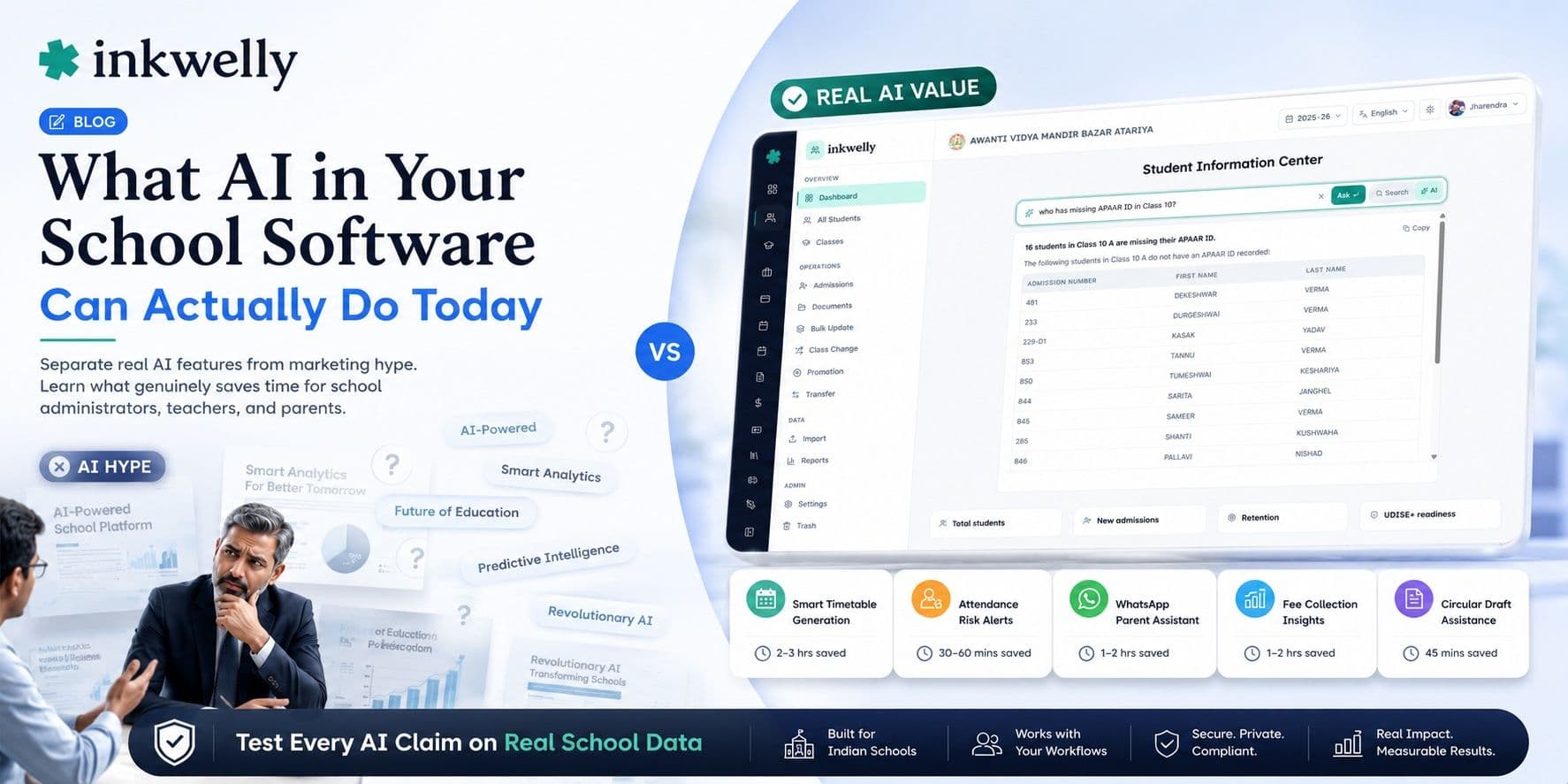
A principal in Pune sits through her fourth ERP demo this month. Every slide has the word 'AI' on it. AI attendance. AI fee prediction. An AI chatbot for parents. A 'smart' timetable. She nods along, but she has one quiet question nobody answers: what does any of this actually do on a Tuesday in her school office, when a parent is shouting about a wrong fee receipt and two teachers are absent? The salesperson talks about 'the future of education'. She just wants to know whether the software will save her clerk an hour a day. By 2026, 'AI' has become the most over-printed word on every school software brochure in India — and the hardest to pin down.
Here is the thesis of this guide: AI in school software is real and genuinely useful — but only in a few specific places, and almost none of them are the ones vendors lead with. The honest question is not 'is it AI-powered?'. It is 'which boring, repetitive job does this remove from my staff?' Judge the outcome, not the label on the slide.
What 'AI' actually means in a school ERP
Strip away the marketing and 'AI' in a school ERP usually means one of a handful of real things. Some are genuinely helpful; some are a chatbot wearing a suit. Industry estimates suggest a large share of school platforms now ship some AI feature, and by 2026 it is treated as a baseline expectation rather than a premium add-on. That makes 'we have AI' a meaningless claim on its own — every vendor can say it. What matters is which jobs the AI removes from a human, how accurate it is, and whether you can trust it without checking its work every single time. Here is what 'AI' actually refers to behind the buzzword:
What 'AI' usually means in practice
- Predicting fee defaulters: the system flags families likely to delay payment so your office calls them first. Useful — if it learns from your own payment history, not a generic model.
- Spotting at-risk students: patterns in attendance and marks surface a child slipping before the term ends. Genuinely valuable for a class teacher, if the alerts are specific rather than vague.
- Parent-query chatbots: an assistant that answers 'what are the holidays?' or 'what is my fee due?' at 9 pm so the office phone stops ringing. Helpful for repetitive questions; frustrating if it cannot hand off to a human.
- Smart timetabling: generating a clash-free timetable across teachers, rooms, and periods in minutes instead of days. This is real, mature, and a genuine time-saver.
- Auto-drafting communication: AI writes the first draft of a circular, a fee reminder, or a notice that a human edits and sends. A real time-saver, with a person always in the loop.
- Report-card remark assistance: suggesting remarks from a child's performance so teachers start from a draft, not a blank box.
- Document and data extraction: reading an admission form and filling fields automatically, cutting manual typing and re-entry.
- Natural-language reports: asking 'show me Class 8 fee collection this month' in plain English instead of building a report by hand. Promising — but verify the numbers before you trust them.
Why the hype gap is wider in India
The distance between real and hype is wider in India than the global brochures admit. An AI feature trained on American school data may misread an Indian school's terms, boards, and fee cycles entirely. A chatbot that only speaks English is useless to a parent in a Tier-2 town who messages in Hindi. 'Predictive analytics' means little if your school has two years of clean data and the model really needs ten. And every AI feature that touches a child's marks, attendance, or behaviour raises a real question under the DPDP Act: where does that data go, is it used to train someone else's model, and does it stay in India? The useful question is not how clever the AI sounds — it is whether it works on your data, in your languages, within your rules.
How to separate AI hype from AI value
You will not learn the truth from a slide deck. Put every 'AI' claim through this test during the demo:
- Ask 'what human task does this remove?' If the answer is a vague 'it makes things smarter', it is marketing. If it is 'your clerk stops manually flagging late payers', it is real. Demand the specific job.
- Ask to see it run on real-looking data, live. A canned demo always works. Ask them to add a student, mark attendance, and trigger the 'at-risk' alert in front of you.
- Test the chatbot with a hard question. Ask it something off-script — and something in Hindi. See whether it answers, admits it cannot, or invents an answer. A confident wrong answer is worse than no answer.
- Ask how accurate the predictions are, and what happens when they are wrong. An honest vendor will tell you no prediction is perfect and show you how a human reviews it. Anyone claiming 100% is selling.
- Ask where the data goes. Is your students' data used to train models? Does it leave India? Get it in writing — this is a DPDP Act question, not a nice-to-have.
- Ask what it costs and whether AI is a separate charge. 'AI' is increasingly a paid tier on top of the base price. Know the all-in number before you compare.
- Ask what works without AI. If the core fees, attendance, and report cards are weak and the 'AI' is a thin layer on top, you are buying a gimmick on a shaky base.
Where the market actually sits
It helps to know the landscape. Most established Indian school ERPs — the names you'll run into include Entab, Vidyalaya, MyClassboard, Fedena, Teachmint, Campus 365, and Edunext — have added AI features over the last two years, usually a chatbot, some predictive analytics, or auto-drafting. A few newer entrants market themselves as 'AI-first'. The reality is that the underlying jobs — collecting fees, marking attendance, generating report cards — are the same across all of them; AI is a layer on top, not a different product. So compare the boring core first, then treat AI as a tiebreaker. A school running beautifully on a tool with no AI badge is far better off than one fighting a clever chatbot bolted onto weak fundamentals.
What it costs
AI is quietly reshaping the bill. The base remains familiar: roughly ₹100–₹500 per student per year, or a flat annual fee from around ₹12,000 for a small school to several lakhs for a large group. But increasingly, 'AI' features sit in a higher tier or a separate add-on — an AI chatbot, advanced analytics, or auto-drafting billed on top of the core. Some vendors bundle a little AI to justify a price hike across the board. Pin down two things: first, is the specific AI feature you actually care about included, or is it extra? Second, are there usage-based charges — per chatbot message, per AI report — that can balloon as you scale? The honest comparison is the all-in annual cost for your student count, with the AI features you'll truly use included, against a solid tool with none. Often the non-AI tool wins on value.
Where Inkwelly fits
Inkwelly's view is deliberately unglamorous: AI should remove drudgery, not replace judgement, and it should never be the reason you choose your school software. The fundamentals come first — fee collection, attendance, report cards, and parent communication that simply work, every day, in English and Hindi, on a cheap phone. Where AI genuinely helps — drafting a circular you then edit, surfacing a student slipping in attendance, answering a parent's routine question — we add it as a quiet assistant with a human in the loop, on data that stays in India. We will not put 'AI' on every slide to win a demo. If you want to see the difference between an AI badge and an AI that saves your office real time, the demo test above is the fastest way. For the broader buyer view, read how to choose a school ERP.
“The right question is never 'is it AI-powered?' It is 'which job does this take off my staff's plate — and can I trust it without checking?'”
So, hype or real?
Both. Smart timetabling, auto-drafting, at-risk alerts, an off-hours chatbot for routine questions — these save real time today, in the right tool, on your data. The rest is a label on a slide. Decide the way you would for any feature: ignore the badge, name the job it removes, test it live on your own data and languages, and check where that data goes. Buy the software that does the boring things flawlessly. Let AI be the thing that makes a good tool slightly better — never the thing that excuses a weak one.
See where AI actually saves your office time
Book a free demo and bring your hardest 'does this really work?' questions — we'll show you what's real and what we'd skip.
Frequently asked
8 questionsIs AI in school management software actually useful or just marketing?
Both, depending on the feature. Smart timetabling, auto-drafting circulars, at-risk-student alerts, and an off-hours chatbot for routine parent questions genuinely save time. Much of the rest is a label on a slide. The test is simple: ask which specific human task the AI removes — if there isn't a clear answer, it's marketing.
What can AI do in a school ERP?
The genuinely useful AI features are: predicting which families may delay fees, flagging students slipping in attendance or marks, generating clash-free timetables, drafting circulars and reminders for a human to edit, suggesting report-card remarks, extracting data from admission forms, and answering routine parent queries. Each should keep a human in the loop.
Does AI school software cost more?
Often, yes. The base price stays familiar — about ₹100–₹500 per student per year or a flat annual fee — but AI features increasingly sit in a higher tier or a separate add-on, sometimes with per-message or per-report usage charges. Always ask whether the AI feature you care about is included, and get the all-in annual number.
Is it safe to use AI features with student data in India?
It depends on the vendor. Under the DPDP Act, you should confirm in writing where student data is stored, whether it stays in India, and whether it is used to train the vendor's or a third party's AI models. If a vendor cannot answer clearly, treat that as a red flag — a child's data is sensitive.
Can an AI chatbot answer parents in Hindi?
Good ones can, but many cannot — a chatbot trained mainly on English will struggle with a parent messaging in Hindi or Hinglish. Test it live during the demo with a real Hindi question and an off-script one, and check whether it answers correctly, hands off to a human, or invents an answer.
Should I choose a school ERP just because it has AI?
No. By 2026 almost every vendor can claim AI, so the badge means little. Choose the tool that handles fees, attendance, report cards, and communication flawlessly first, then treat AI as a tiebreaker. A tool that nails the fundamentals with no AI beats a clever chatbot bolted onto weak basics.
What is the difference between 'AI-first' software and a normal ERP with AI features?
Mostly marketing positioning. The core jobs — collecting fees, marking attendance, making report cards — are the same in both; AI sits as a layer on top. 'AI-first' vendors lead with it; established ERPs have added it. Judge both on how well the core works and how genuinely the AI saves time, not the label.
Can AI really predict which students are at risk or which parents will delay fees?
It can flag likely cases, not give certainties, and only when it learns from enough of your own clean history. Treat the output as a prioritised call-list for your staff, not a verdict. Ask the vendor how accurate it is and how a human reviews each flag — anyone claiming perfect prediction is overselling.
You might also like
3 readsSee Inkwelly on your school
30-minute demo. We open your current ERP with you and load your data into Inkwelly on the call. Dated go-live plan by the end of it.