Schools must admit state-allotted RTE students, says Supreme Court calls quota a national mission
A two-judge bench at the Supreme Court has ruled that private unaided schools have a binding obligation to admit children allotted by state governments under the 25 percent RTE quota — and cannot withhold seats while challenging eligibility.
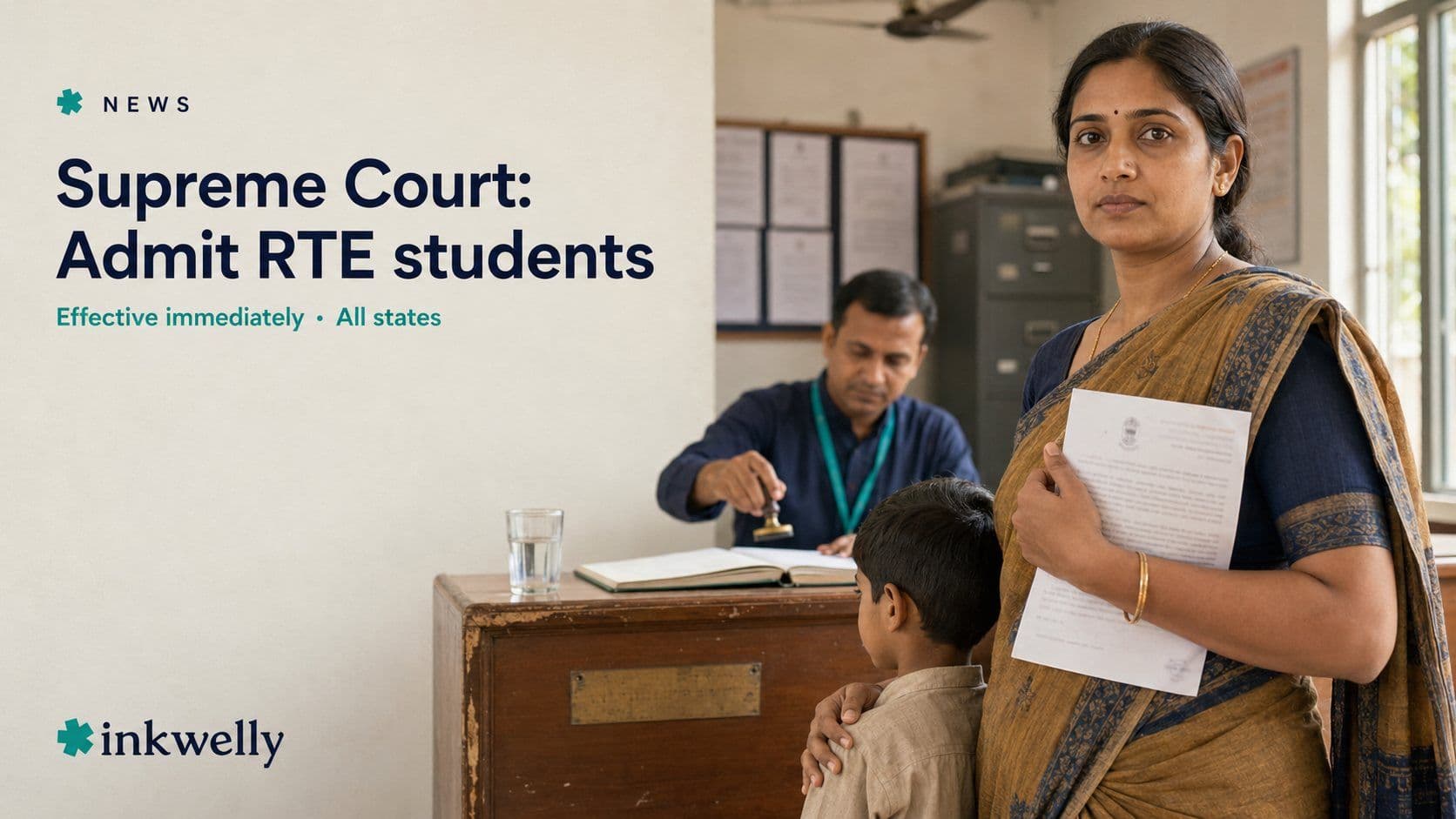
NEW DELHI, May 9 — The Supreme Court has ruled that private unaided schools have a binding obligation to admit children allotted by state governments under the 25 percent Right to Education quota, dismissing an appeal by a Lucknow private school that had refused to enrol a pre-primary student forwarded by the Uttar Pradesh authorities. The bench called the quota "a national mission".
For private schools running RTE admissions for the 2026-27 cycle, the ruling closes a door that several institutions had been quietly using — withholding admission while raising eligibility objections in parallel. The order, delivered on April 28, applies to every state and union territory and lands as Karnataka, Maharashtra, Gujarat and Tamil Nadu run their RTE lotteries through May.
The bench of Justices P. S. Narasimha and Alok Aradhe was hearing an appeal by Lucknow Public School, Eldeco, against an Allahabad High Court order directing it to admit a child allotted by the Uttar Pradesh school education department for the 2024-25 session. In its order — Lucknow Public School v. State of Uttar Pradesh, 2026 INSC 422 — the court held that "the school was obligated to grant admission to the student. Any grievance regarding the selection process cannot be used as a ground to deny or delay admissions." The bench observed that the 25 percent quota under the RTE Act has the potential to "reshape India's social fabric by promoting inclusivity and equal opportunity," and described it as a national mission to secure the preambular objective of equality of status.
The April 28 ruling tightens a thread the court has been pulling on for months. In January, the bench directed all states and union territories to frame transparent rules for the 25 percent RTE allotment process. Three months later, the same bench has signalled that schools cannot sit in appeal over decisions taken by the government under the RTE framework — a message that lands directly on private schools running 2026-27 admissions through state portals. Earlier RTE coverage from this beat: Karnataka RTE 2026-27 deadline May 17.
The implementation pressure now sits on state education departments. Karnataka's first lottery round runs May 25, and Tamil Nadu has crossed 20,000 RTE applications for 2026-27. Private schools that contest a specific allotment — for fake caste documents or out-of-zone addresses — must now first admit the child and pursue the dispute separately, the court said.
Source: The Hans India, Asian Mirror. Judgment: Lucknow Public School v. State of UP (2026 INSC 422).
Related on Inkwelly
Modules this affects:
- Student Information Management — capture RTE-allotment-letter numbers and parent income proof at admission
- School Events & Calendar — pin state RTE lottery and document-verification dates so the office never misses an allotment window
For schools running 2026-27 admissions:
- AI admission auto-fill — pull allotment-letter PDFs into student records without manual data entry
- Bulk import students — load every RTE-allotted child for a class section in one pass
Operational guides:
- How to admit a single new student in Inkwelly — step-by-step admission for a state-allotted child
- How to configure student admission settings — set RTE category fields, fee waivers and document checks once for the year
Earlier in this thread:
You might also like
2 readsSee Inkwelly on your school
30-minute demo. We open your current ERP with you and load your data into Inkwelly on the call. Dated go-live plan by the end of it.