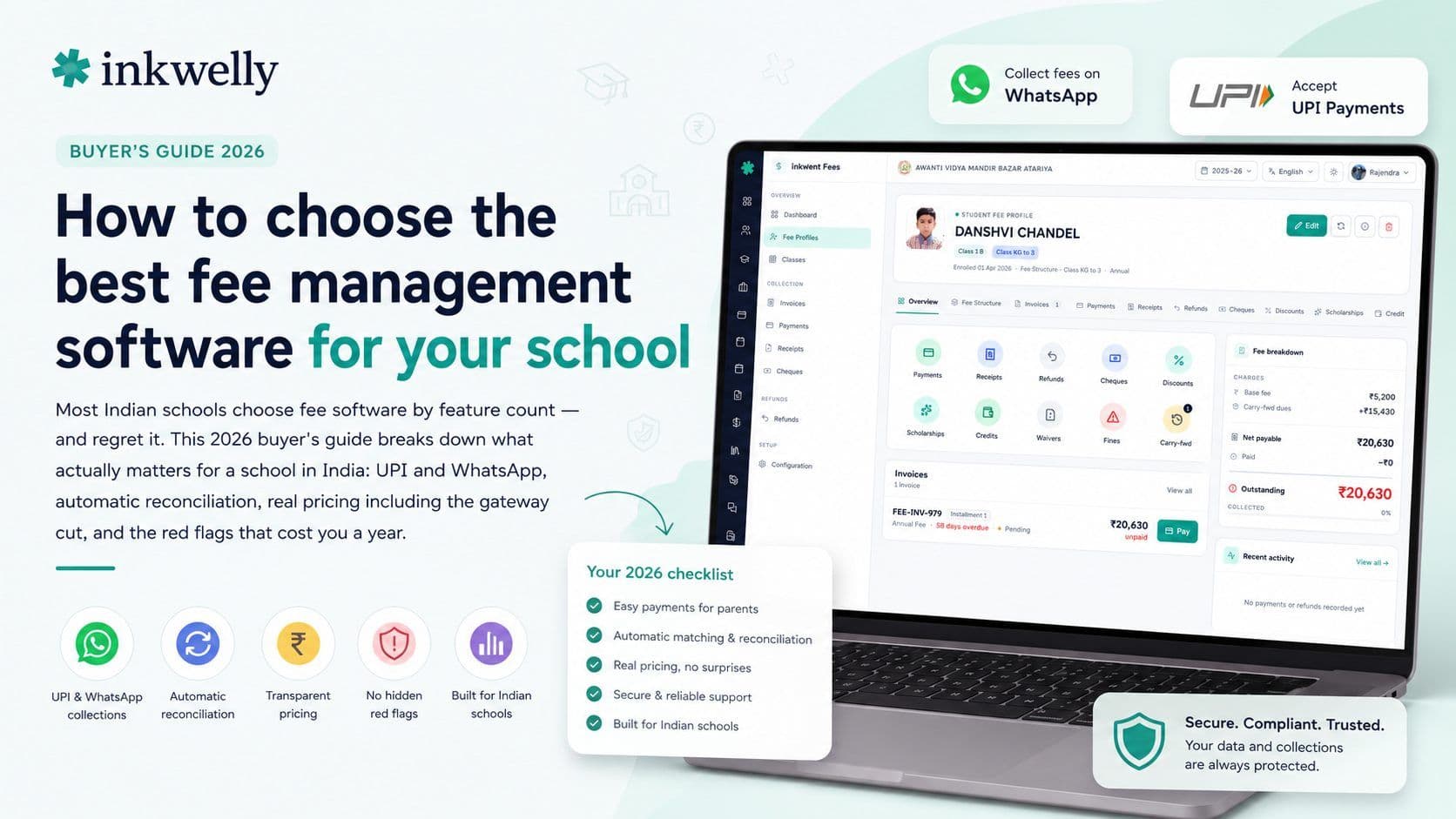
How to choose the best fee management software for your school best
Most Indian schools choose fee software by feature count — and regret it. This 2026 buyer's guide breaks down what actually matters for a school in India: UPI and WhatsApp, automatic reconciliation, real pricing including the gateway cut, and the red flags that cost you a year.
The demo that looks great and collects nothing
A principal sits through three fee-software demos in a week. Each one is a blur of dashboards, colourful charts and a feature list as long as your arm. They all look capable. So the school signs for the one with the most features — and six months later the office is still chasing the same parents, still writing receipts by hand, still matching bank entries to names every Monday.
The demo sold features. The school needed collected fees. Those are not the same thing — and choosing fee management software by feature count is the single most expensive mistake an Indian school makes.
Judge it by what reaches the parent, not the feature list
There is one question worth asking of every feature in a fee-software demo: does this make a parent pay faster, or does it just look good on screen? A school's fee system is only as good as the rupees it actually brings in — on time, correctly recorded, with the least staff effort. Everything below flows from that single test.
What fee management software actually has to do in an Indian school
Strip away the marketing and a fee system has one job: take the money a parent owes and get it into the school's bank account, correctly recorded, with as little manual work as possible. In India that job has specific, non-negotiable parts — most of them tied to how Indian parents actually pay (UPI, WhatsApp) and how Indian schools actually run their fee year (boards, installments, RTE, late fees). If a product is weak on any of these, no amount of dashboards will save your collection rate.
The must-haves for an Indian school
- Online payment by UPI, debit/credit card and net banking — UPI alone now drives the majority of parent payments, so it cannot be an afterthought
- WhatsApp fee reminders and payment links — the one channel Indian parents actually open, far ahead of email or SMS
- Automatic reconciliation — every payment lands tagged to the right student and installment, so nobody matches bank statements to names by hand
- Receipts that send themselves — a receipt on WhatsApp or email within seconds of payment, on your school's letterhead
- Flexible fee heads and structures — tuition, transport, exam, lab and miscellaneous fees, set per class and per session
- Discounts and concessions — sibling, staff-ward, early-payment and merit, applied by rule rather than by hand
- RTE and government-reimbursement handling — mark RTE students and prepare claims without a separate register
- Late-fee rules — flat, percentage, slab or hybrid, applied automatically after the due date
- Cheque and cash at the counter — because not every parent pays online, and the counter must stay in the same ledger
- Refunds and adjustments — time-based refund slabs and credit balances handled cleanly
- Reports a trustee understands — collection, pending, daily counter and gateway-charge reports without an export-to-Excel ritual
Seven things to actually check before you sign
Feature lists lie by omission. These are the checks that separate software that collects from software that merely demos well:
- Ask to see a real payment, end to end. Send a live payment link to your own phone, pay 1 rupee by UPI, and watch whether the receipt arrives and the student's ledger updates on its own. If the salesperson hesitates, that is your answer.
- Check who the money settles to. It must settle into the school's own bank account through a regulated gateway like Razorpay — not pool in the vendor's account first.
- Count the manual steps after a payment. The best systems have zero: no manual receipt, no manual matching. Every extra step is a daily cost multiplied by your student count.
- Test the parent's side on a cheap phone. Open the payment flow on a basic Android phone over mobile data. If it is slow or confusing there, your real parents will abandon it.
- Make them set up your board's fee year. Installments, term fees, transport slabs, RTE — insist they build your actual structure in the demo, not a generic one.
- Find the total price, including the gateway cut. The software fee plus the payment-gateway charge is the real cost. A cheap plan with a high gateway cut is not cheap.
- Confirm where the data lives. Student and parent data should be stored in India and handled in line with the DPDP Act.
What it should cost in India — and what 'cheap' really costs
Pricing in the Indian market falls into two shapes. Per-student plans run roughly 20 to 50 rupees per student per year; flat annual plans for a single school commonly sit between about 12,000 and 40,000 rupees, depending on features and school size. Most vendors will tell you the software pays for itself in a month or two through saved staff time and faster collection — and for a school with real pending dues, that is usually true.
But the sticker price is only half the cost. The other half is the payment-gateway charge — the small percentage taken on each online payment. A plan that looks cheap on the software line can quietly cost more once a high gateway cut is added to every UPI and card payment across the year. Always ask for the software price and the gateway charge together, and compare the total.
Red flags that cost schools a year
A few warning signs reliably predict regret. Money that settles into the vendor's account before reaching the school is the most serious — it puts your cash flow in someone else's hands. A demo where the salesperson will not show a live payment usually means the real flow is clumsy. 'WhatsApp integration' that turns out to be a manual copy-paste, not automatic messages, is another. So is a price that hides the gateway charge, or a contract that locks you in for years with no clean way to export your own student and fee data. Any one of these is a reason to slow down; two of them is a reason to walk away.
Where Inkwelly fits
Inkwelly was built around the one test in this guide: does the parent pay faster, with less office work? Fees are collected by UPI, card and net banking; payment links go out on WhatsApp, where parents actually read them; money settles into the school's own account through Razorpay; and every payment reconciles to the right student with a receipt sent automatically. Sibling, staff-ward and RTE concessions, late-fee slabs, cheque handling and refunds are all rule-driven inside the Student Fee module, and the same ledger covers both online and counter payments. It is one example of software that passes the checks above — the point of this guide is that you hold every option, including this one, to the same standard.
“Schools don't have a feature problem. They have a collection problem. The software that wins is the one that gets the most parents to pay with the least effort — everything else is decoration.”
How to decide in a week
Shortlist two or three options. In each demo, send a live payment to your own phone, make them set up your actual fee structure, and count the manual steps left after a payment clears. Add the gateway charge to the software price and compare the totals. Then pick the one your office — not the salesperson — found easiest. A school that buys on that basis rarely regrets it; a school that buys on feature count almost always does.
See fee collection that reconciles itself
A 20-minute walkthrough with your own classes and fee structure — and a real payment link sent to your phone. No slide deck.
Frequently asked
7 questionsHow much does school fee management software cost in India?
Per-student plans typically run about 20 to 50 rupees per student per year, while flat annual plans for a single school usually fall between roughly 12,000 and 40,000 rupees, depending on features and size. Always add the payment-gateway charge (the small percentage taken on each online payment) to the software price to get the real cost.
Can parents pay school fees by UPI?
Yes. Any modern fee software in India should accept UPI alongside debit and credit cards and net banking, since UPI is now how most Indian parents prefer to pay. The payment should settle directly into the school's own bank account.
What is the difference between fee management software and a full school ERP?
Fee management software handles only fees — invoicing, collection, receipts and reports. A school ERP includes fees plus admissions, attendance, academics, transport and communication in one system. Many schools start with fees and grow into the full ERP; buying fees inside an ERP avoids entering the same student data twice.
Can we switch fee software in the middle of the academic session?
Yes. Fees are recorded per student and per installment, so a clean import of your current students and pending dues lets you switch mid-session without losing history. The bigger risk is staying another year on software your office is fighting.
Does it work for CBSE, ICSE and state-board schools?
Good fee software is board-agnostic — it works for CBSE, ICSE/ISC, IGCSE/IB and every state board, because fee structures, installments and concessions are configured per school rather than per board.
Can it handle RTE students and fee concessions?
Yes. Look for software that lets you mark RTE students, apply sibling, staff-ward and merit concessions by rule, and prepare government reimbursement claims without keeping a separate register.
Will it send fee receipts on WhatsApp automatically?
The best systems send a receipt on WhatsApp (or SMS and email) within seconds of a payment clearing, with no manual step. If 'WhatsApp' turns out to be a manual copy-paste, that is a red flag.
You might also like
4 readsSee Inkwelly on your school
30-minute demo. We open your current ERP with you and load your data into Inkwelly on the call. Dated go-live plan by the end of it.