Online School Fee Collection: UPI, Cards & Net Banking Explained
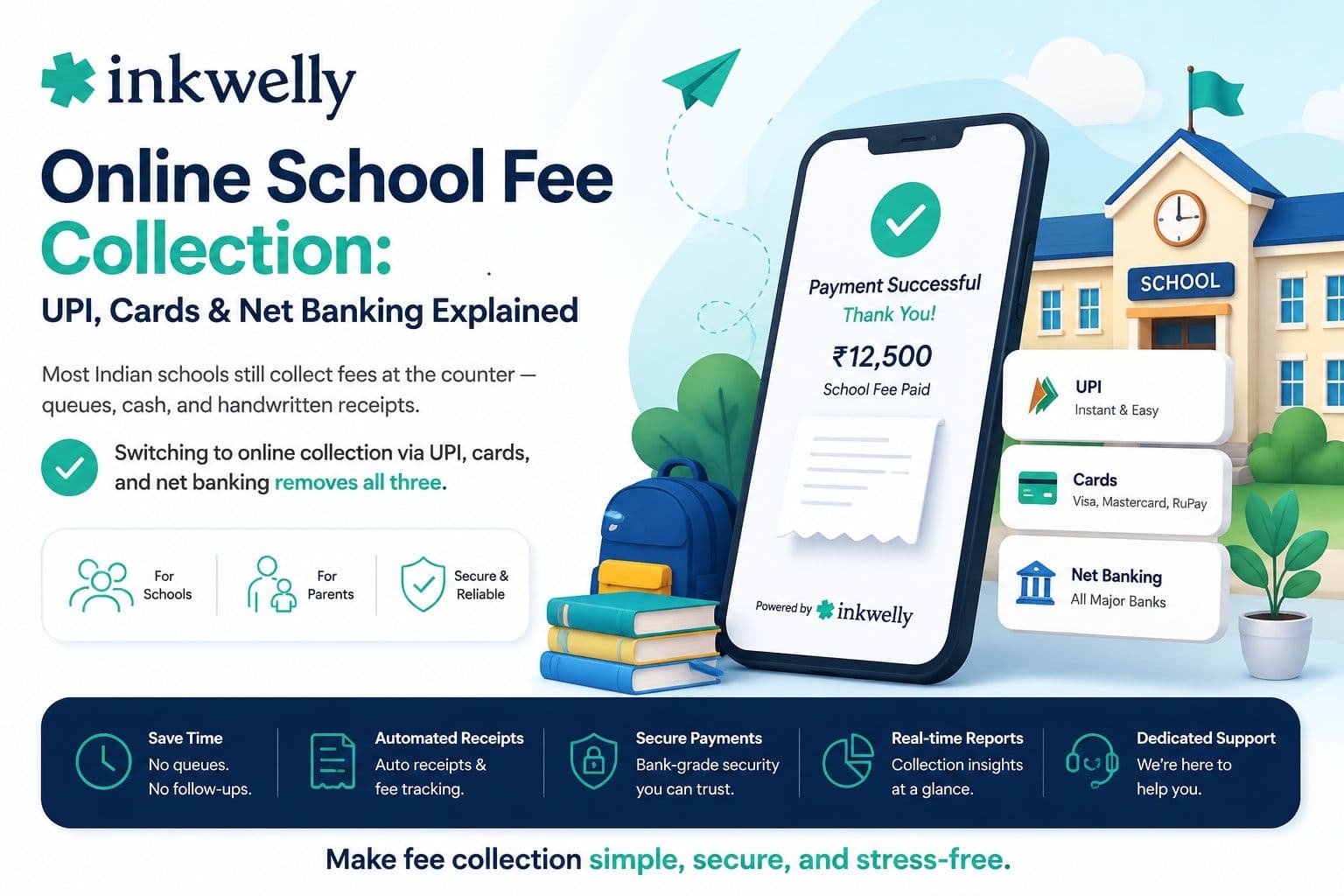
Most Indian schools still collect fees at the counter — queues, cash, and handwritten receipts. Switching to online collection via UPI, cards, and net banking removes all three. Here is how it works, what it costs, and how to set it up before your next fee cycle.
A class teacher in a Tier-2 UP school spent three hours every Monday sorting fee envelopes, matching payment slips, and updating the ledger by hand. The school collected on time from roughly 60% of parents; the rest drifted for weeks. In October 2025, the Ministry of Education formally wrote to all states, CBSE, KVS, and NVS asking them to shift to digital fee collection. That shift is already underway in metros and is now reaching mid-size and smaller schools. The question is no longer whether to collect fees online — it is how to do it right.
Online fee collection for schools is not just UPI. It covers five payment methods, two gateway options, one compliance requirement, and a handful of decisions that determine whether parents actually use it or continue queuing at the counter. Get the setup right and collections improve; get it wrong and you add a digital layer on top of the same cash problem.
When a school enables online fee payment, several moving parts need to be in place before a single parent can pay from their phone.
- UPI (Google Pay, PhonePe, Paytm): The dominant payment method for Indian parents — instant, zero cost to the payer, supported on every smartphone. NPCI allows fee transactions up to ₹5 lakh per UPI payment, covering even the most expensive annual fees.
- UPI AutoPay: Parents set a one-time mandate that auto-debits the fee on the due date — no reminder needed, no counter visit. Schools using AutoPay report 30–40% fewer follow-up calls on fee defaults.
- Debit and credit cards (Visa, Mastercard, RuPay): Covers parents who prefer card payment. RuPay domestic card MDR is lower than Visa/Mastercard, making it cheaper to encourage.
- Net banking: Preferred by some parents for high-value one-time annual payments. Slightly slower than UPI but familiar to older parents.
- Payment gateway (PA): Your school ERP must connect to a licensed Payment Aggregator (Razorpay, PayU, Cashfree) registered with the RBI. Schools cannot accept card or net banking payments directly — the PA is the mandatory intermediary.
- Automatic receipt delivery: Every online payment must generate and send a receipt via WhatsApp, SMS, or in-app notification without any manual step. The receipt is the parent's proof of payment; a gap here causes disputes.
- Automated reconciliation: The gateway settles to the school's bank account on T+1 or T+2. Your ERP should match each settlement to the correct student ledger automatically — no manual CSV import.
Most schools that attempt online fee collection run into one of three problems: parents do not know the link exists, payments arrive in the bank but are not matched to the correct student, or the ERP cannot issue a proper receipt. All three are setup failures, not technology failures. The Ministry of Education's October 2025 circular explicitly lists these failure modes and asks schools to test the end-to-end flow before announcing the switch to parents.
Setting up online fee collection properly takes about two to three weeks. Here is the sequence:
-
Choose a payment gateway. Razorpay, PayU, and Cashfree are the most common choices for Indian schools. Compare: integration time with your ERP, settlement speed (T+1 vs T+2), MDR for UPI (effectively 0%), MDR for cards (0.9–2%), and support for UPI AutoPay mandates.
-
Complete the KYC. The gateway will ask for school registration documents, a cancelled cheque for the school's current account, PAN/TAN, and sometimes a board recognition certificate. Allow 3–10 working days.
-
Integrate with your school ERP. A well-built ERP connects to the gateway via API — no manual CSV export. Confirm this works before announcing anything to parents.
-
Test with a ₹1 transaction. Pay from a personal UPI ID, confirm the receipt generates automatically, confirm the ledger updates, and confirm the settlement hits the bank account. This catches 90% of issues before parents encounter them.
-
Communicate to parents. A WhatsApp broadcast with a screenshot of the payment screen and a two-line how-to beats a PDF circular every time.
-
Set up reconciliation checks. Once a week, verify that gateway settlements match ERP ledger credits. Most disputes arise from parents who paid but still show a balance — reconciliation gaps are the usual cause.
Most major school ERPs now claim online fee collection support. Teachmint, Fedena, Entab (CampusCare), MyClassboard, and Campus 365 all offer gateway integration. The difference is in depth: some integrate only UPI QR codes; others support AutoPay mandates, RuPay cards, and real-time reconciliation. Ask each vendor to demo a parent paying from their phone, the receipt being delivered to WhatsApp, and the student ledger updating — in that order, live. A vendor who cannot show that full sequence during a demo probably cannot deliver it reliably in production.
Online fee collection adds a recurring cost that many schools underestimate:
Payment gateway MDR: UPI is effectively zero for most transactions. Domestic debit cards run 0.5–1.5%; credit cards 1.5–2%; net banking ₹5–₹15 flat. For a school collecting ₹40 lakh/year with 60% via UPI and 40% via cards, total MDR is roughly ₹20,000–₹40,000/year — a pass-through cost unavoidable with any gateway.
Vendor per-transaction fee (if any): Some ERPs layer an additional ₹1–₹3 per transaction on top of the MDR. On 3,000 transactions/year, that is ₹3,000–₹9,000 extra. Confirm in writing.
WhatsApp receipt delivery: If your ERP charges per message, each receipt costs ₹0.30–₹0.70. For 3,000 payments/year, that is ₹900–₹2,100/year.
Gateway integration should not be a paid add-on from the ERP vendor — it should be included in the annual subscription. If quoted separately, treat it as a negotiating item.
Inkwelly's fee module connects directly to Razorpay for UPI, UPI AutoPay, debit cards, credit cards, and net banking. Every successful payment generates a receipt automatically and delivers it to the parent via WhatsApp, SMS, or in-app notification — no manual step. The student's fee ledger updates in real time. Reconciliation is automatic: each gateway settlement is matched to individual student records without any CSV import. There is no vendor per-transaction fee layered on top of the Razorpay MDR.
“The schools that successfully moved fee collection online were not the most tech-savvy — they were the ones that tested the full parent journey before announcing the switch.”
Online fee collection is table stakes for any school ERP in 2026. The technology is mature and reliable. What separates a smooth rollout from a troubled one is not the gateway — it is the ERP's ability to connect payment, receipt, ledger, and parent notification in a single unbroken flow. Before you commit to any platform, ask for a live demo of that full loop. If the vendor cannot show it in real time, the integration is probably not as tight as the brochure suggests.
See how Inkwelly handles online fee collection
Frequently asked
7 questionsHow do Indian schools collect fees online?
Schools connect their ERP to a licensed Payment Aggregator (Razorpay, PayU, Cashfree) which handles UPI, cards, and net banking. Parents receive a payment link by WhatsApp or SMS, pay from any UPI app or card, and receive a receipt automatically. The gateway settles to the school's bank account within 1–2 working days.
What is UPI AutoPay and can schools use it for fee collection?
UPI AutoPay is a recurring mandate where parents authorise a one-time deduction on a fixed date each month or quarter. Google Pay, PhonePe, and Paytm all support it. The school receives the fee automatically on the due date — no reminder needed. Parents must consent via their UPI app; schools cannot create mandates on a parent's behalf.
Which payment gateway should a school use in India?
Razorpay and Cashfree are the most common choices for Indian schools in 2026. Both support UPI, UPI AutoPay, RuPay/Visa/Mastercard debit and credit cards, and net banking. Razorpay is slightly faster to set up for first-time users; Cashfree offers competitive settlement timings. Both require a KYC process of 3–10 working days.
What is MDR and how much do schools pay on online fee transactions?
MDR (Merchant Discount Rate) is the fee charged by the payment gateway per transaction. UPI MDR is effectively 0% for most school fee transactions. Domestic debit cards run 0.5–1.5%; credit cards 1.5–2%; net banking ₹5–₹15 flat. For a school collecting ₹40 lakh/year online, total MDR is roughly ₹20,000–₹40,000/year.
Can parents pay school fees in installments online?
Yes, if your school ERP supports installment schedules. The school creates the plan (e.g., three equal payments over a term), and parents receive separate payment links or AutoPay mandates for each installment. Not all ERPs support this — confirm it with a live demo.
How do parents get a fee receipt after paying online?
A well-integrated ERP generates and delivers the receipt automatically via WhatsApp, SMS, and in-app notification as soon as the gateway confirms the payment — usually within 30 seconds. If there is any manual step such as an accountant approving the receipt, the system is not fully integrated.
Is online fee collection mandatory for schools in India?
It is not legally mandatory, but the Ministry of Education issued a circular in October 2025 encouraging all states, CBSE, KVS, and NVS to shift to digital fee collection. Most urban and semi-urban schools now offer it, and parent expectations are rising quickly.
You might also like
5 readsSee Inkwelly on your school
30-minute demo. We open your current ERP with you and load your data into Inkwelly on the call. Dated go-live plan by the end of it.