A WhatsApp payment link collects fees faster than any reminder faster
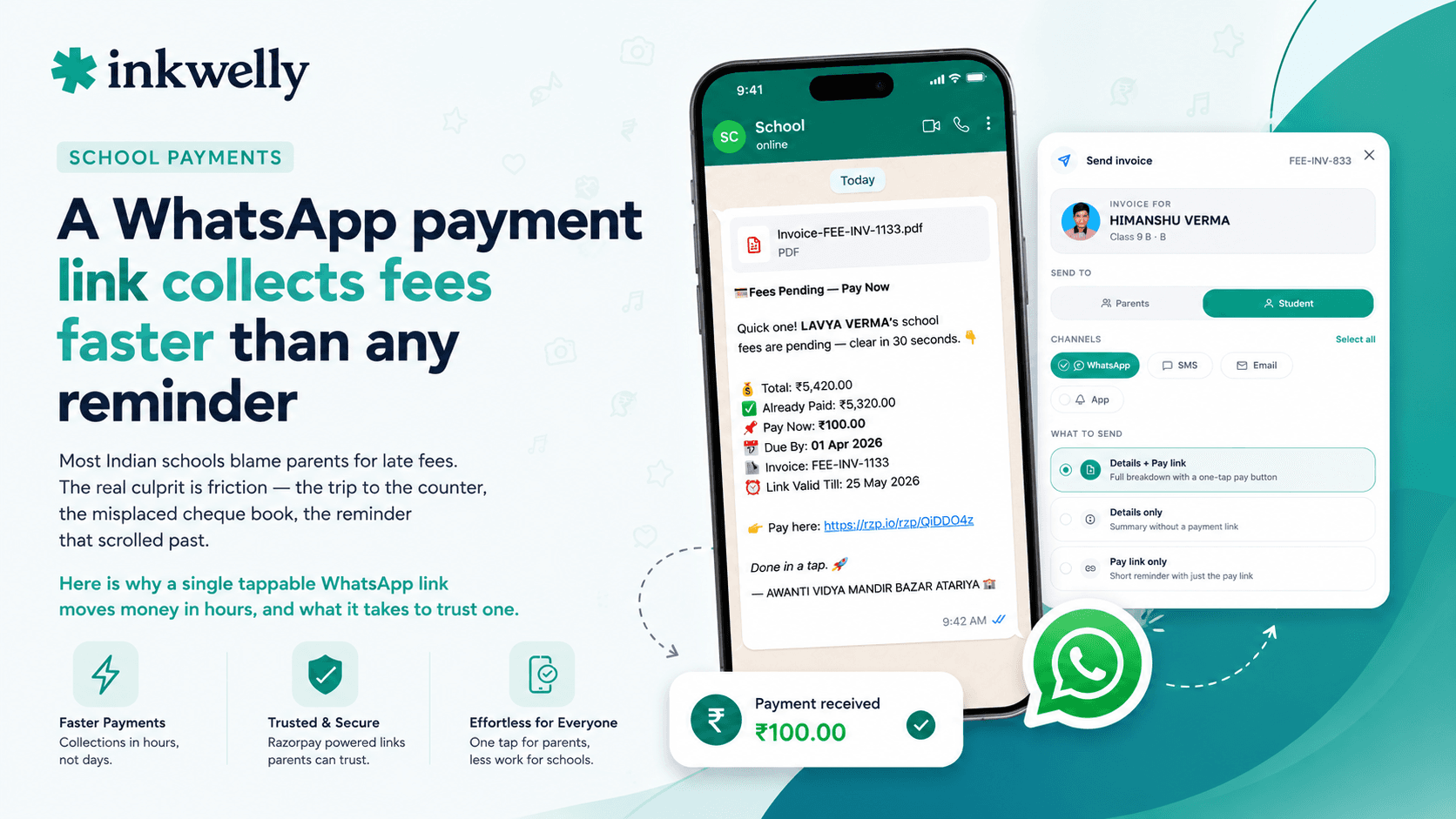
Most Indian schools blame parents for late fees. The real culprit is friction — the trip to the counter, the misplaced cheque book, the reminder that scrolled past. Here is why a single tappable WhatsApp link moves money in hours, and what it takes to trust one.
The 3 PM fee counter
Walk into almost any school office on a fee-due Saturday and you will see the same scene. A queue at the accounts window. A parent who left the cheque book at home. Another who swears the reminder never arrived. The office assistant reading out the same pending amount for the fortieth time, by hand, from a register. Two clerks pulled off their actual work to collect money that parents fully intend to pay. By 3 PM everyone is tired, the queue has not moved, and tomorrow it starts again.
This is not a parent problem. It is a friction problem — and most schools have been solving it from the wrong end.
The thesis
Parents do not delay fees because they refuse to pay. They delay because paying is inconvenient — and every reminder a school sends adds pressure without removing the inconvenience. Hand the parent a single tappable WhatsApp link that opens straight to a UPI or card payment, and the money that was always coming arrives in hours instead of weeks.
The problem was never the parent
Schools have a deep instinct that late fees are a discipline problem. So the response is almost always more pressure: a second SMS, a third reminder, a call from the office, a note sent home with the child. None of it touches the actual reason the fee is still pending.
Think about what a parent has to do to pay the old way. Read the reminder. Remember it past the next distraction. Find the cheque book, or set aside cash, or plan a trip to the school during the exact hours they are themselves at work. For a working couple in a Tier-2 city, 'come to the fee counter between 10 and 2 on a weekday' is a genuinely hard ask — not because they don't have the money, but because they don't have the slot.
Every reminder a school sends assumes the parent forgot. Usually they didn't. They simply hit the same wall of inconvenience again, and the reminder only made them feel guilty about a wall the school itself built. The schools that fixed their collections did not write better reminders. They removed the wall. That is the whole shift — and it is why the Student Fee module treats 'how does the parent actually pay' as the real design problem, not 'how do we chase harder'.
The old reminder
An SMS or a diary note saying an amount is due. The parent has to remember it, find the cheque book, and reach the counter during office hours. They can only pay while the counter is open. The office re-sends reminders, reads out balances and writes receipts by hand. Dues stay pending for days, sometimes weeks.
A WhatsApp payment link
A message the parent actually reads, with a Pay Now button. One tap pays by UPI, card or net banking — from the sofa, at 9 PM, on a Sunday, from another city. The office does nothing; the receipt sends itself the moment payment clears. The same dues often clear within hours of the first message.
Why the link has to live on WhatsApp
A payment link is only as good as the chance the parent opens it. This is where channel choice quietly decides everything. An emailed link sits unread in an inbox most Indian parents barely check. An SMS link is increasingly buried under spam and OTPs, and half the time the parent isn't sure it is genuine. WhatsApp is different — it is the one app nearly every Indian parent opens many times a day, where a message from the school carries the school's name and feels trustworthy.
That trust matters more than convenience. A parent who would never tap a link in a random SMS will open one inside a WhatsApp message from their child's school, because the context tells them it is real. The message can carry the child's name, the exact pending amount and the installment it covers, so there is no confusion about what is being paid.
There is a second, quieter advantage: WhatsApp leaves a record. The parent can scroll back to the message, the amount and the date. When a fee dispute surfaces months later — 'you never told us' — the school has a timestamped message instead of a he-said-she-said. Routing fee links through the Communications Center means every one of these messages is logged, not lost in someone's personal phone.
What changes the week you switch
The shift is not subtle. The first fee cycle after a school turns on WhatsApp payment links usually looks visibly different, and the change shows up in places the school did not expect — not just in the collection figure, but in how the office spends its day and how parents feel about the school.
What a school notices in the first cycle
- Parents pay in the evening, after work — most link payments land outside the school's own office hours, when no counter could ever have been open
- The accounts desk stops being a collection counter and goes back to actual accounting
- Receipts reach parents on WhatsApp within seconds of payment, so the 'did it go through?' calls quietly disappear
- Out-station and NRI parents finally pay on time, because distance stops being a reason to delay
- Every payment lands already tagged to the right student, so nobody spends Monday matching bank entries to names
- Late-fee disputes fall, because the parent holds a dated message proving exactly when they were asked
“Parents were never refusing to pay. They were refusing the queue, the cheque book they couldn't find, and the reminder that scrolled away by lunchtime. Take the friction out, and the money was always going to come.”
'But is a link safe?' — the question every accountant asks
This is the first thing a careful accountant raises, and it deserves a straight answer rather than a sales line. The honest version is that the link itself never touches the money. It opens a secure payment page on the same UPI and card rails the parent already trusts for electricity bills, online shopping and movie tickets. The school never sees a card number. Money settles into the school's own bank account, and a receipt is raised automatically against the correct student and installment.
For the accounts team this is the part that actually changes their life: there is no manual matching. Every rupee that comes in is already linked to a name, a class and an invoice, so the dreaded Monday-morning job of reconciling a bank statement against a list of names simply stops existing.
Where a payment link won't help
This is not magic, and it is worth being honest about the limits. A WhatsApp link does nothing for the parent who genuinely cannot pay this month — that is a conversation and a fee-concession decision, not a collection-tool decision. It will not rescue a fee structure parents find unfair; it only removes the friction of paying one they already accept. And in pockets where families still prefer cash — boarding schools with rural catchments, some budget schools — the link becomes one option among several, not the only one. A school that rips out its cash counter on day one will simply annoy people. The link earns its place by being easier, not by being forced.
So what should a school actually do
Start small and let the numbers do the convincing. Turn on payment links for one class or one installment, send them on WhatsApp alongside your normal reminder, and watch how fast that batch clears compared to the rest. Most schools see enough of a gap in the very first cycle to roll it out everywhere. The goal is not to chase parents harder — it is to stop chasing them at all, and let a single tap do the work the fee counter has been doing by hand for years.
See fee links on WhatsApp with your own school's data
A 20-minute walkthrough — your classes, your fee structure, a real payment link sent to a test number. No slide deck.
Frequently asked
6 questionsIs it safe for parents to pay school fees through a WhatsApp link?
Yes. The link opens a secure Razorpay payment page using the same UPI, card and net-banking options parents already use for everyday payments. The school never sees card details, and the money settles directly into the school's own bank account.
What if a parent doesn't use UPI?
The same link also accepts debit and credit cards and net banking, so parents who don't use UPI can still pay in the way they are comfortable with. Cash and cheque at the counter remain available as well — the link is an added option, not a replacement.
Does the school get the money instantly?
The payment is confirmed immediately and the receipt is sent to the parent within seconds. Settlement into the school's bank account follows the standard payment-gateway cycle, just as it does for any online business in India.
Will the payment show up against the right student automatically?
Yes. Each link is tied to a specific student and installment, so when the parent pays, it is recorded against that child's fee ledger automatically. There is no manual matching of bank entries to names.
Does this work for parents who barely use a smartphone?
WhatsApp is the one app almost every Indian parent already uses daily, which is exactly why it works better than email or an app download. For the few who still prefer to pay in person, the school's cash and cheque counter stays open.
Can we still accept cash and cheque at the counter?
Absolutely. Most schools keep the counter running and simply send WhatsApp links alongside it. Over a cycle or two, more parents choose the link on their own because it is easier — but nothing is taken away.
You might also like
2 readsSee Inkwelly on your school
30-minute demo. We open your current ERP with you and load your data into Inkwelly on the call. Dated go-live plan by the end of it.