Moving from Excel and registers to a school ERP without breaking the running session migration
Most Indian schools that switch to an ERP aren't replacing old software — they're replacing twenty spreadsheets and a stack of registers. This guide walks owners and principals through what that migration really involves, what data to clean first, when to cut over, and how to do it without breaking the session you're already in.
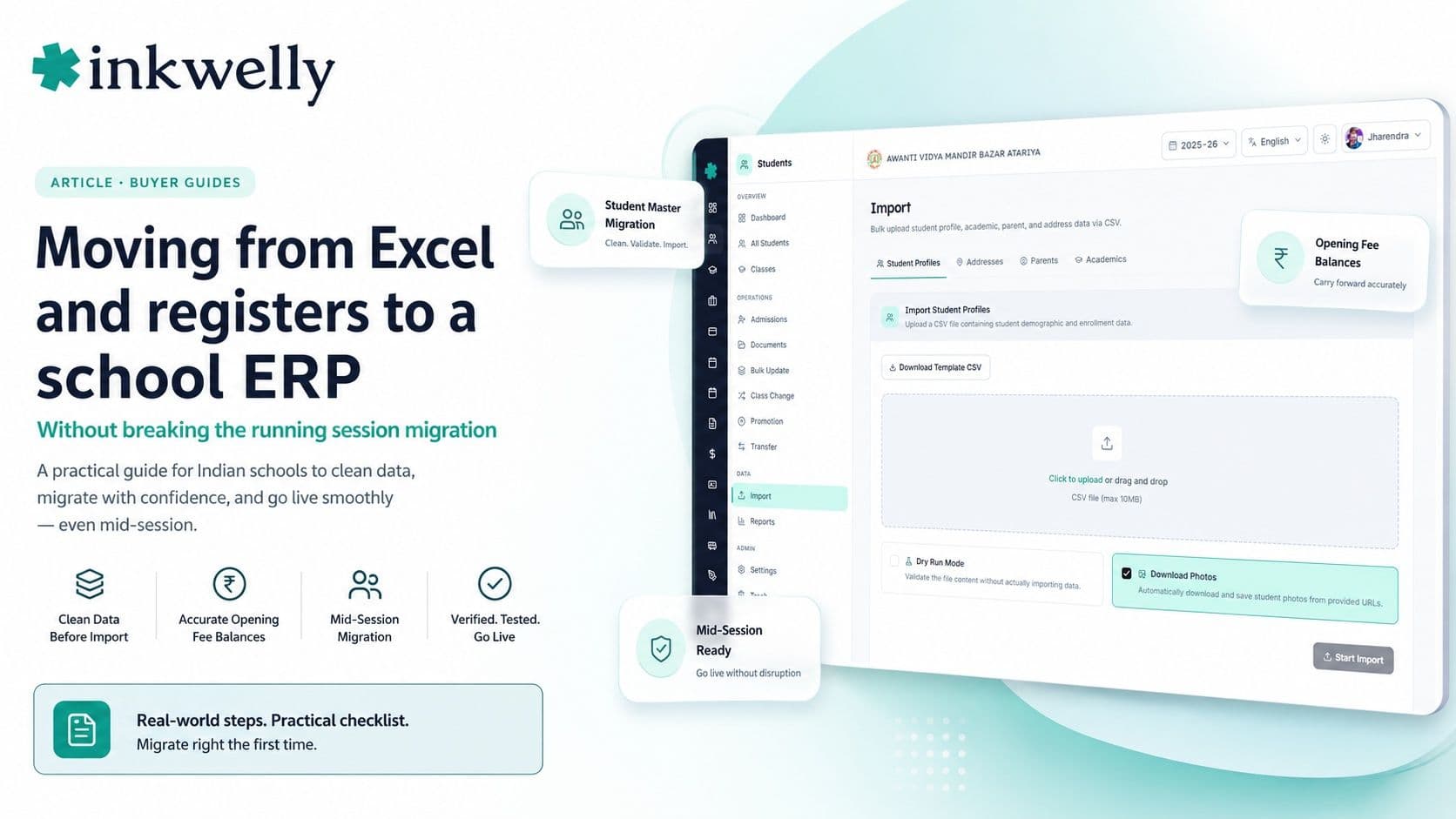
It's the third week of July. The admission register is a hardbound book in the front office, the fee collection runs off a spreadsheet called Fees_Final_v4.xlsx that only the accountant can read, and attendance lives in a different register in each classroom. A parent calls asking why last month's payment isn't reflecting, and three people open three files to find out. None of this is broken, exactly — the school has run this way for years. But it doesn't scale, it doesn't survive a staff member leaving, and it can't send a parent an instant receipt. This is the starting point for most Indian schools moving to an ERP: not switching software, but leaving Excel and paper behind for the first time.
The honest truth about an Excel-to-ERP migration
Moving from spreadsheets and registers to a school ERP is not a technical project — it is a data-cleaning project with a software install at the end. The software part takes days. Getting your student list, fee balances, and class structure clean enough to trust takes most of the effort, and skipping that step is the single biggest reason migrations go wrong. Get the data right and the system runs itself; rush the data and you'll spend the next term reconciling numbers that don't add up.
What you're actually migrating
When schools picture migration they think of student names. In practice you are moving several distinct sets of data, each with its own owner and its own mess. Listing them honestly up front is what separates a two-week migration from a two-month one:
- Student master — admission number, full name, class and section, date of birth, gender, and at least one verified parent contact. This is the backbone; everything else hangs off it.
- Parent and guardian contacts — usually the dirtiest data. Expect duplicate parents, two children under two different phone numbers, and numbers that haven't worked in years.
- Class and section structure — the actual classes you run this year, the streams in senior school, and which teacher is the class teacher of each section.
- Opening fee balances — what each student owed as on the day you cut over: pending dues, advance paid, and any concession already granted. This is the line item schools most often get wrong.
- Fee structure — the heads (tuition, transport, lab, exam), the amounts by class, the installment schedule, and late-fee rules.
- Staff list — names, roles, and contact numbers; pay scales too if you're bringing payroll in from day one.
- Promotion / academic history — which student sits in which class this session, and optionally last year's results if you want them on record.
- Transport routes and stops — only if you run buses and want them in from the start; otherwise add later.
- Historical attendance and marks — usually NOT worth importing. Start attendance fresh from go-live day; keep old registers as the archive.
The India-specific things that trip schools up
A migration that would be routine for a corporate office has a few twists unique to Indian schools, and they're exactly the parts a generic guide skips. Plan for these and the rest is easy:
- Mid-session reality — most schools decide to switch in July–December, not in the clean gap before a new session. That means you're carrying opening fee balances, not starting from zero, and the system has to accept money already collected this year.
- Opening balances are non-negotiable — if a parent paid two of four installments before you went live, the ERP must show two paid and two pending. Get this wrong and every fee receipt for the rest of the year is suspect.
- Promotion data — Indian schools think in terms of last year's Class 5 becoming this year's Class 6. The migration must reflect the current session's class for every student, not the class they were admitted into years ago.
- Parent phone numbers are the SMS/WhatsApp lifeline — a wrong number means a parent who never gets a receipt or an absence alert. Cleaning these is worth a full day on its own.
- RTE and concession students — free-seat and concession students need their reduced or zero fee structure mapped correctly, or you'll bill a parent who shouldn't be billed.
How to migrate without breaking the running session
The goal is a switch parents and teachers barely notice. This is the sequence that works for an Indian school moving off Excel and registers, and it's the part worth reading twice:
-
Take a one-page data inventory first. Sit with the office staff for an hour and list every spreadsheet and register in use, who owns it, and which copy is the freshest. You can't migrate what you haven't found.
-
Clean before you import, not after. Deduplicate students, fix parent phone numbers, and resolve the "two records for one child" mess in Excel itself — it's faster there than inside any ERP.
-
Freeze a cut-over date and a single source of truth. Pick a date; from that morning, fees and attendance go into the ERP only. No parallel spreadsheet "just in case" — that's how the two versions drift apart.
-
Migrate the student master and fee structure first. Get students, classes, and the fee heads in and verified before anything else. Everything depends on this layer being correct.
-
Enter opening fee balances as on the cut-over date. For each student, record what's already paid and what's still pending this session. Spot-check twenty students against the old register before trusting the rest.
-
Run one week in parallel for fees only. Collect in the ERP, but reconcile against the old sheet each evening for the first week. Once a week matches, retire the spreadsheet for good.
-
Start attendance and communication fresh from go-live. Don't backfill months of attendance. Begin clean on day one; the daily habit forms within a fortnight.
-
Train the office before the teachers. The front office touches fees and admissions every day — get them confident first, then roll out to class teachers.
Before: Excel + registers
Fee balances live in one accountant's spreadsheet. A parent's payment question means opening files and cross-checking by hand. A staff member leaving takes institutional memory with them. No receipt goes out automatically, and the principal has no single view of who owes what.
After: one ERP
Every student, fee, and contact sits in one place any authorised staff member can see. A payment reflects instantly and the parent gets a receipt on WhatsApp. Absence alerts go out the same morning. The principal opens one dashboard and sees collection, dues, and attendance for the whole school.
The kinds of options you'll run into
When a school starts looking, the names that come up include Teachmint, Vidyalaya, Fedena, Entab, MyClassboard, Campus 365 and Edunext, alongside newer cloud-first platforms. Some are strong on a single area like fees or communication; others are full ERPs covering admissions, academics, exams and transport. For a school leaving Excel, the deciding factor is rarely the longest feature list — it's how much hand-holding the vendor gives you on the migration itself, and whether their import tools accept your messy spreadsheet as-is or demand a perfectly formatted file you don't know how to produce.
What this actually costs — in money and time
Cloud school ERPs in India typically run ₹15,000–₹1,50,000+ per year depending on student count and modules, often priced per student per year. But the cost that catches schools off guard during a migration is staff time, not the license. A clean migration for a 600-student school is realistically a 1–3 week effort spread across your office staff and the vendor — most go live within 2–3 weeks when records are already in spreadsheets, longer when everything is on paper. Ask whether data migration is included free (many vendors do it at no extra charge) or billed as a setup fee, because a quoted ₹40,000 license can hide a ₹15,000 "data setup" line you only see later.
Where Inkwelly fits
Inkwelly is built for exactly this jump — schools moving off Excel and registers, mid-session, without a clean break to wait for. Student records, classes, and the Student Information backbone come in first; then fees with proper opening balances so a parent who paid two installments shows two paid and two pending from day one. Attendance and parent communication start fresh from go-live, and the office sees one dashboard instead of twenty files. The migration support is hands-on by design — we'd rather take your messy spreadsheet and clean it with you than hand you a template and wish you luck.
“Migrating to a school ERP isn't a software project with some data work at the end. It's a data-cleaning project with a software install at the end — and the schools that accept that finish in two weeks instead of two terms.”
Deciding in two weeks
You don't need a quiet summer to switch. Take a week to inventory and clean your data, pick a cut-over date, migrate students and fee balances first, and run fees in parallel for the first week. Start attendance and communication fresh, train the office before the classrooms, and keep your old registers as the archive — never the live source. Done in this order, the move from Excel and paper to one system is something parents and teachers barely notice, and the front office stops dreading the next fee question.
See a migration done with your own data
Book a free demo and bring your real fee spreadsheet — we'll show you your students and opening balances live.
Frequently asked
8 questionsHow long does it take to move a school from Excel to an ERP?
For a school whose records already live in spreadsheets, most migrations finish in 2–3 weeks, and some vendors complete the data move itself in 24–48 hours. Schools moving entirely off paper registers take longer because the records have to be typed in first. The software install is quick; cleaning and verifying the data is what sets the timeline.
Can we switch to a school ERP in the middle of the session?
Yes, and most Indian schools do exactly that. The key is migrating opening fee balances correctly — what each student has already paid and still owes as on your cut-over date — so the year's accounts stay accurate. You don't have to wait for a new session in April to start.
What data should we clean before migrating to a school ERP?
Clean three things first: deduplicate students, fix and verify parent phone numbers, and resolve any duplicate or split records for the same child. Do this in Excel before importing — it's faster there than inside the ERP, and clean data is the difference between a two-week migration and a two-month one.
Should we import old attendance and exam results into the new ERP?
Usually not. Start attendance fresh from go-live day and keep your old registers as the archive. Importing months of historical attendance adds risk and effort for little daily value. Past exam results can be added if you want them on record, but they're optional, not urgent.
When is the best time to switch a school to an ERP?
The cleanest break is just before a new session begins, around April, when you can start fee balances from zero. But mid-session switches are common and work fine as long as opening balances are entered accurately. Pick a cut-over date, freeze it, and use the ERP as the single source from that morning.
What is the biggest risk when migrating to a school ERP?
Wrong fee data. If opening balances are off, every receipt for the rest of the year is suspect and parents lose trust. The second risk is keeping a parallel spreadsheet 'just in case' — the two versions drift apart within weeks. Verify a sample of balances against the old register before going live, and commit to a single source of truth.
Do school ERP vendors help with data migration, or do we do it ourselves?
Many vendors handle migration from Excel, paper, or an old system at no extra charge, but the quality varies. The real test: ask them to import your actual, unedited fee spreadsheet during the demo and show correct dues for twenty students. If they need a 'properly formatted template' first, you'll be doing the hard cleanup yourself.
Will switching to an ERP disrupt our running classes and fee collection?
Not if you sequence it right. Migrate students and fee structure first, enter opening balances, run fees in parallel for one week while reconciling against the old sheet each evening, then retire the spreadsheet. Start attendance and communication fresh from go-live. Done this way, parents and teachers barely notice the switch.
You might also like
4 readsSee Inkwelly on your school
30-minute demo. We open your current ERP with you and load your data into Inkwelly on the call. Dated go-live plan by the end of it.