Which student attendance system actually fits your school actually
Biometric, RFID card, and app-based attendance each solve a different problem and fail in a different way. This guide helps principals match the method to how children actually arrive — with honest costs, the DPDP risks, and a demo test that starts at your own gate at 7:55 am.
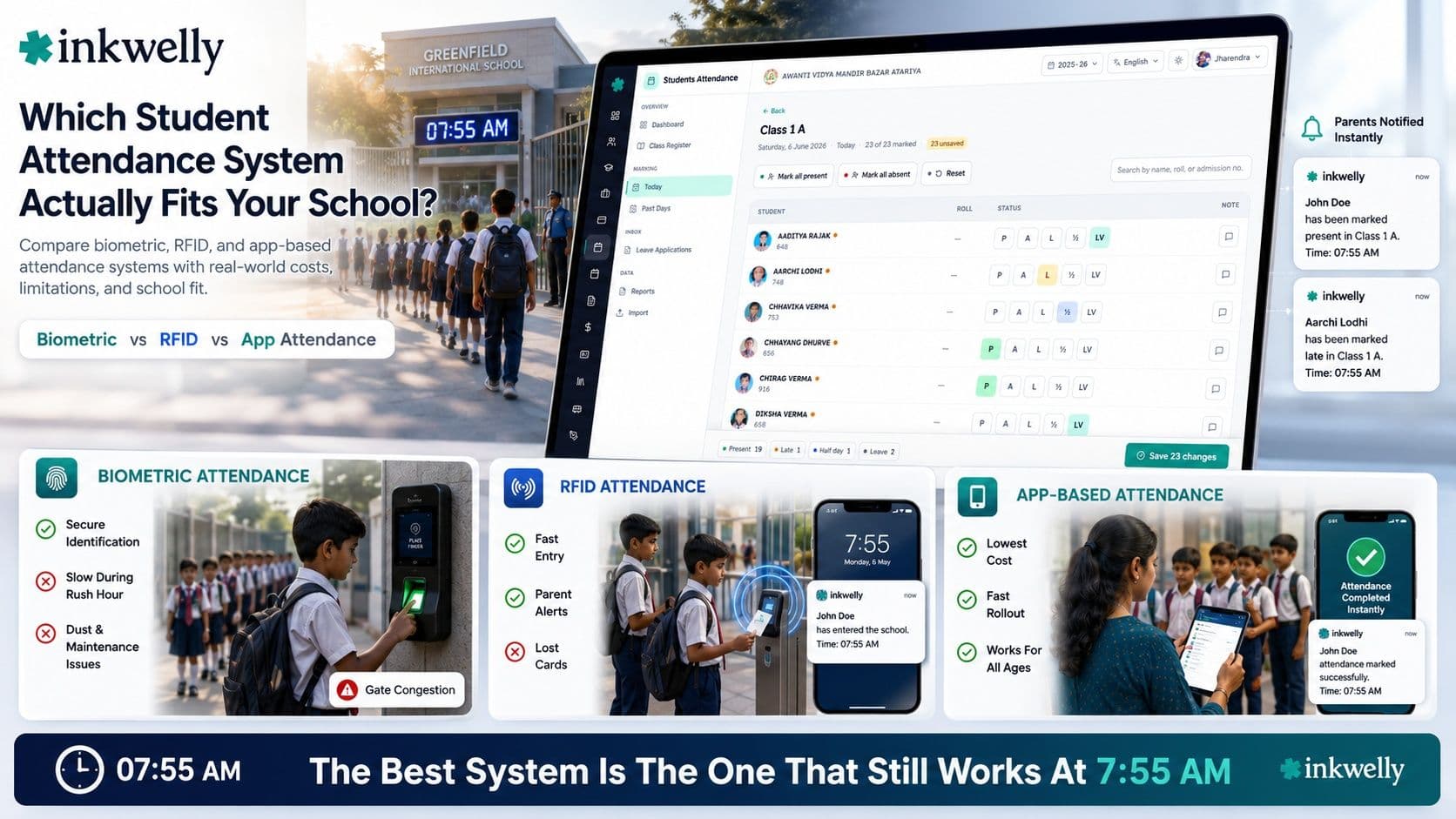
It is 7:55 am at a school gate in Indore. Eight hundred children are streaming in, and the principal has just spent two lakh rupees on a shiny biometric machine that was supposed to end attendance headaches. Instead, there is a queue forty children deep, a Class 2 child whose tiny thumb won't read, a sensor smudged with the morning's dust, and a watchman frantically wiping it with his shirt. Meanwhile the first bell has rung. The vendor promised 'modern, automated attendance'. What the school got was a new bottleneck at the busiest minute of the day. The real question was never which technology is most advanced — it was which one survives a real Indian school morning.
Here is the thesis: there is no single best attendance system for schools — only the right fit for your gate, your age groups, and your budget. Biometric, RFID card, and app-based marking each solve a different problem and fail in a different way. Choosing well means matching the method to how children actually arrive, not to the most impressive demo.
What each system actually is
Strip away the sales pitch and there are really three ways a school marks attendance, plus the old register. Each has a clear job it does well and an equally clear weakness. Before you spend a rupee, understand what you are actually buying, because the differences show up not in the brochure but at 7:55 am, in the exam hall, and on the day a parent asks 'was my child in school today?'. Here is the honest breakdown of the main options:
The four ways schools mark attendance
- Teacher app marking: the class teacher taps present or absent on a phone or tablet in the first period. Cheapest, fastest to roll out, works for every age, and feeds parent alerts instantly — but it relies on the teacher actually marking, and it records who is in class, not who walked through the gate.
- Biometric (fingerprint or face): a machine reads a fingerprint or face at entry. Hard to fake and good for staff and older students — but slow at a crowded gate, unreliable with small children's fingerprints, allergic to dust and power cuts, and a serious child-data question under the DPDP Act.
- RFID or smart-card / band: students tap or walk past a card or band reader at the gate, and a parent gets an SMS. Fast, contactless, and excellent for gate-in/gate-out and bus boarding — but a card can be shared, lost, or forgotten, so it proves the card arrived, not necessarily the child.
- Hybrid: RFID or face at the gate for entry, exit, and parent alerts, plus teacher app marking in class for the official register. More moving parts and more cost, but it answers both 'did my child reach school?' and 'were they in every class?'.
- The paper register: still the fallback. Free and reliable, but no parent alert, no instant report, and hours of monthly compilation — the very work software is meant to remove.
What separates a good rollout from an expensive paperweight
The deciding factors in India are rarely the ones on the spec sheet. A fingerprint scanner that works flawlessly in an air-conditioned demo behaves very differently at a dusty gate in a Rajasthan summer, with 800 children and a 6 am power cut. Children in the foundational years often cannot give a reliable fingerprint at all. A face camera needs decent light and a steady network. An RFID gate needs every child to carry the card every single day — including the one who left it in yesterday's uniform. And any device that captures a child's fingerprint or face puts you squarely inside the DPDP Act, with real obligations around consent and storage. The technology is the easy part; the gate, the dust, the children, and the law are what decide whether it lasts a full session.
How to choose: questions before you buy
Don't buy the most advanced system. Buy the one that survives your school. Run any vendor through this:
- Start from the question you actually need answered. 'Did my child reach school safely?' points to gate-based RFID or face with a parent alert. 'Were they present in every class?' points to teacher app marking. Most schools want both — be honest about which matters more.
- Time it at your real peak. Ask how many children the device clears per minute, then multiply by your gate rush. A 3-second scan and 800 students is a 40-minute queue on one device. Count how many devices you'd actually need.
- Test it on your youngest and your oldest. Have a Class 1 child and a Class 10 student both use it. Foundational-age fingerprints are notoriously unreliable; if the system can't handle them, you're back to the register for the youngest classes.
- Ask what happens when it fails. Power cut, dead network, dusty sensor, lost card — what is the fallback, and does attendance still get recorded? A system with no graceful fallback becomes a daily crisis.
- Ask where biometric data is stored and who owns it. Under the DPDP Act, a child's fingerprint or face is sensitive data. Demand Indian servers, clear parental consent, and the ability to delete it. If the answer is vague, choose a non-biometric method.
- Add up the true cost. Hardware, installation, annual maintenance, replacement cards, SMS credits, and the per-student software fee — not just the sticker price of one machine.
- Check the parent alert. The whole point is the SMS or app notification when a child is marked. See exactly what the parent receives, how fast, and in which language.
The options you'll run into
It helps to know the landscape. Dedicated biometric and RFID hardware comes from the usual device makers — eSSL, Mantra, and ZKTeco among them supply the scanners most Indian schools end up with. On the software side, the full school ERPs you'll shortlist — Entab, Vidyalaya, MyClassboard, Fedena, Teachmint, Campus 365, and Edunext — mostly offer app-based marking and integrate with RFID or biometric hardware to varying degrees. The pattern worth noticing: hardware vendors sell you a device; ERP vendors sell you the record and the parent alert that sit on top. The device without good software is just a turnstile; the software is what turns a tap at the gate into a report the office and parents can actually use. Compare both halves, not just the machine.
What it costs
The spread is wide. App-based marking usually rides on your existing per-student ERP fee — roughly ₹100–₹500 per student per year — with no extra hardware, which is why it is the cheapest path. A biometric or face device runs anywhere from ₹15,000 to over ₹50,000 each, and a busy school needs several to avoid gate queues, plus annual maintenance. RFID is cheaper per gate but adds a recurring cost most schools forget: replacement cards or bands for the children who lose them, term after term. Then there are SMS credits for every parent alert, billed on top. The honest comparison is the three-year total — hardware, installation, maintenance, cards, messaging, and software, divided by your student count — against plain app marking. For many schools, especially smaller ones, the app wins comfortably; the hardware earns its cost only where gate-level entry and exit genuinely matter.
Where Inkwelly fits
Inkwelly's stance is practical: attendance is only useful if it is marked every day and the parent hears about it the same minute. Our student attendance module is built around fast app marking — a class teacher marks a full section in seconds, on a cheap phone, and parents get an instant alert in English or Hindi. Where a school genuinely needs gate-level entry and exit — for safety, or to know the moment a child boards the bus — we work with RFID and the transport module so a tap at the gate or bus door triggers the same parent alert, while the teacher's class register stays the source of truth for the official record. We're honest about biometrics: for young children and dusty gates they often create more problems than they solve, so we'd rather get the daily marking and the parent alert right. For the wider buyer view, see how to choose a school ERP.
“The best attendance system is not the most advanced one. It is the one that still works at 7:55 am, in the dust, with eight hundred children in a hurry.”
So which should you buy?
Start from your real need, not the technology. If you mainly want a reliable daily register and instant parent alerts, app marking is the cheapest, fastest, most age-proof choice — and for most schools it is enough. Add RFID at the gate or on the bus when knowing entry, exit, and boarding genuinely matters for safety. Reach for biometrics only for staff and older students, and only with a clear DPDP answer on data. Above all, test it at your own gate before you pay. The right system is the one your school forgets is even there.
Attendance that's marked in seconds and reaches parents instantly
Book a free demo — bring your gate timings and your toughest 'what if it fails?' questions.
Frequently asked
8 questionsWhich attendance system is best for schools — biometric, RFID, or an app?
There is no single best — it depends on your need. App-based teacher marking is cheapest, fastest, and works for all ages, ideal for a reliable daily register with instant parent alerts. RFID suits gate entry, exit, and bus boarding. Biometric fits staff and older students. Most schools do best with app marking, adding RFID at the gate only if safety tracking matters.
Is biometric attendance good for young children?
Usually not. Children in the foundational years (roughly ages 3–8) often cannot give a reliable fingerprint, and a slow scan creates long gate queues at the busiest minute. For young classes, app-based marking by the class teacher is faster and far more dependable. Reserve biometrics for staff and senior students if you use it at all.
How much does a school attendance system cost in India?
App-based marking usually rides on your per-student ERP fee of about ₹100–₹500 per student per year with no extra hardware. A biometric or face device costs roughly ₹15,000 to over ₹50,000 each, and a busy school needs several plus annual maintenance. RFID adds recurring replacement-card costs. Always compare the three-year total including SMS credits, not just one device's price.
Is biometric attendance for students legal under the DPDP Act?
A child's fingerprint or face is sensitive personal data, so using it brings real obligations under the DPDP Act — verifiable parental consent, storage on secure (ideally Indian) servers, and the ability to delete it. It is not banned, but if a vendor cannot clearly answer where the data is stored and who can access it, choose a non-biometric method instead.
What is the difference between RFID and biometric attendance?
RFID uses a card or band the student taps or carries past a reader — fast and contactless, but it proves the card arrived, not necessarily the child, since cards can be shared or lost. Biometric uses a fingerprint or face that is hard to fake but slow at crowded gates and tricky for young children. RFID suits gate and bus tracking; biometric suits smaller, controlled groups.
Can parents get an SMS when their child is marked present?
Yes — instant parent alerts are the main reason to digitise attendance. Whether you use an app, RFID gate, or biometric device, the system can send an SMS or app notification the moment a child is marked. Check during the demo exactly what the parent receives, how quickly, and whether it is available in Hindi.
Is app-based attendance reliable without any hardware?
Yes, and it is the most common choice in Indian schools. The class teacher marks a full section in seconds on a phone, parents get an instant alert, and reports generate automatically — no scanners, cards, or queues. Its one limitation is that it records who is in class, not who entered the gate, so add RFID only if gate-level tracking matters.
Do we still need a paper register if we use a digital attendance system?
Generally no — a good digital system becomes the official record and removes the monthly compilation work. Many schools keep the register as a short-term fallback during rollout or for power-cut days, but the goal is to retire it. Make sure your system stores attendance reliably and can export board-ready reports before you stop the paper register.
You might also like
3 readsSee Inkwelly on your school
30-minute demo. We open your current ERP with you and load your data into Inkwelly on the call. Dated go-live plan by the end of it.