Best Student Attendance Software with WhatsApp Alerts for India
A teacher marks a student absent. Within 30 seconds, the parent knows — on WhatsApp. That loop is now available in every Indian school with the right software. This guide covers what to look for, how WhatsApp attendance alerts actually work, and what separates a reliable system from one that fails under daily load.
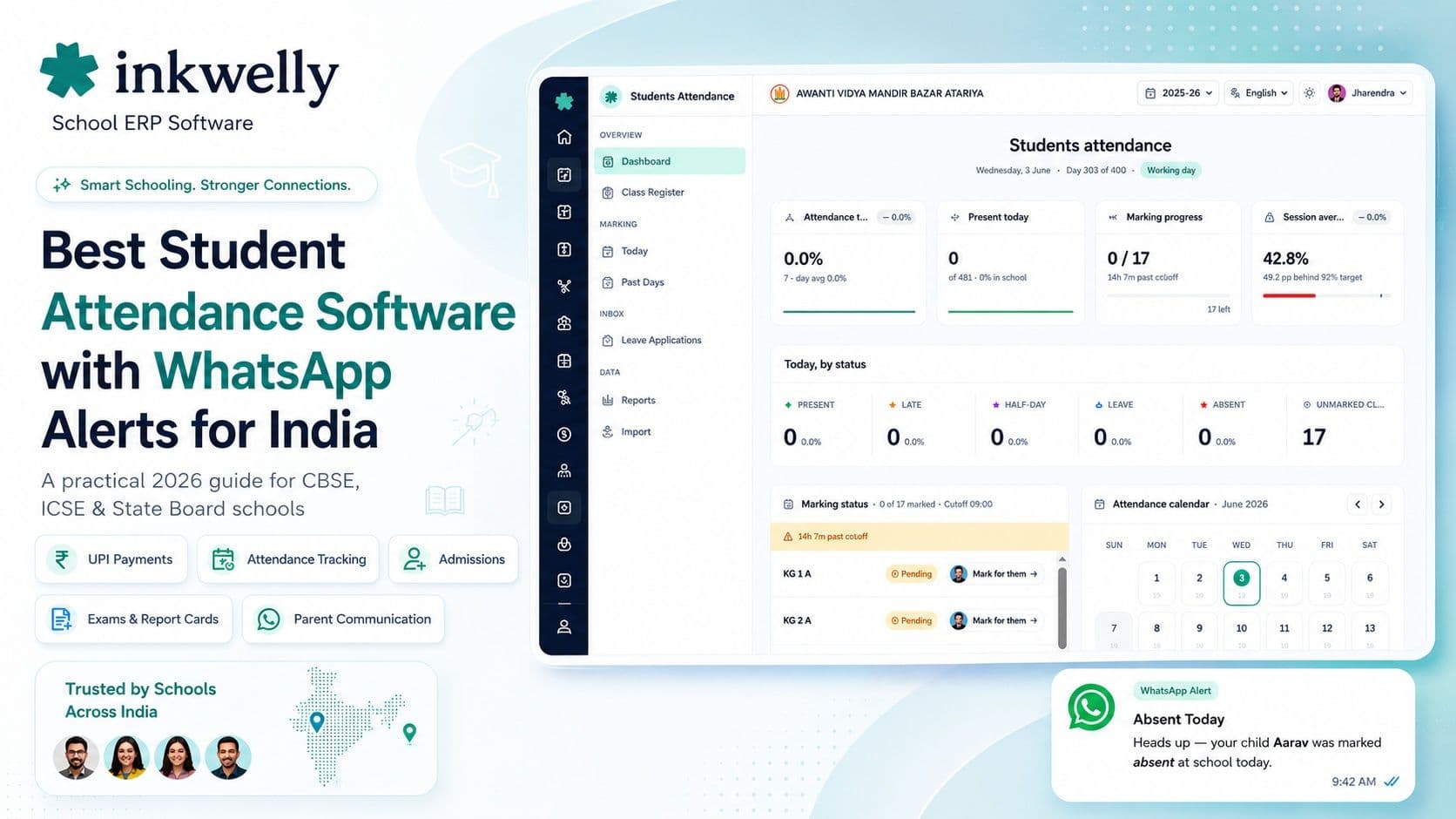
The class teacher of Grade 6 in a 700-student CBSE school in Pune used to fill the attendance register by 9:15 AM, hand it to the office, and watch it sit in a pile for two days before a parent received a phone call about their child's absence. By then, the student had skipped four more classes. Good attendance software solves this gap — not just by digitising the register, but by closing the loop with parents in real time. With over 400 million WhatsApp users in India, that loop now runs on a platform every parent already uses daily.
Student attendance software is not primarily a record-keeping tool — it is a parent communication tool with a record-keeping backend. The schools that see real improvements in attendance rates are the ones that treat the WhatsApp alert as the core feature, not a marketing add-on.
When evaluating attendance software, separate the core requirements from the nice-to-haves. Here is what matters for Indian school conditions.
- Mobile marking for teachers: Attendance must be markable from a phone, not just a desktop. Offline sync matters for schools with patchy morning internet — the app should queue marks and upload when connectivity returns.
- Period-wise and subject-wise tracking: CBSE schools must track period-wise attendance for the 75% compliance calculation. A system that records only daily presence is incomplete for Classes 9–12.
- Real-time WhatsApp alert to parent: The alert should go out within 60 seconds of the teacher marking an absence — not in a batch at 3 PM, which is too late to act on the same day.
- Low-attendance triggers: Automatic flags when a student drops below 75% or a threshold you define, alerting the class teacher, form teacher, and optionally the parent.
- Daily and monthly summary reports: Class-wise, section-wise, and student-wise summaries that export to Excel or PDF for CBSE UDISE+ and board reporting.
- Leave application and approval: Students via parents submit leave requests digitally; teachers approve, and the system adjusts the attendance record and compliance calculation automatically.
- Holiday calendar integration: Scheduled holidays, half-days, and school events should automatically exclude those dates from the denominator in attendance percentage calculations.
- Audit trail on edits: Once marked, attendance should not be editable without a visible record of who changed what and when. This matters for CBSE inspections and parent disputes.
The CBSE mandate requires 75% minimum attendance for a student to be eligible for board examinations — and most state boards have similar rules. A school with 1,200 students tracking 8 periods per day generates roughly 9,600 attendance entries daily. Software that runs cleanly at this scale, offline, with instant WhatsApp delivery, is a genuinely harder problem than the vendor pitch suggests. Attendance systems that look identical in a 100-student demo often break down at 1,000+ students under real daily load.
Ask these five questions in every attendance software demo:
-
Does the WhatsApp alert use the official WhatsApp Business API? API-based alerts through Meta-approved partners are reliable and template-approved. Workarounds using unofficial channels may work in a demo but fail at scale. Ask directly.
-
How many WhatsApp messages are included in the base price? WhatsApp Business API charges roughly ₹0.30–₹0.70 per template message in India. A 500-parent school sending daily absence alerts uses approximately 750–1,500 messages/month. Confirm whether this is bundled or billed extra.
-
Can teachers mark attendance offline? Schools in Tier-2 and Tier-3 towns frequently have patchy morning connectivity. If the teacher app requires live internet to mark attendance, expect daily failures and gaps in your records. Offline sync is not optional — it is baseline.
-
Show me the 75% compliance report. Ask the vendor to generate the attendance percentage report for a class of 40 students over one month. If it takes more than 60 seconds during the demo, it is not production-ready for a large school.
-
What happens when a teacher marks an absence incorrectly? The correction workflow must be auditable — logged with who changed what and when, with a reason required. A system that allows silent edits is a compliance risk.
Most full-featured school ERPs include a student attendance module. Names you will encounter include Fedena, Entab (CampusCare), MyClassboard, Campus 365, Teachmint, and Edunext. Dedicated attendance tools and WhatsApp automation platforms also exist as standalone options. The gap between them is usually in WhatsApp API quality, offline marking reliability, and period-wise tracking depth. Standalone tools are typically cheaper but do not connect to the fee ledger, timetable, or report card — meaning you end up maintaining two systems for data that should be in one.
What schools should budget for attendance software in 2026:
As part of a full school ERP: Bundled at no extra charge. At ₹50,000–₹1,50,000/year for a 500–1,000 student school, attendance is one of 8–12 included modules.
Standalone attendance app: ₹5,000–₹20,000/year for basic marking and reporting. Add WhatsApp API integration and the cost typically doubles.
WhatsApp Business API message costs: ₹0.30–₹0.70 per template message. A 500-student school averaging 50 absences/day over 200 school days uses around 10,000 messages/year, which equals ₹3,000–₹7,000/year in API charges. This is separate from the ERP subscription and is the most common surprise in year two.
Fedena and Entab typically cost ₹35,000–₹60,000+/year inclusive of attendance, with WhatsApp priced as a separate add-on. Cloud-first platforms increasingly bundle WhatsApp message packs in the base subscription.
Inkwelly's student attendance module supports period-wise and daily marking from a mobile app with offline sync. WhatsApp alerts go out via the official WhatsApp Business API within 60 seconds of an absence mark. Low-attendance warnings trigger automatically at the threshold you configure, alerting the student's parents directly. The 75% compliance report exports in one click. Attendance data feeds directly into the report card, timetable, and leave management — no manual data bridging between systems.
“The schools that reduced chronic absenteeism the most were not the ones with the most complex software — they were the ones whose parents received a message before lunch.”
Student attendance is one of the first things a school should get right in a new ERP — not because it is the most complex feature, but because it directly affects student outcomes and parents notice immediately. The WhatsApp alert quality is the clearest signal of how well-built the rest of the system is. If the alert is unreliable, delayed, or missing half the time, the underlying data probably has the same problem. Test it live in the demo: mark an absence and time how long the parent notification takes.
See live attendance marking and WhatsApp alerts in Inkwelly
Frequently asked
7 questionsHow does WhatsApp attendance notification work for schools?
When a teacher marks a student absent in the ERP app, the system triggers a WhatsApp template message via the official WhatsApp Business API to the student's registered parent number. Well-integrated systems deliver this within 30–60 seconds. The message includes the student's name, class, section, and the period or date of absence.
What is the 75% attendance rule for CBSE schools?
CBSE requires students to maintain a minimum of 75% attendance to be eligible for board examinations. Schools must track period-wise attendance for Classes 9–12 and report to CBSE. Students below 75% receive a formal warning and parents are notified — both of which good attendance software automates.
Can teachers mark student attendance offline?
Yes, in systems that support offline sync. The teacher app stores marks locally and uploads them when connectivity returns. For schools in Tier-2 or Tier-3 towns with patchy morning internet, offline sync is essential — without it, attendance records have gaps that affect board compliance calculations.
How do schools track attendance for 1,000+ students daily?
Period-wise marking is distributed across teachers, each marking their own class. The system aggregates centrally. At scale, the critical requirements are a fast mobile marking interface (under two taps per student), offline sync, and automatic prevention of duplicate entries.
What is the best free attendance app for schools in India?
Most free attendance tools cap at 50–100 students and do not include WhatsApp alerts via the official API. For full-school use with reliable parent notifications, paid plans starting at ₹12,000–₹15,000/year are available and include WhatsApp integration. Free tools typically monetise through per-message charges or limited features.
How much does student attendance software cost in India?
As a standalone tool: ₹5,000–₹20,000/year. As part of a full school ERP (recommended): bundled at no extra cost. WhatsApp API message charges add ₹3,000–₹10,000/year depending on school size and absence rates. Fedena and Entab charge ₹35,000–₹60,000+/year for the full ERP inclusive of attendance.
Does attendance software connect to report cards and timetable?
It should — but not all do. In a fully integrated ERP, attendance feeds directly into the student's report card (attendance percentage printed automatically), into the timetable (for period-wise tracking), and into leave management (approved leaves adjust the compliance calculation). Standalone attendance tools do not have these connections.
You might also like
3 readsSee Inkwelly on your school
30-minute demo. We open your current ERP with you and load your data into Inkwelly on the call. Dated go-live plan by the end of it.