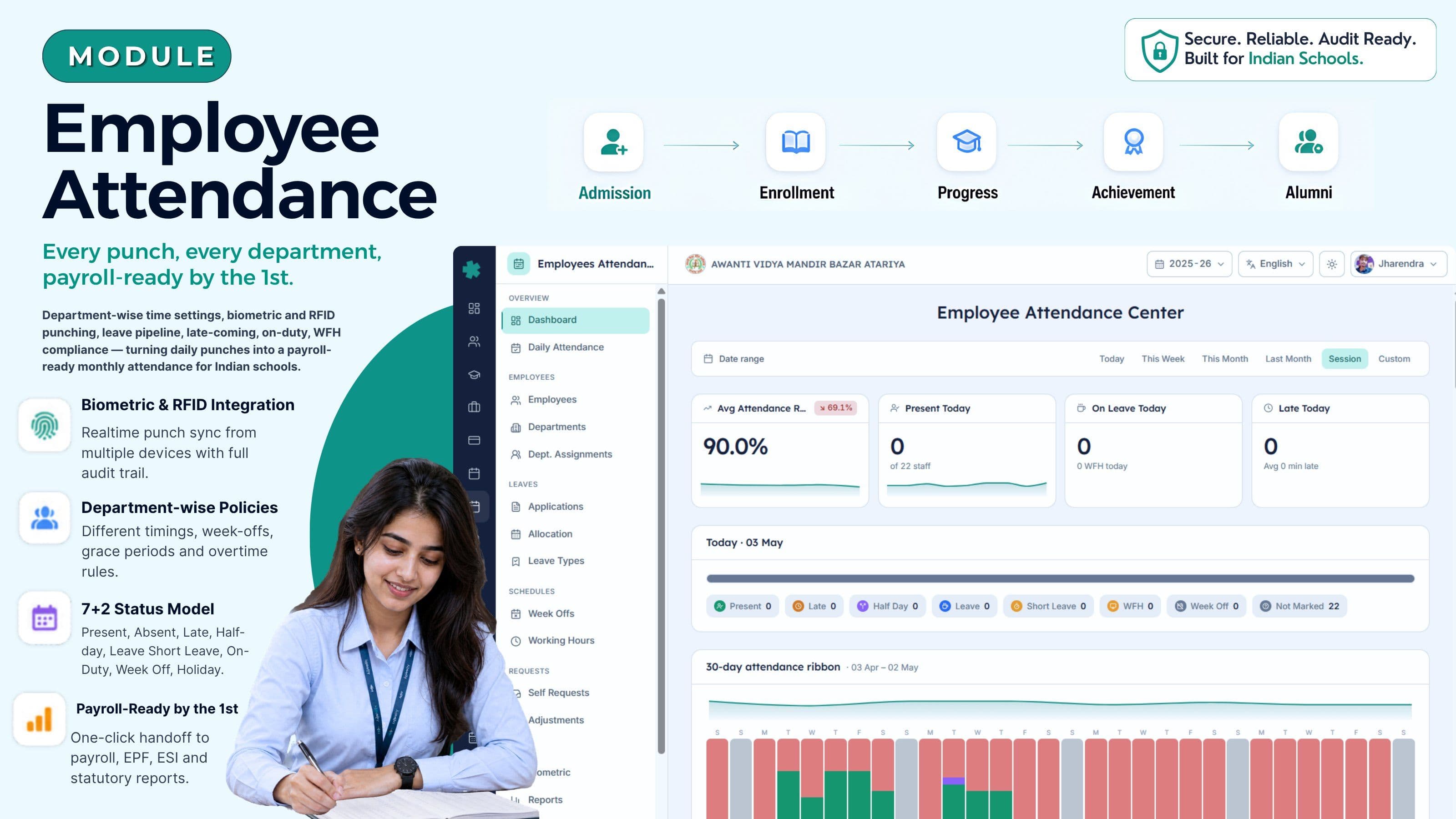
Every punch, every department, payroll-ready by the 1st. payroll-ready by the 1st.
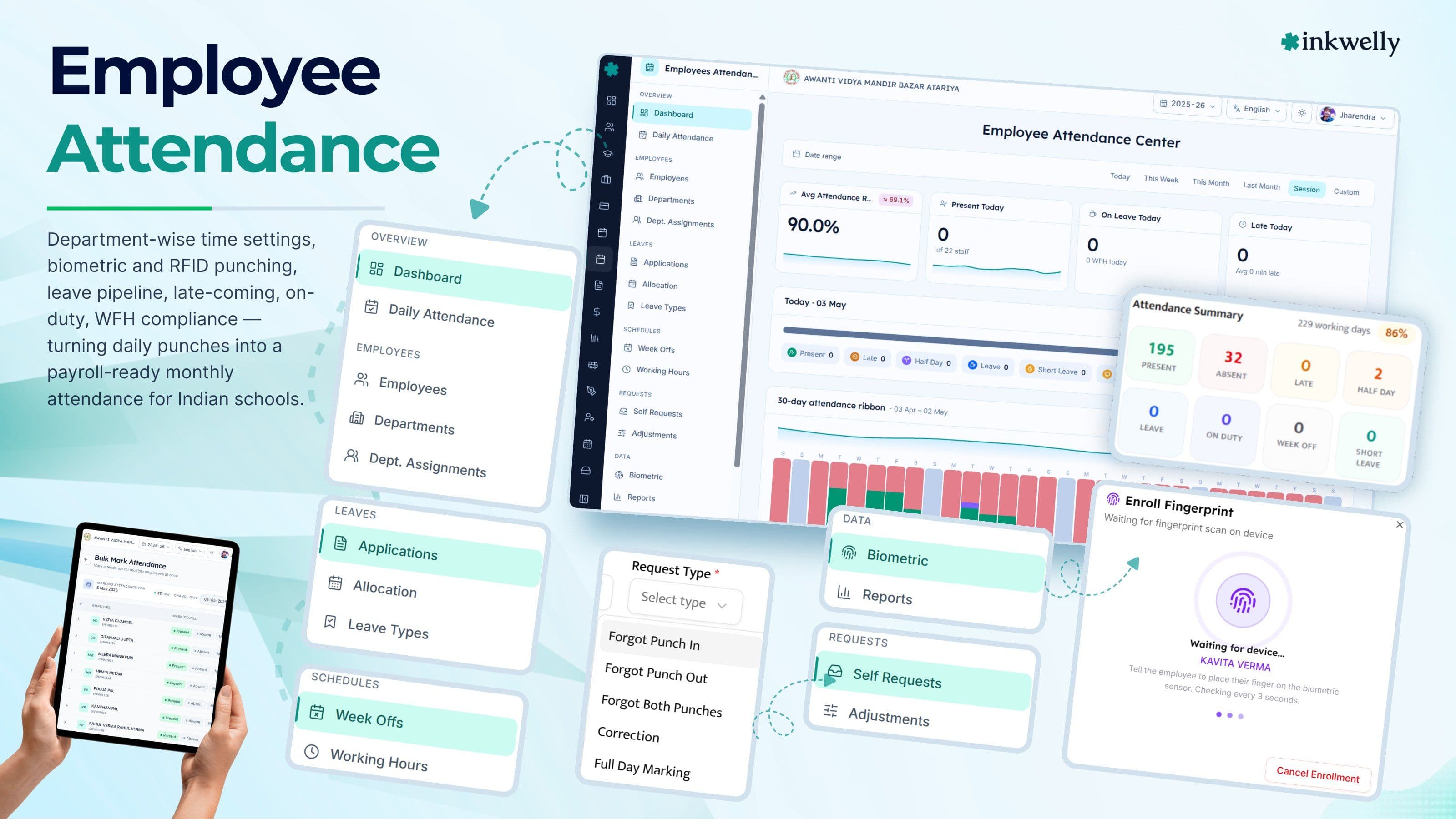
Department-wise time settings, biometric and RFID punching, week-offs, late-coming, half-day, on-duty, leave pipeline and WfH compliance — turning daily punches into a payroll-ready monthly attendance for Indian schools.
How most Indian schools track staff attendance today
At 7:50 a.m. the senior PRT teacher signs the register at the gate. The PT teacher signs at 7:52. The Mathematics PGT signs at 7:56. By 8:00 the register has 38 signatures; the rest of the 64-strong staff are still on the way. The peon writes 'L' against the late-comers in red ink — except for the head clerk's wife, who has been with the school for nineteen years. The biometric machine at the office has been broken since Holi; the school is back on the paper register. By month-end the head clerk transcribes the register into an Excel sheet — working days, present days, leaves, late-comings — and emails it to the accountant for payroll.
The accountant runs salary on the 5th of every month. He flags discrepancies on the 3rd. The principal's PA chases corrections from the staff on the 4th. The peon goes back to the register, which is now in the head clerk's house, and brings it back. The TGT teacher who was on EL for four days in the second week disputes the calculation — her LTC chit was never reached the head clerk. The PT teacher who was on-duty for the inter-school cricket for three days finds those marked absent. By the 7th the salary is paid, with three corrections still pending. The whole month, every month.
The cost is not the four days of payroll dispute. The cost is the EPFO 14B notice when the working-days computation does not match the ECR you filed. The ESIC inspection that asks for September's attendance and the head clerk cannot find the register. The senior PGT who leaves and tells four other teachers that 'this school doesn't even pay correct salary'. The teacher's union meeting after a leave dispute. The CBSE renewal that is delayed because pupil-teacher ratio cannot be substantiated with a current attendance register. Staff attendance is not paperwork — it is the foundation of payroll, of statutory compliance, of teacher trust, of board recognition.
What we built instead
Inkwelly's Employee Attendance module is department-wise time policy + biometric / RFID punching + leave pipeline + WfH compliance + payroll-ready monthly attendance — every working day, every staff member, every department, every status, with full audit and a one-click handoff to payroll.
It understands that an Indian school is not one department. The Teaching department arrives at 7:45 and leaves at 2:30. The Office department is 9:00 to 5:00. The Transport department is 6:00 to 9:00 and 1:00 to 4:00 — split shift. The Cleaning staff is 6:00 to 10:00. The Security is round-the-clock in three shifts. Each has different in-time, late-coming threshold, half-day windows, week-off rule, overtime rule, grace period. We modelled all of it as department time settings — configured once, applied every day.
It understands that biometric is the truth, but biometric is not the whole truth. The fingerprint device captures a punch when the staff member arrives. It does not capture that the PGT teacher was on-duty at the inter-school debate. It does not capture the TGT who is on approved sick leave. It does not capture the head clerk who took two periods short-leave for a doctor visit. We capture every status — Present, Absent, Late, Half-day, Leave, Short Leave, On-Duty, Week Off, Holiday — with biometric punches as one source among four (manual, biometric, portal, admin), reconciled with audit trail.
It understands that the destination is payroll. The 1st of every month, the payroll module pulls the previous month's working days, present days, paid leaves, unpaid leaves, late-coming counts, half-day counts, overtime hours, and computes salary, EPF, ESI, TDS, professional tax, and the ECR file for EPFO. The bridge between attendance and payroll is one click — not a head-clerk Excel transcription that introduces three errors per cycle.
Highlights
- Department-wise time settings — Teaching, Office, Transport, Cleaning, Security — each with its own in-time, out-time, late-coming threshold, half-day windows, grace period, overtime rule.
- 7+2-status attendance model — Present, Absent, Late, Half-day, Leave, Short Leave, On-Duty, Week Off, Holiday — covering every working-day reality of an Indian school staff member.
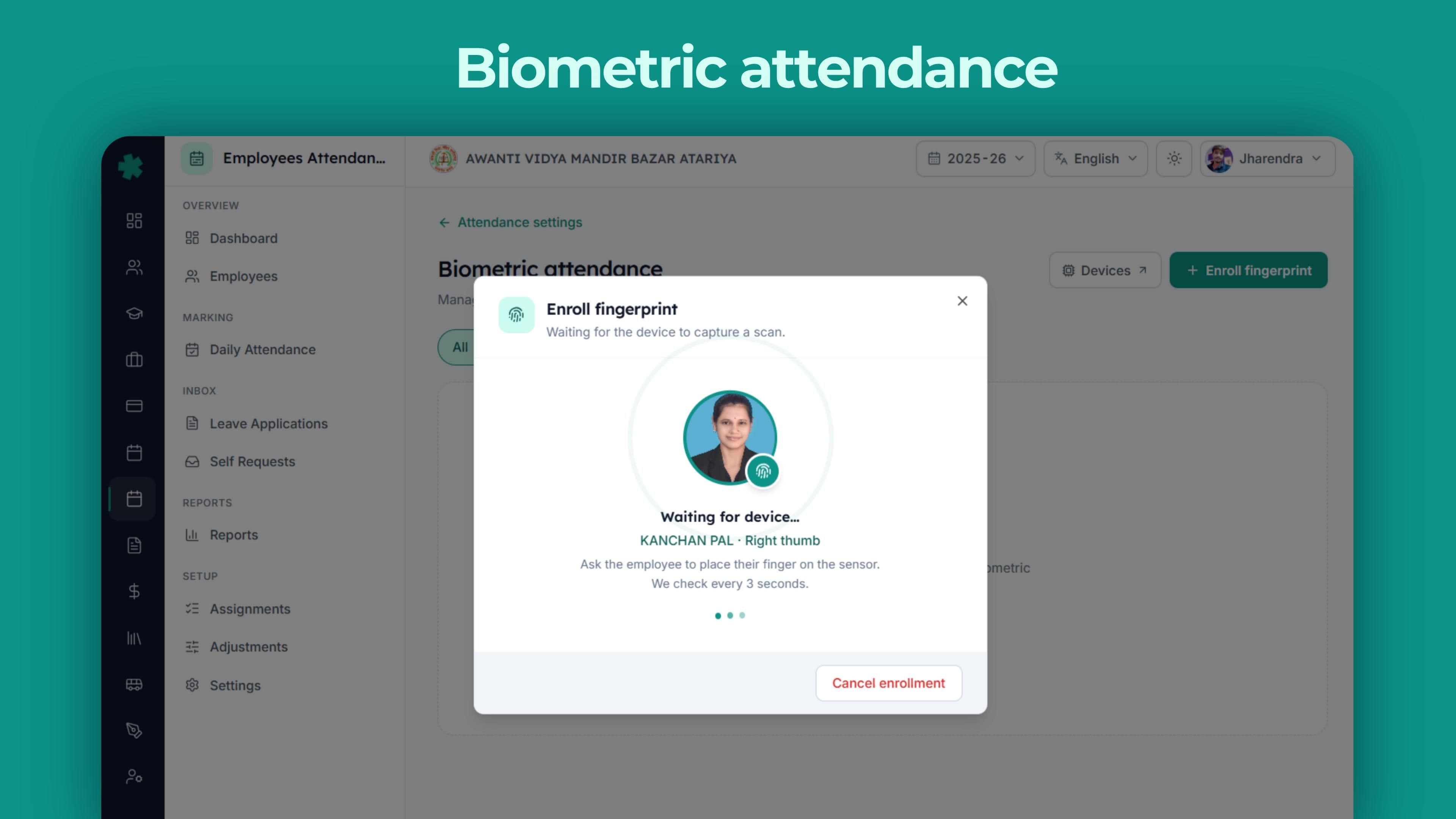
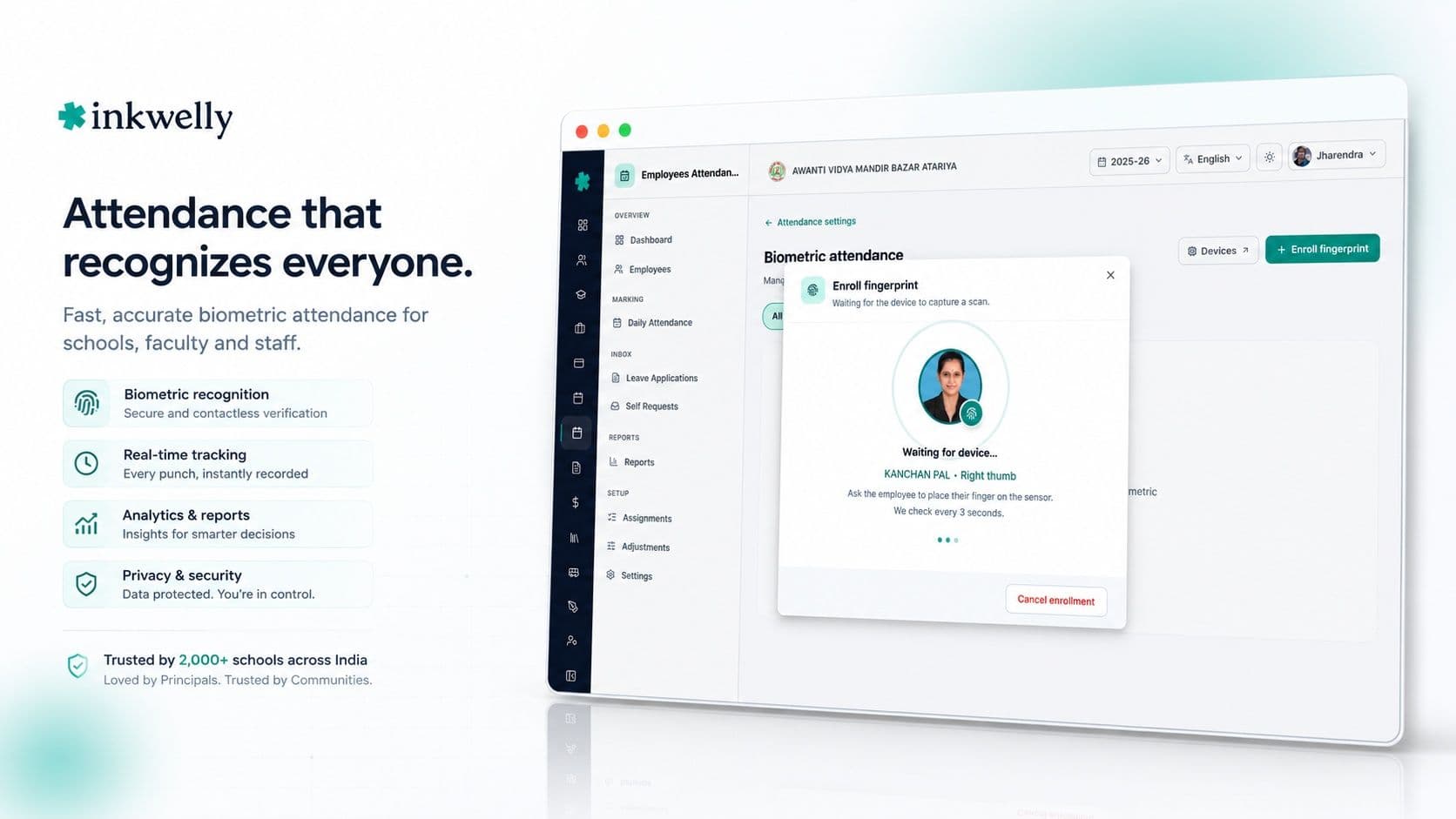
- Biometric and RFID punch ingestion — Realtime, eSSL, ZKTeco, Matrix, Mantra device adapters; punches stream in every 5–10 minutes; punch integrity checks flag missing-out-punch and duplicate-in-punch.
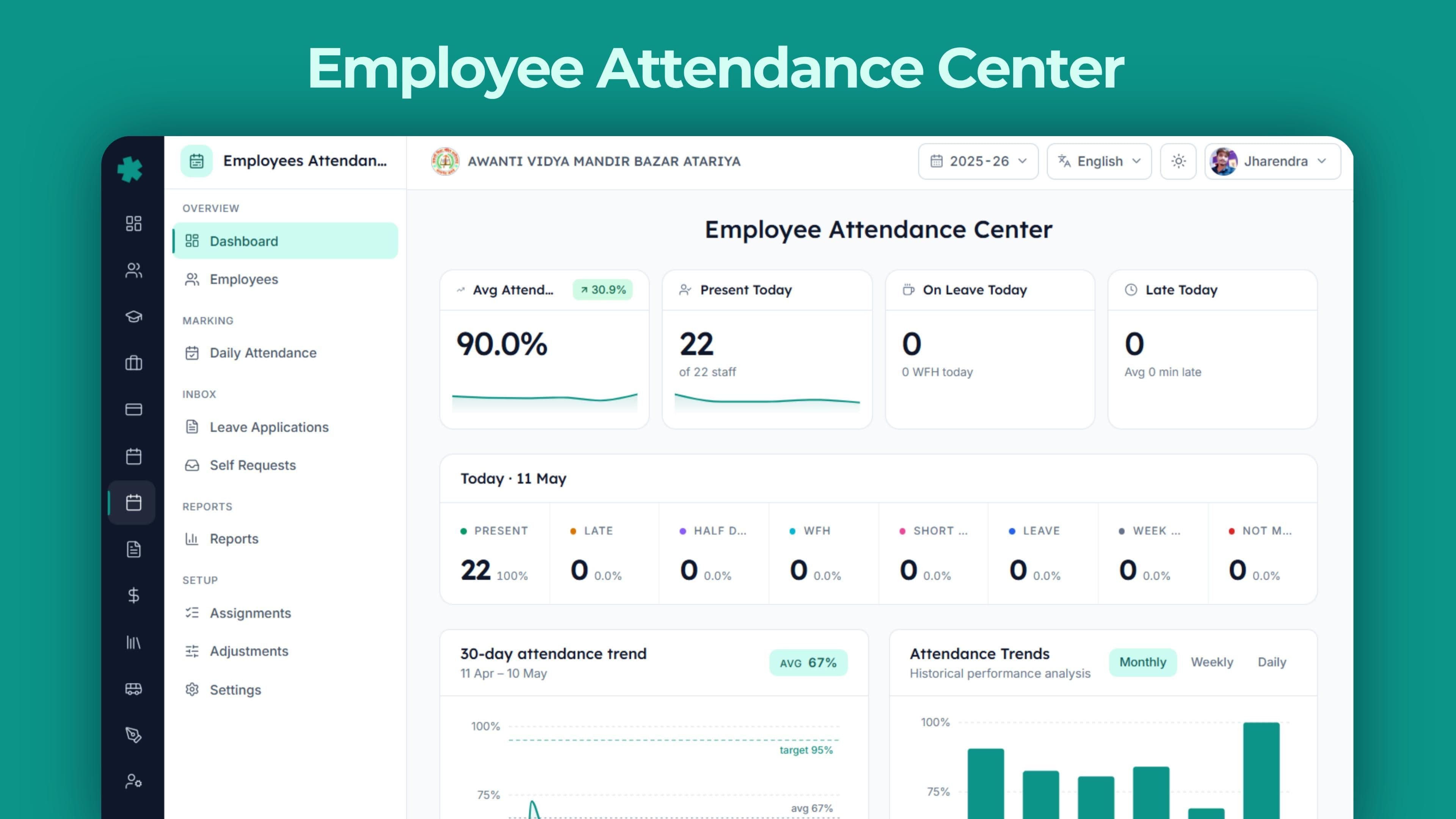
- Today ribbon and 30-day ribbon — today's department status at a glance plus a rolling 30-day attendance ribbon showing patterns the principal can see in seconds.
- Punch integrity card — missing in, missing out, duplicate, anomaly count per department per day; surfaced for office reconciliation.
- Late-coming analysis — every department's late-coming count, average late minutes, repeat offenders, configurable threshold for HR action.
- Working-hours card — actual hours vs expected hours per employee; overtime auto-computed; minimum hours for full-day / half-day enforced.
- Week-off configuration — per department or per employee; supports first/second/third/fourth/last Saturday models; auto-applied no manual entry.
- Leave pipeline — every leave application from request to approval to attendance impact; CL, EL, ML, LWP, RH, paternity, maternity — every leave type Indian schools offer.
- WfH compliance — work-from-home policy enforcement, daily WfH check-ins, productivity flag, separate from in-school presence.
- Self-requests — staff portal self-service for missed-punch correction, leave application, WfH request — with audit and approval workflow.
- Governance panel — every policy violation, attendance exception, audit alert, in one principal-readable panel for daily review.
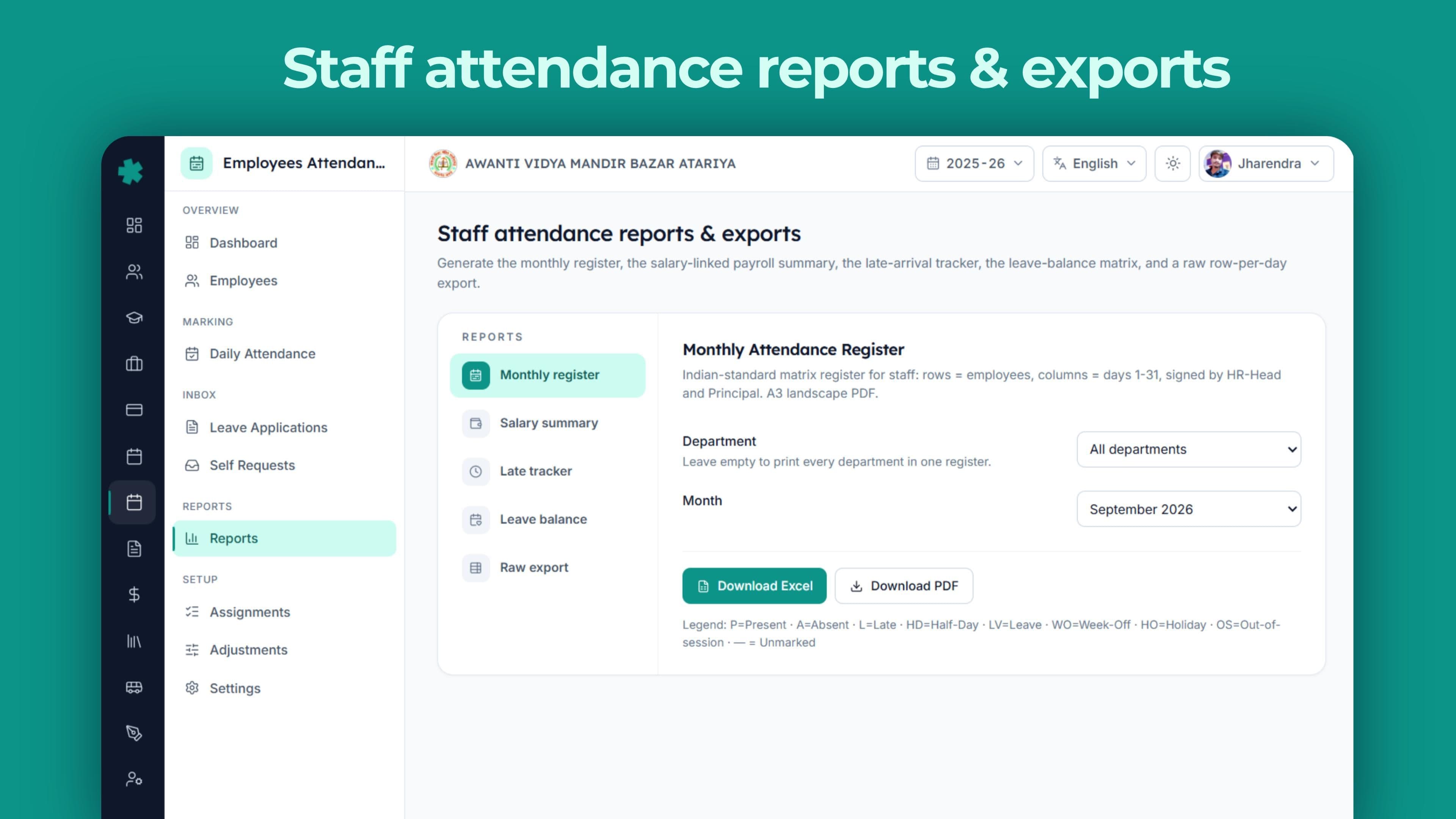
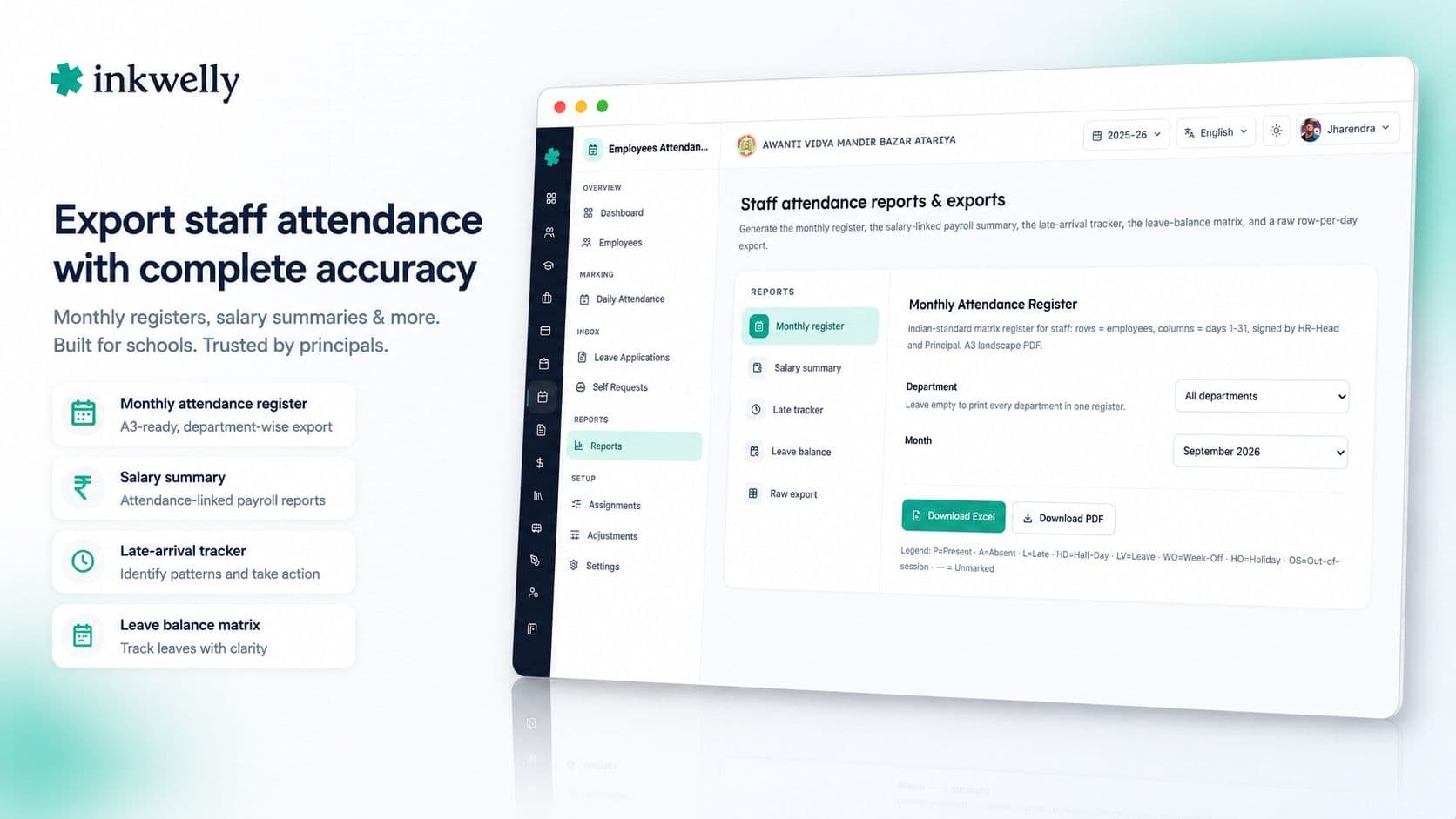
- Payroll-ready monthly export — working days, present days, paid/unpaid leaves, late count, half-day count, overtime hours — in the format Inkwelly Payroll needs.
See the product
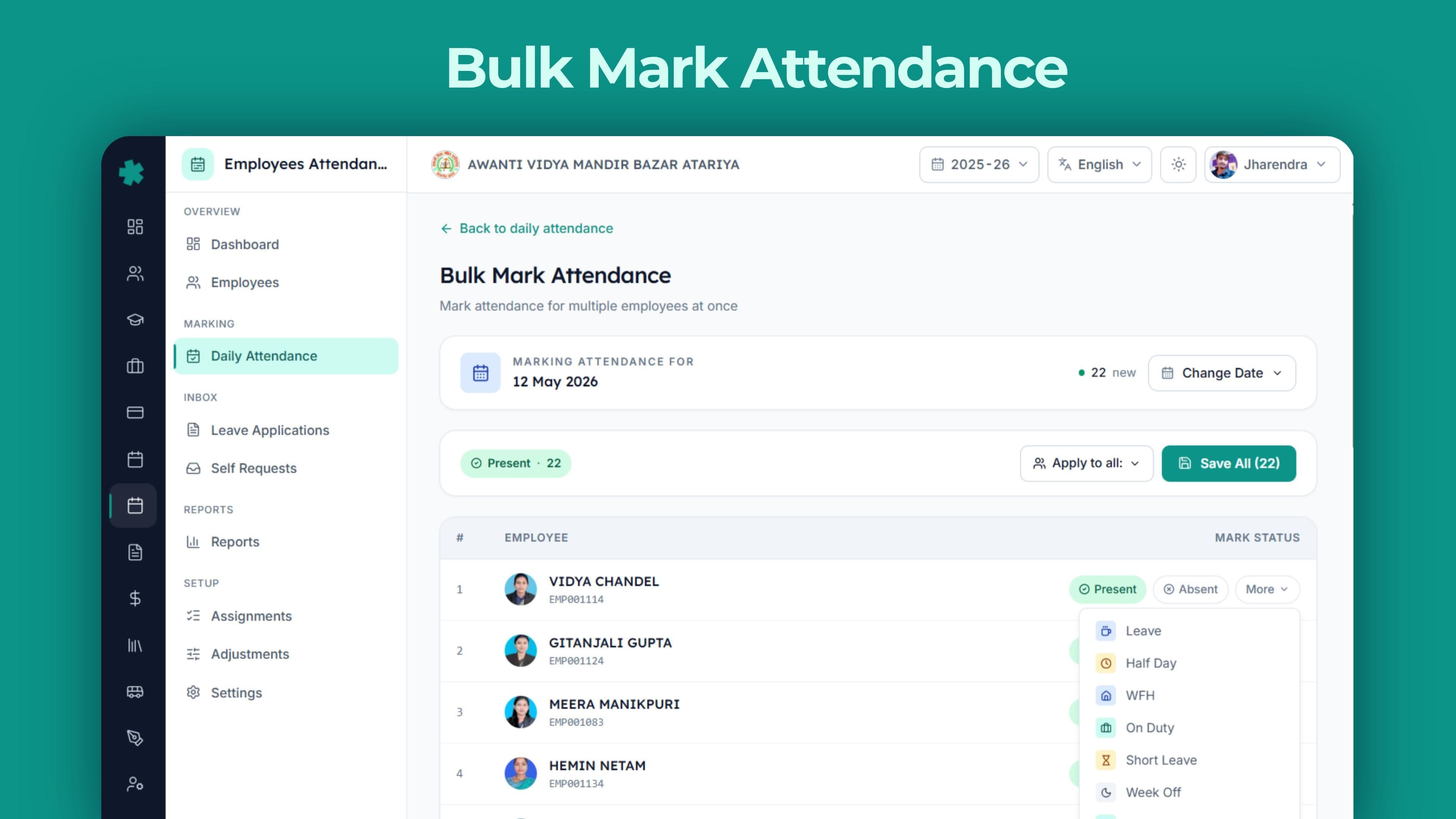
Department time settings — the foundation
A school is not one department running on one schedule. Teaching staff arrive at 7:45 because the assembly is at 7:55 and the first period at 8:00. Office staff arrive at 9:00 because parents start walking in at 9:30. The transport department's drivers and conductors arrive at 6:00 because the buses leave by 6:30. Each has a different definition of late, of half-day, of when punching is allowed, of grace period.
We modelled department time settings as the first-class concept that governs everything downstream. Each department has its in-time (the official start), late-coming time (after which Late status applies), out-time (official end), half-day windows (when arrival or early departure becomes half-day), punch-not-allowed-before / after (so a teacher who punches at 5 a.m. is rejected), full-day-absent-after (the cut-off at which an unmarked employee is auto-marked Absent), grace period (minutes of late tolerance before late count increments), overtime start, overtime cap, minimum-hours-for-full-day and minimum-hours-for-half-day. Every value is configurable, audited on change, and applied to every employee assigned to that department — no per-employee retyping.
In-time / Out-time
Official department start and end. Teaching might be 7:45/2:30; Office 9:00/5:00; Transport split-shift 6:00–9:00 + 1:00–4:00. Drives every downstream calc.
Late-coming time
After this, Late status applies. Configurable per department; typically 8:00 for teaching, 9:15 for office. Repeat-offender threshold drives HR action.
Half-day windows
Half-day-enter-after (e.g., 10:30) and half-day-leave-before (e.g., 12:30) trigger automatic half-day status if punch falls in either window.
Punch not allowed
A teacher trying to punch at 5 a.m. or 11 p.m. is rejected; protects against accidental double-punch and biometric error windows.
Full-day absent after
If no punch by, say, 10:30, the employee is auto-marked Absent. Surfaces the absence to the principal; teacher cannot retro-mark without admin override.
Grace period
Minutes of late tolerance before late count increments. Typically 5–10 minutes; some schools 15. Honours the 'one minute late is not late' culture, with audit.
Overtime rule
Overtime starts after a set threshold (e.g., 30 minutes past out-time); capped per day; flows to [payroll](/modules/employee-payroll) for honorarium calculation.
Min hours for full-day / half-day
If actual hours < min-full-day, status drops to half-day; if < min-half-day, drops to absent. Safeguards against 'arrived and left in 30 minutes' edge cases.
Biometric and RFID — the truth, with caveats
Most Indian schools have a biometric or RFID device at the staff entrance. Realtime, eSSL, ZKTeco, Matrix, Mantra are the popular brands. They capture a punch when the staff member's fingerprint or RFID card is recognised. The data sits in the device until the head clerk downloads it once a month — in the cheap setup. In the better setup, the device pushes punches to a server every few minutes.
We ingest punches from any of these devices via published adapters. Punches stream in every 5–10 minutes (or batch every hour, configurable). Each punch is assigned to the right department's policy. Late, half-day, full-day are derived. Missing punches — punched in but not out, or out but not in — are flagged on the punch integrity card for office reconciliation. Duplicate punches — two in-punches without an out — are merged with audit trail. Anomalies — a punch from a different geofence (relevant for multi-campus schools) — are flagged. Biometric is the truth; we make it the right truth.
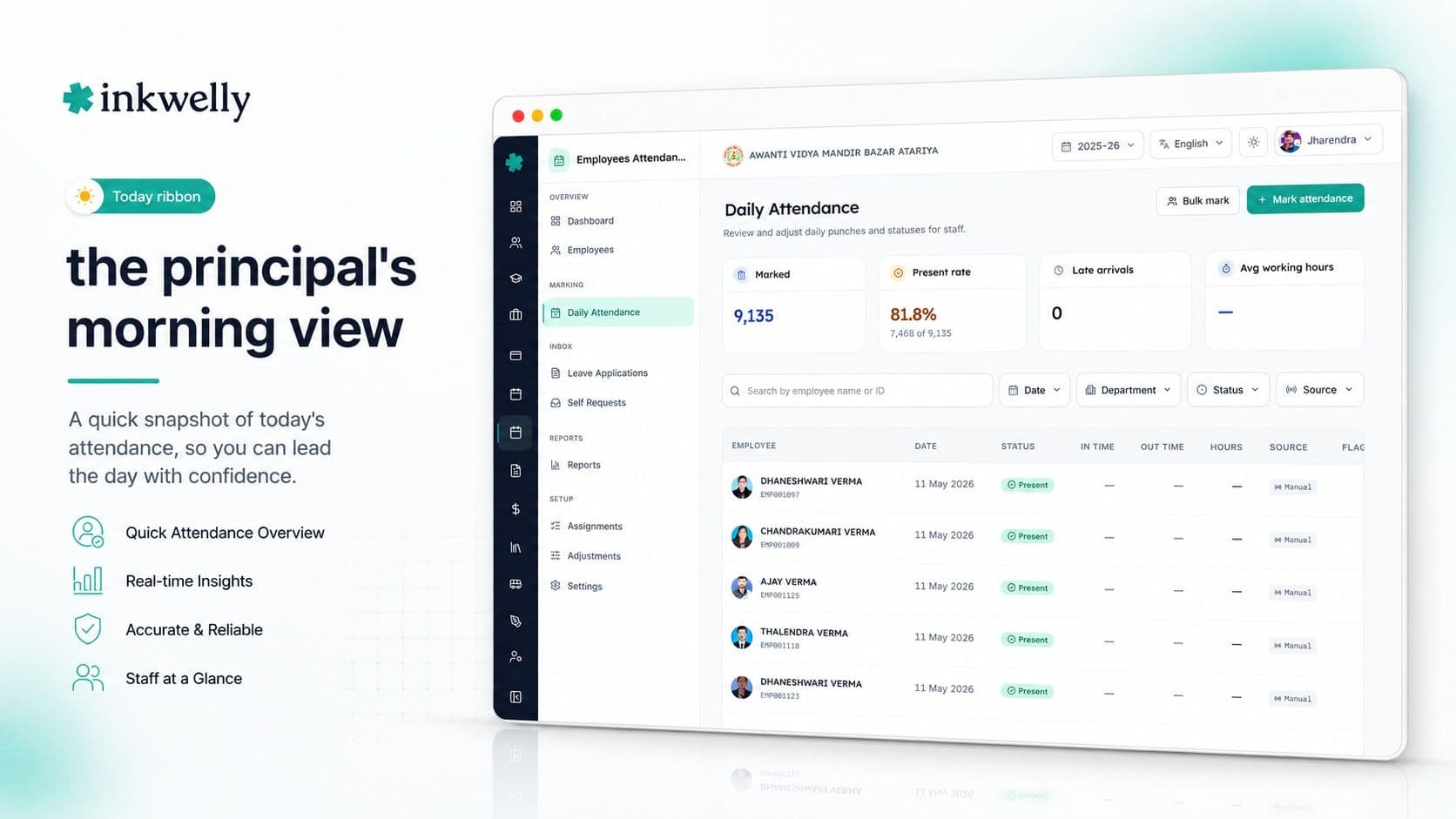
Today ribbon — the principal's morning view
At 9:00 a.m. the principal opens the Employee Attendance dashboard. The today ribbon shows every department — Teaching 56/64 punched, Office 9/12, Transport 8/8, Cleaning 6/6, Security 3/3 — colour-coded green/amber/red. She sees that 8 teaching staff have not punched yet; one click drills into the list — Mrs. Sharma (TGT, on EL approved), Mr. Khan (PRT, no record), Mrs. Verma (PGT, late by tradition), 5 others.
She asks her PA to call Mr. Khan. By 9:15 he replies — vehicle breakdown, will be in by 10. The PA records a self-request on his behalf; the system creates a missed-punch entry pending principal approval. By 9:20, every staff member is accounted for, the principal has actionable information, and the attendance for the day is on its way to being clean.
30-day ribbon — patterns the principal sees in seconds
A single day is a data point. Thirty days is a pattern. The 30-day attendance ribbon shows every working day for the last month as a coloured cell per department; teaching department's row, then office, then transport, on down. A week of red cells in teaching means systemic late-coming; the principal acts. A streak of half-day cells in transport means the bus driver is splitting shifts incorrectly; she investigates.
Patterns the principal would never have seen in a register suddenly become obvious. Most schools find one or two systemic issues in their first month — the first month already pays for the system. We add anomaly detection on top: a sudden 30% drop in a department flags as alert; a single employee's late-coming streak crossing 5 days flags HR review.
Punch integrity — missing, duplicate, anomaly
Biometric data is rarely clean. The teacher punches in at 7:42 but forgets to punch out and walks home. The substitute teacher uses the principal's card by mistake. The biometric device's clock drifts by 4 minutes after a power cut. The RFID gate misreads on a wet day and creates a duplicate punch.
Inkwelly's punch integrity card surfaces every issue: missing-out-punches, missing-in-punches, duplicate punches within a 2-minute window, out-of-window punches. The office sees a daily count; one click drills into the offending records. Resolutions are audit-logged — 'auto-closed at out-time', 'merged duplicate', 'no out-punch, marked half-day'. Most schools are surprised by how clean their data becomes after one month of integrity reconciliation.
Late-coming analysis — the conversation HR has been avoiding
Every school has a few teachers who arrive at 8:05 every day, against a 7:45 in-time. The head clerk knows. The principal sometimes knows. The discussion is uncomfortable. Most schools never have it.
Inkwelly surfaces the data. Late-coming count by department, by employee, by week. Average late minutes. Repeat offenders — staff who have been late more than 4 times in a month, or have crossed the school's tolerance threshold. The principal walks into the conversation with a screen, not an anecdote. 'Mrs. Verma, in October you were late on 12 of 22 working days, average 14 minutes. Let's understand why.' Most repeat offenders correct within a month. Some accept a salary deduction policy. The conversation finally gets had — with data, not bias.
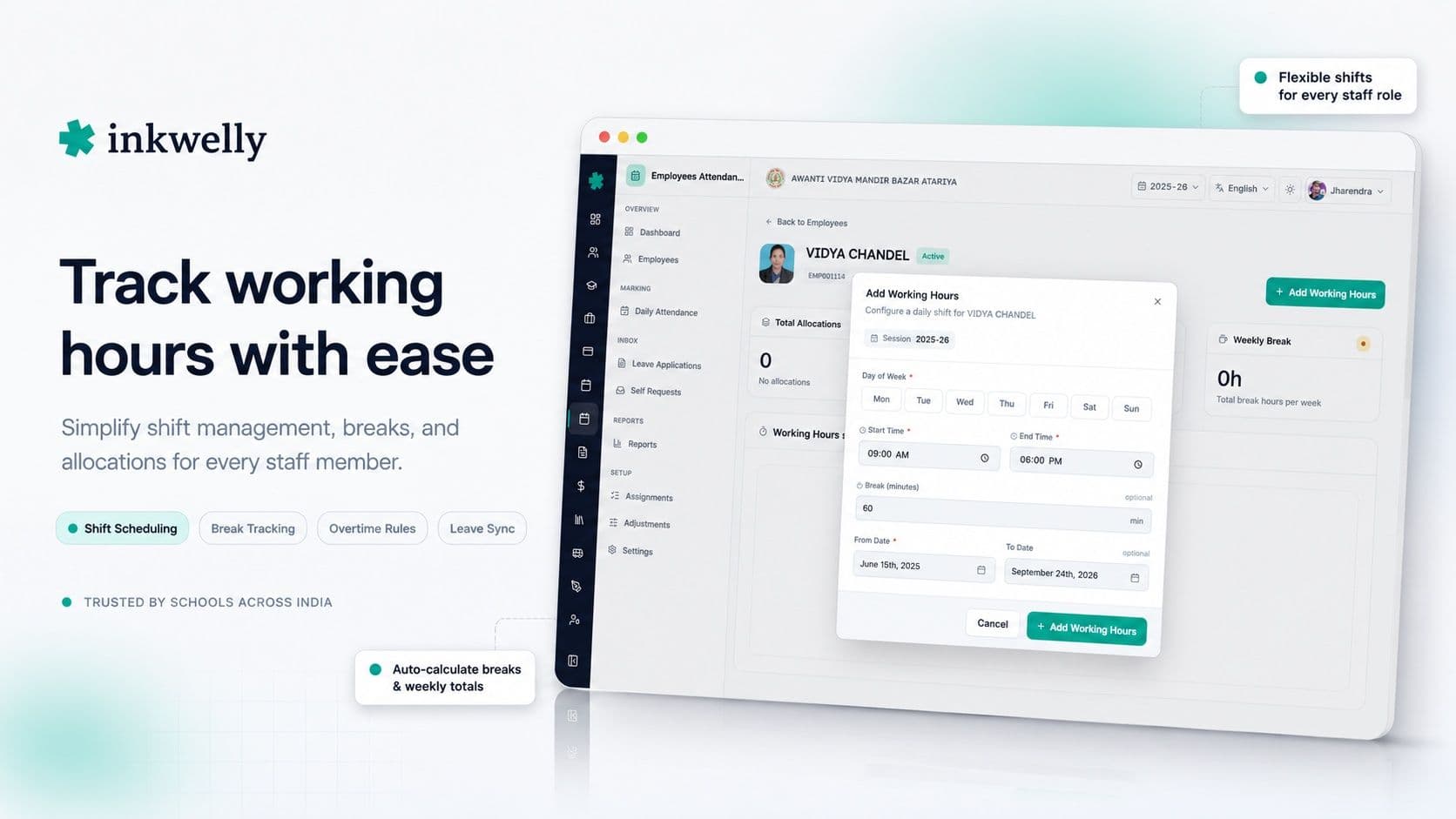
Working hours — actual vs expected
A school day is not 7:45 to 2:30 for everyone. The teaching department teaches 6 periods; the lab assistant prepares for the science practical; the librarian stays an extra hour for the senior school's free period. Each department has expected hours; each employee has actual hours from punches. The working hours card surfaces the difference.
Overtime is auto-computed based on the department's overtime rule — typically 30 minutes past out-time, capped at 2 hours per day. Honorarium for overtime flows to payroll. Minimum-hours-for-full-day enforces that an employee who arrived and left within 90 minutes does not count as a full day for salary. Minimum-hours-for-half-day enforces a similar floor for half-day. Edge cases that used to start payroll disputes now have a deterministic answer.
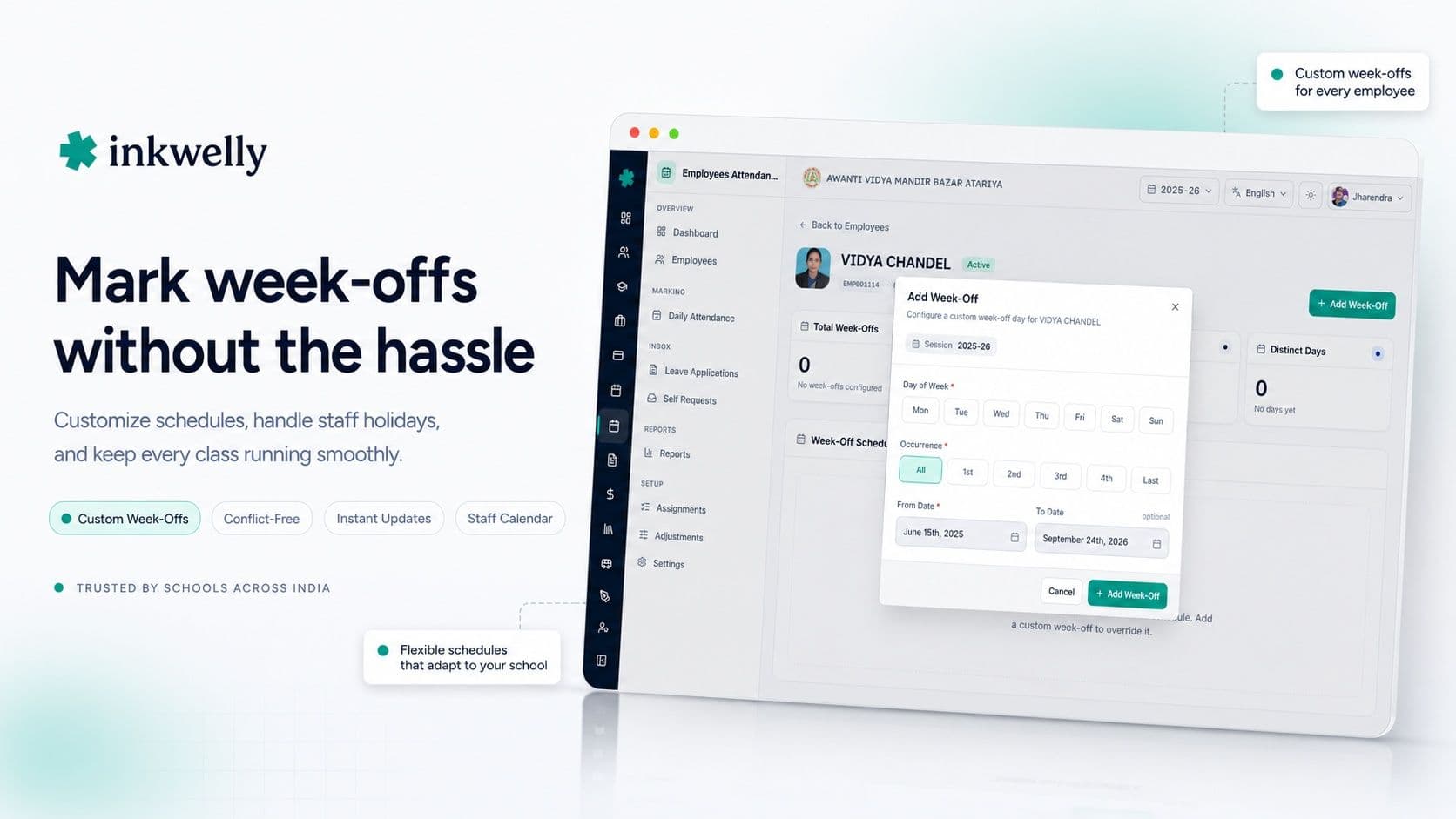
Week-offs — the Saturday rule, encoded once
Sundays are off. Saturdays are… complicated. Some schools have all Saturdays off. Many have second and fourth Saturdays off. Some have first and third Saturdays half-day, second and fourth full off. State-board schools often follow the state government's holiday calendar. Each department might have its own rule — office staff working all Saturdays even when teaching has alternates off.
Inkwelly encodes the week-off rule per department or per employee. Day-of-week and day-type (ALL, FIRST, SECOND, THIRD, FOURTH, LAST) drive auto-application — second and fourth Saturday for teaching, all Sundays for everyone, first and third for office. Effective-from / effective-to dates support mid-year policy changes. The class teacher does not configure this; the system applies it every day. Working days computed against actual scheduled days, not calendar.
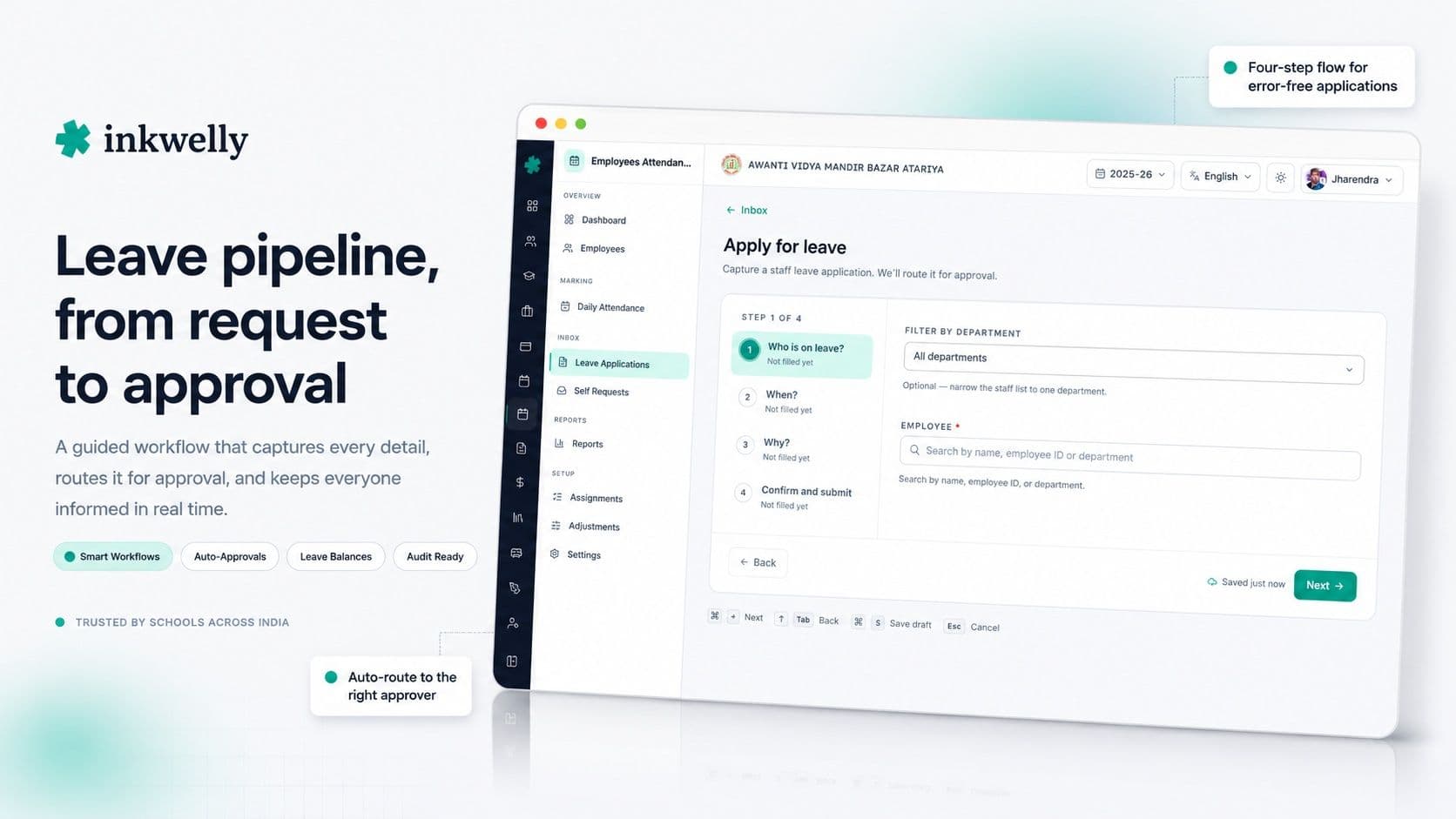
Leave pipeline — CL, EL, ML, LWP, RH, paternity, maternity
Indian school staff leave types are not what global HR tools assume. Casual Leave (CL) — typically 12 per year. Earned Leave (EL) — typically 15, encashable. Medical Leave (ML) — with medical certificate above 3 days. Leave Without Pay (LWP) — unpaid, with approval. Restricted Holiday (RH) — a list of optional festivals where employee picks 2 of 12. Paternity, maternity, compassionate. Each has its own entitlement, accrual, carry-forward, lapse rule.
Inkwelly's leave pipeline supports every leave type Indian schools offer. The employee submits a request from the self-service portal; the head of department or principal approves; on approval, the attendance status auto-flips to Leave on the right dates with the right type tag. EL is reduced from the leave balance; CL similarly; LWP marks the dates unpaid for payroll computation. Year-end accrual, carry-forward and encashment rules are encoded once.
Work-from-home compliance — since the pandemic, here to stay
Many schools introduced WfH for non-teaching staff during the pandemic and kept it for office, accounts, IT, and curriculum-development roles. The policy needs governance — daily check-ins, productivity flags, integration with the leave system so a sick day on a WfH day stays sick.
Inkwelly's WfH compliance card surfaces who is on WfH today, their check-in time, the work assignment confirmed for the day, and a productivity flag at end of day. The school's WfH policy — frequency cap (e.g., 2 days per week), advance approval required, role-eligibility (teaching staff typically excluded) — is encoded once and enforced. The head of department gets a daily summary of her team's WfH usage; the principal gets a school-level usage trend.
Self-service portal — staff fix their own attendance
Staff at /e/<id> can submit a missed-punch correction ("I forgot to punch out yesterday at 2:30"), a leave application, a WfH request, an on-duty declaration. The form captures the relevant evidence — a photo, a doctor's note, a school invitation. The head of department or office gets a notification, approves or rejects with reason, the attendance is updated.
The alternative — staff walking up to the head clerk every other day asking for an Excel correction — dies. Office staff stop being attendance bookkeepers. Teachers fix their own punches. Trust improves. Audit improves — every change has a reason, an approver, a timestamp, a device. The 5th-of-the-month payroll dispute conversation has 80% less material to argue about.
Governance panel — every policy violation in one place
A full-day-absent threshold breached. A WfH cap exceeded. A late-coming streak crossing 5 days. A duplicate punch unresolved. A leave application pending more than 24 hours. The governance panel surfaces every policy violation and attendance exception in a single principal-readable list, sorted by severity, dated, with the responsible department and the recommended action.
Most schools never had visibility into policy violations — they happened, they accumulated, they surfaced as disputes. Inkwelly turns the daily 5-minute governance review into a measurable habit. The principal walks into the staff meeting on Friday with concrete numbers — 'this week we had 12 missed-out punches, 7 in teaching department; 3 WfH cap breaches; 1 leave dispute carried over for 4 days'. The conversation is data-led.
“Pehle har 5 tareekh ko salary dispute hota tha. 4 teachers complain karte the. Inkwelly aane ke baad attendance 1 tareekh ko payroll mein chala jata hai. October 2025 se zero dispute. School ka mahaul hi badal gaya hai.”
Before and after Inkwelly Employee Attendance
Inkwelly vs generic school ERPs
Different people, same one register
Staff attendance means different things to the principal, the head of department, the head clerk, and the staff member. We built the same data to serve all four — with the right view for each.
Principal
Live school-wide attendance. Department-by-department breakdown. Today ribbon — every department's status. 30-day ribbon — patterns. Punch integrity — daily exceptions. Late-coming analysis — repeat offenders. Leave pipeline — pending approvals. WfH compliance — cap usage. Governance panel — every policy violation. Trends — 90-day, year-on-year. Pupil-Teacher Ratio (PTR) live, calculated against Student Information. Every signal a principal asks for, on screen.
Head of department / Coordinator
Her team only. Today's status — who has punched, who is on leave, who is on-duty. Her team's late-coming this week. Pending leave approvals from her team. WfH usage in her team — within or beyond cap. Her team's punch integrity exceptions. Direct approval/rejection on missed-punch and leave requests. Her team's monthly attendance, exportable for HR review. The HOD finally has the data to manage — not just the title.
Head clerk / Office staff
The heaviest user. Adjustments queue — missed-punch corrections, leave applications, on-duty declarations — to process daily. Punch integrity reconciliation — close out missing-out punches, merge duplicates. Department-wise monthly attendance preparation — the bridge to payroll. Biometric device health — last sync, missing logs, anomaly count. Leave allocation reset at year-end. Every action audit-logged, every record reversible, no data loss.
Staff member self-service
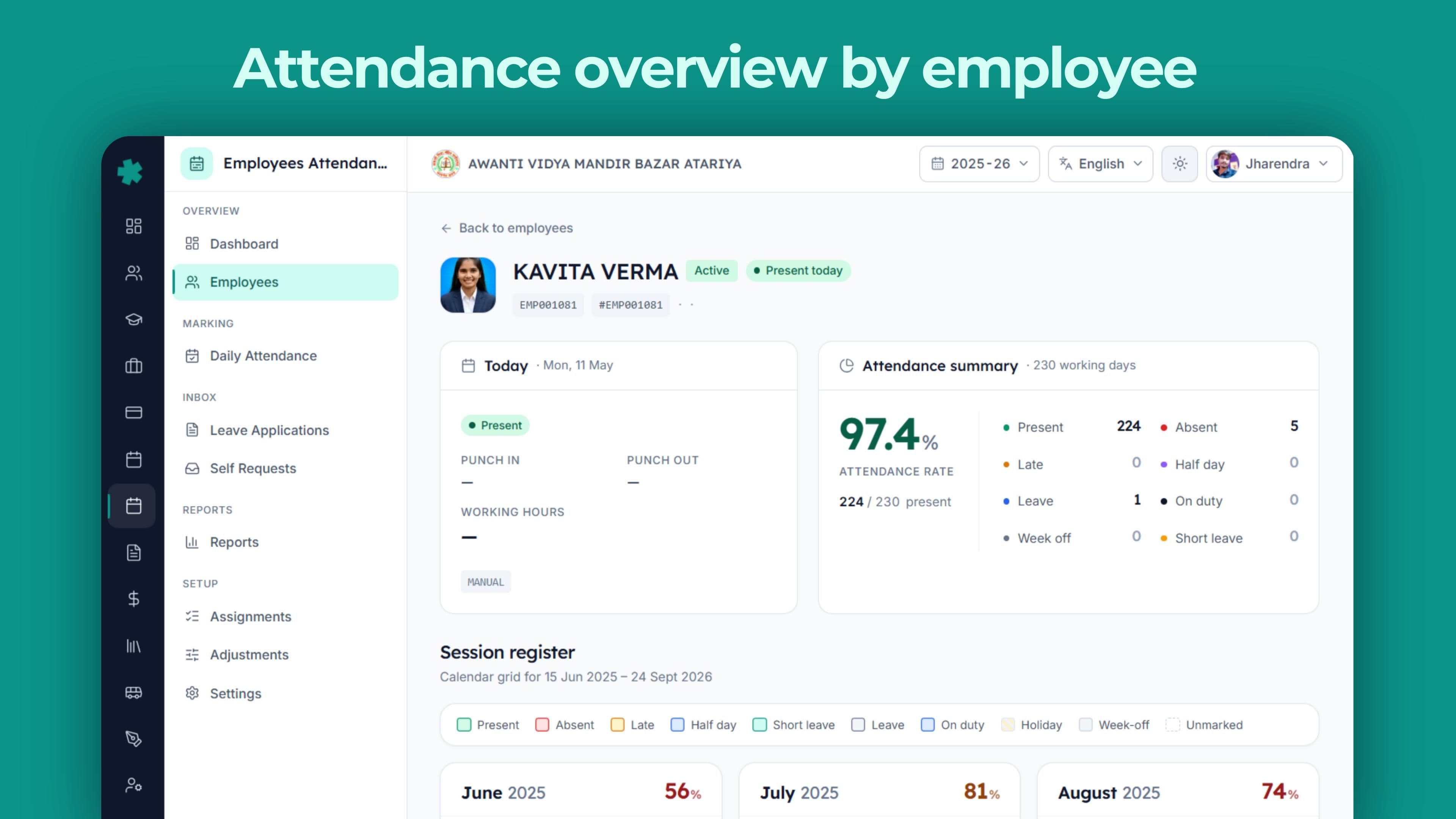
At /e/<id>, the teacher sees her own attendance summary — month-to-date, working days, present, late count, leave balance by type (CL, EL, ML, LWP, RH). She submits a missed-punch correction with evidence. She applies for leave with supporting documents. She requests WfH for next Tuesday. She declares on-duty for the inter-school cricket on Saturday. Every request flows through approval; she sees status live. The 5th-of-the-month payroll dispute conversation never starts.
Inkwelly vs imported global HRMS tools
One register powers four other modules
Employee Attendance is the daily heartbeat that the school's other systems read from. A change here — an EL approved, a missed-punch corrected, an on-duty declared, a department in-time changed — flows everywhere instantly, audit-logged, no drift.
Staff attendance data is sensitive — movement, biometric, salary basis
Biometric data captures fingerprints. Attendance reveals daily movement patterns. Working-days drives salary, EPF, ESI. Wrong handling has DPDP Act 2023 exposure, employment-law exposure, and trust exposure. We treat it accordingly — not as an afterthought.
- Biometric template encryption — fingerprints stored only as templates, AES-256 encrypted, never as images. Templates cannot be reverse-engineered into fingerprints.
- AES-256 encryption at rest on PostgreSQL; TLS 1.3 in transit on every endpoint.
- Role-based access — principal sees all, HOD sees her team, head clerk sees what she processes, employees see only their own.
- Per-record audit log — who marked, when, from which device, with edits captured. Visible to inspectors and on subject access request.
- DPDP Act 2023 ready — explicit consent for biometric processing at onboarding; renewable, revocable; deletion-on-request honoured.
- Soft-delete with 90-day restore — accidentally deleted attendance comes back; no salary loss, no panicked support tickets.
- Multi-tenant isolation at the database level. Your school's staff data is fully isolated from any other tenant. Forever.
- Hosted in India (Mumbai region). No cross-border PII transfer for normal operation; biometric templates never leave India.
- EPFO / ESIC inspection-ready — monthly attendance, leave balances, and working-days base reconcilable to ECR file with audit trail.
Migration — bring your existing register over
Most schools come to us already running on paper register, biometric machine + monthly Excel transcription, or another HRMS. Migration is the part schools fear most, so we own it. Free for the first session of attendance, on us.
From paper register + Excel
Most mid-tier Indian schools have a hardbound register at the gate plus a master Excel that the head clerk maintains. We accept the Excel as-is. Our migration team maps your columns to Inkwelly fields, validates against your employee master, reconstructs department-wise time policy from the school's HR documents, and imports daily attendance back to a chosen start date. Paper-only schools can opt for OCR scanning of registers — paid service, optional.
From Spine HR, Keka, GreytHR, Saral PaySoft, Talisma, Educomp
We have migrated attendance histories from the major Indian HRMS and school ERPs. Export staff attendance, leave balances, leave applications history, biometric raw logs in the standard formats — we map every status to Inkwelly's nine-status model, reconstruct department time policy, and import every cell. Most schools are live in under a week. Parallel-run validation against your previous system runs for 14 days. After cutover, you stop paying for two systems.
From biometric / RFID — keep your existing device
If your school has a Realtime, eSSL, ZKTeco, Matrix or Mantra device at the gate, you do not need to replace it. Inkwelly's adapters connect to the device's standard protocol; punches stream in every 5–10 minutes; the device-vendor's software is no longer needed. Schools save the AMC of the vendor software (typically ₹15,000–40,000/year) by switching to Inkwelly's ingestion. Multi-device support — a school with a gate device and an office device — is native.
See your school's staff attendance in 30 minutes
Bring your existing register, biometric export or HR Excel to the demo. We will set up your departments, ingest 30 days of punches, run a real monthly attendance, project payroll for one teacher — during the call. By the end, you will see your real staff inside Inkwelly.
“Every school marks staff attendance. Few can hand off a payroll-ready monthly attendance on the 1st with zero disputes. We built this for the few who care about the difference.”
The dashboard signals your principal actually wants
A staff attendance module's job is not to log punches. Its job is to tell the principal — every Friday morning — exactly what the school's staff health looks like, where the policy violations are, and which conversation HR needs to have before Monday. We built the dashboard for that conversation.
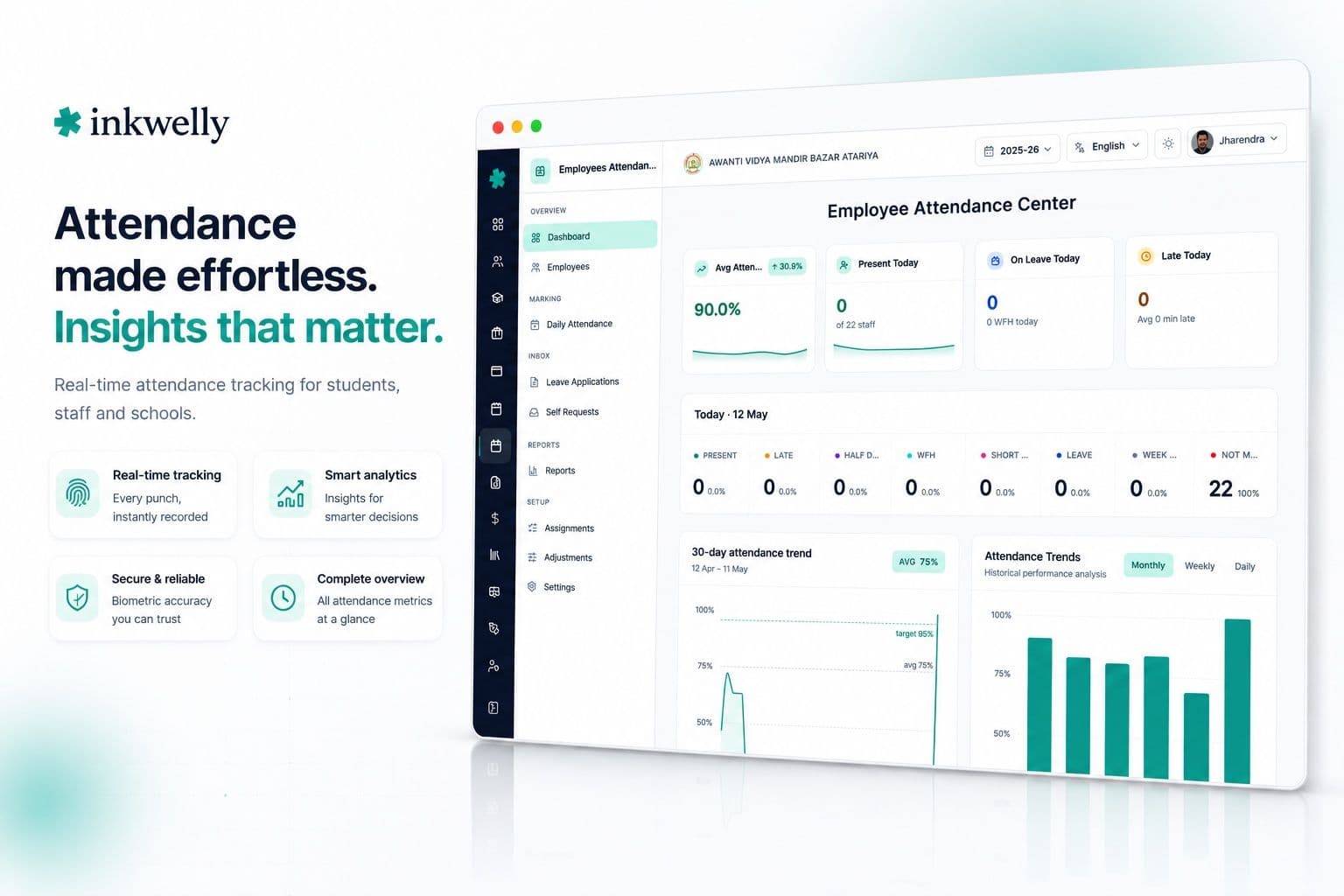
What you see on the dashboard
- Hero KPIs — today's school-wide attendance %, staff present, staff absent, on leave, on-duty, late count, average attendance rate.
- Today ribbon — every department's status with punched count and unpunched names; one-click drill-down.
- 30-day attendance ribbon — each department's last 30 days as coloured cells; pattern anomalies flagged.
- Status distribution — present, absent, late, half-day, leave, short-leave, on-duty, week-off, holiday as a stacked bar.
- Department breakdown — teaching, office, transport, cleaning, security — attendance averages, late-coming counts, WfH counts.
- Punch integrity card — missing in, missing out, duplicate, anomaly counts; one-click resolution.
- Late-coming analysis — by department, by employee, by week; repeat offenders flagged for HR review.
- Working hours card — expected vs actual, overtime hours, shortfall flags.
- Leave pipeline card — pending leave by type (CL, EL, ML, LWP, RH), by department.
- WfH compliance card — today's WfH count, cap usage by employee, productivity flags.
- Self-requests card — missed-punch corrections, leave applications, WfH requests pending decision.
- Governance panel — policy violations, exceptions, audit alerts — a principal-readable daily list.
- Trends card — 30-day, 90-day, year-on-year attendance trends; benchmarked across departments.
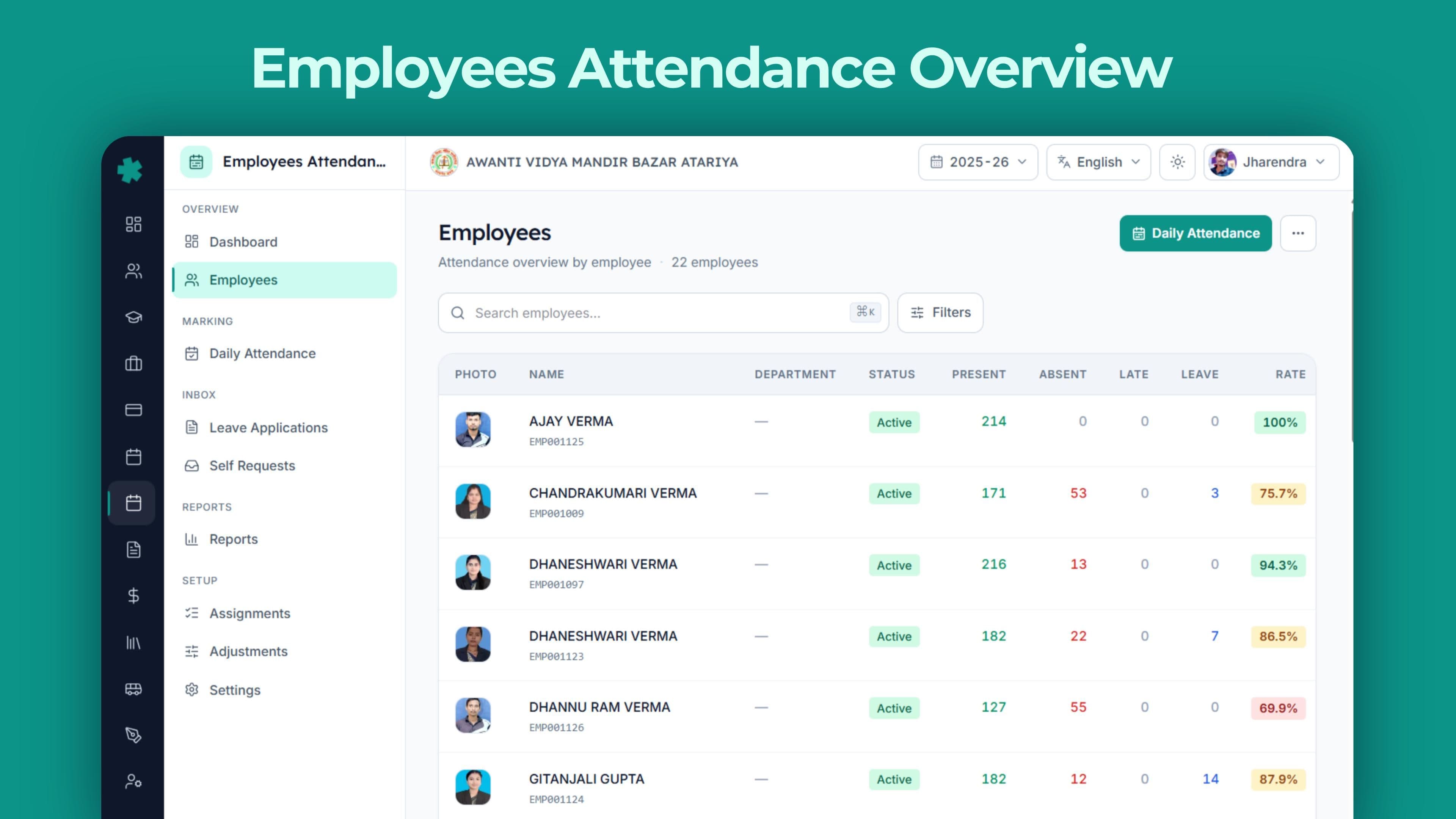
- Employee list card — the master employee list with attendance summary, late count, leave balance, last punch.
What's included with Employee Attendance
- Unlimited employees, departments, working-day rules.
- 9-status attendance model (Present, Absent, Late, Half-day, Leave, Short Leave, On-Duty, Week Off, Holiday).
- Department-wise time settings — in/out, late, half-day, grace, overtime, min hours.
- Biometric / RFID device adapters (Realtime, eSSL, ZKTeco, Matrix, Mantra).
- Today ribbon, 30-day ribbon, punch integrity card, late-coming analysis.
- Working-hours, week-off, leave pipeline (CL, EL, ML, LWP, RH, paternity, maternity).
- WfH compliance, self-service portal at /e/<id>, governance panel.
- Adjustments queue, monthly attendance preparation, payroll-ready export.
- One-click handoff to Inkwelly Payroll for salary, EPF, ESI, ECR.
- Audit log per record, soft-delete with 90-day restore, role-based access.
- Hosted in India (Mumbai), DPDP Act 2023 compliant, employee consent verified.
- Multi-language support — English, Hindi, regional script for staff messages.
Ready to see what 'every punch, payroll-ready by the 1st' actually looks like?
30 minutes. No commitment. Bring your biometric export, register, or HR Excel — we'll bring the structure. By the end of the call, you'll see your real departments, your real teachers, your real biometric punches, and a real monthly attendance handed off to payroll — inside Inkwelly.
Frequently asked
13 questionsCan we use our existing biometric or RFID gate device?
Yes. We have published adapters for Realtime, eSSL, ZKTeco, Matrix and Mantra — the devices most commonly installed in Indian schools. Punches stream in every 5–10 minutes via the device's standard push protocol or scheduled pull. You do not need to replace the hardware; you can stop paying the device-vendor's AMC for their proprietary software.
How are different departments handled — teaching, office, transport, cleaning?
Each department has its own time policy: in-time, out-time, late-coming threshold, half-day windows, grace period, overtime rule, minimum hours for full-day / half-day. Teaching might be 7:45/2:30; office 9:00/5:00; transport split-shift 6:00–9:00 + 1:00–4:00. Configured once per department; applied to every member assigned to it. Audit-logged on change.
What about leave types — CL, EL, ML, LWP, RH?
Every leave type Indian schools offer is supported — Casual Leave, Earned Leave, Medical Leave, Leave Without Pay, Restricted Holiday, paternity, maternity, compassionate. Each has its own entitlement, accrual rule, carry-forward, lapse rule. The leave pipeline runs request → approval → attendance impact; on approval, attendance status auto-flips on the right dates with the right type tag.
How does the Saturday rule (second / fourth Saturday off) work?
Week-off is configured per department or per employee with a day-of-week (MON–SUN) and day-type (ALL, FIRST, SECOND, THIRD, FOURTH, LAST). Teaching with second-and-fourth-Saturday-off plus all-Sunday-off is a two-rule configuration. Office staff with all-Sunday-off only is one rule. The system applies it every day; working days computed against actual scheduled days.
Can the staff submit leave applications and missed-punch corrections themselves?
Yes. Every employee has a self-service portal at /e/<id>. Missed-punch correction (with evidence), leave application (with supporting document), WfH request, on-duty declaration — all submitted from the portal. Each request flows through HOD or principal approval; status is visible live to the employee. Office staff stop being attendance bookkeepers.
How does work-from-home (WfH) compliance work?
WfH policy — frequency cap (e.g., 2 days per week), advance approval requirement, role-eligibility (teaching typically excluded) — is encoded once. Employees request WfH; HOD approves; a daily check-in is required on the WfH day; productivity flag at end of day. The dashboard surfaces today's WfH count, per-employee cap usage, and policy violations.
How is the monthly attendance handed off to payroll?
On the 1st of every month, the [Employee Payroll](/modules/employee-payroll) module pulls the previous month's working days, present days, paid leaves (CL, EL, ML), unpaid leaves (LWP), late-coming counts, half-day counts, overtime hours — in the format payroll needs. One-click handoff. EPF, ESI, TDS, professional tax flow off this base; ECR file generation reconciles to the same attendance numbers.
What if the biometric device's clock drifts or there's a power cut?
Inkwelly's punch integrity card surfaces every clock-drift, missing punch, duplicate punch, and anomaly. Office reconciles daily — typically 15 minutes of work for a 70-staff school. Resolutions are audit-logged. Most schools find their data is cleaner after one month with Inkwelly than after years of vendor-managed devices.
Can we track late-coming and have a salary deduction policy?
Yes. Late-coming analysis surfaces per-employee per-week counts and average late minutes. Repeat-offender threshold (e.g., late > 4 times in a month) flags the employee for HR review. The school's deduction policy — e.g., 1 day's salary per 3 late-comings, or per actual late-minute — is encoded; payroll applies it automatically based on attendance data. The audit trail backs every deduction.
Is biometric data stored securely and does it comply with DPDP Act 2023?
Yes. Fingerprints are stored only as templates (mathematical hashes) — never as images — AES-256 encrypted at rest. Templates cannot be reverse-engineered into fingerprints. Explicit employee consent for biometric processing is captured at onboarding, renewable, revocable. All data is hosted in Mumbai; biometric templates never leave India. Subject access requests are honoured within statutory timelines.
Can we run it in Hindi or our regional language?
Yes. The HOD's view, the head clerk's view, the employee self-service portal, and notifications support English plus Hindi (Devanagari) plus regional script (Bengali, Tamil, Telugu, Kannada, Marathi, Gujarati, Punjabi). Latin digits (0–9) only — never Devanagari numerals — for consistency with the rest of Inkwelly.
How does on-duty (school cricket, debate, NCC) work?
On-Duty is one of the nine first-class statuses. The HOD or office records a roster ("these 5 PT teachers + 12 students are at the inter-school cricket on these dates"). The system marks the staff On-Duty for those dates; biometric absences during the on-duty window are auto-reconciled. Attendance percentage stays at 100% for the day; payroll counts it as present; the achievement is logged on the [employee profile](/modules/employee-information).
What if our school has multiple branches under one trust?
Inkwelly supports multi-school trusts natively. Each branch has its own departments, its own staff, its own biometric devices, its own time policy — fully isolated. Trust-level dashboards roll up attendance KPIs across schools. Payroll handoff happens per branch; consolidated EPF / ESI filings are supported. One platform, every branch, fully isolated by default.
You might also like
4 readsSee Inkwelly on your school
30-minute demo. We open your current ERP with you and load your data into Inkwelly on the call. Dated go-live plan by the end of it.