Best school management software for state-board schools in India state-board
Most school ERPs are built CBSE-first and bolt state boards on later. This guide is the opposite: it starts from what a UP Board, Maharashtra SSC or Karnataka state school actually needs — regional-language report cards, a Hindi parent app, UDISE+ exports and pricing a budget school can afford — and shows you how to choose.
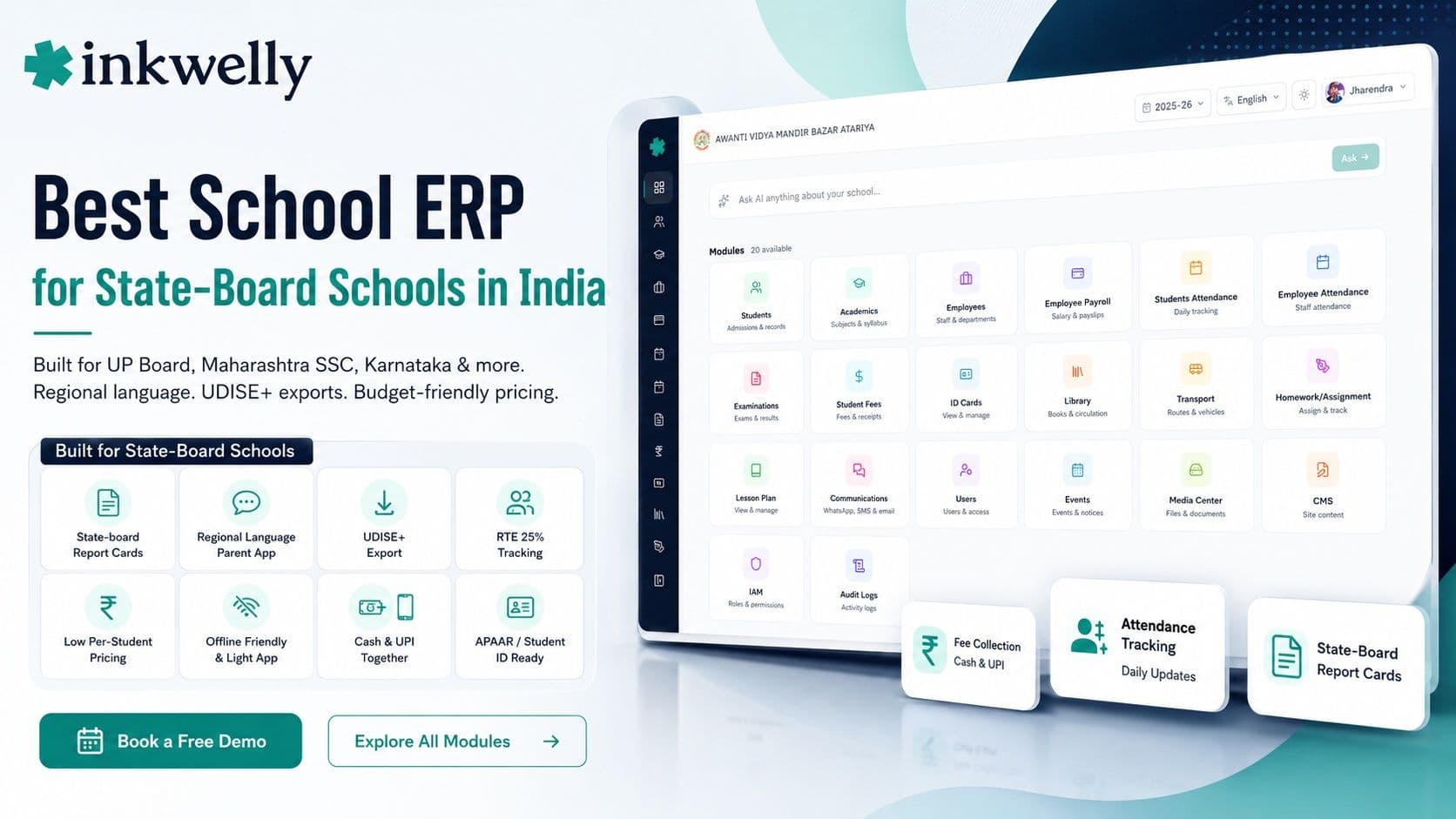
A state-board school in a district town signs up for a well-marketed ERP after seeing it run beautifully at a city CBSE school. Then the first term ends. The report card prints in the CBSE grade format, not the marks-and-division format the state board demands. The parent app speaks only English to families who read Hindi. UDISE+ season arrives and the data has to be re-typed into the government portal by hand. None of this is in the brochure, because the software was never built for a state-board school — it was built for a CBSE school and sold to everyone. This is the single most common mismatch in the Indian market.
Here is the thesis: a state-board school is not a budget CBSE school, and software built for CBSE rarely fits it well. The right product starts from your board's report-card format, your families' language, your compliance calendar and your fee reality — not from a Delhi private school's feature list. Choosing on that basis matters more than any feature count.
What a state-board school actually needs
The needs are specific, and they are exactly the things CBSE-first software treats as an afterthought. If a demo cannot show these working on your board, the feature list does not matter.
The state-board checklist
- Your board's report-card format — marks, division and percentage as your state board prints them (UP Board, Maharashtra SSC/HSC, Karnataka, Tamil Nadu, Rajasthan, MP, West Bengal and others), not a generic CBSE grade sheet.
- A regional-language parent experience — fee reminders, attendance alerts and the app in Hindi or your state language, because most state-board parents do not read English fluently.
- UDISE+ and government data — student and staff data structured so the annual UDISE+ return is an export, not a month of re-typing.
- RTE 25% quota tracking — free-seat students, reimbursement claims and the separate records the state asks for, handled inside the system.
- Budget-friendly, low-per-student pricing — state-board fees are lower, so the software must work at ₹20–₹50 per student, not premium CBSE pricing.
- Offline tolerance and a light app — it must work on entry-level Android phones and patchy small-town internet, not assume city broadband.
- Cash and UPI together — many state-board families still pay cash at the counter, so the system must handle counter receipts as cleanly as online UPI payments.
- APAAR / student ID readiness — the ability to store and manage the national student IDs your state is rolling out.
The India bar: where generic software breaks
The gap between a great state-board fit and a generic one shows up in small, painful places. A CBSE-first system will often force your marks into a grade band your board does not use, leaving your office to fix every report card by hand. Its parent app, translated loosely if at all, gets ignored by Hindi-reading families, so you are back to paper circulars. Its fee module assumes online-first parents and treats cash receipts as a clumsy add-on, when half your collection is still cash. And at UDISE+ time it has no export that matches the government format. Each of these is survivable alone; together they mean the software quietly fails the school it was sold to.
How to choose: the state-board demo test
Do not evaluate on a feature grid. Make the salesperson prove these on your board, with your data, in the demo itself.
- Print your exact report card. Ask to see a real term report in your state board's format — marks, division, the lot. If it comes out looking like a CBSE grade sheet, stop there.
- Switch the parent app to Hindi or your language. Send a test fee reminder and attendance alert. Read them as a parent would. If they are half-English or awkward, your families will ignore them.
- Ask for the UDISE+ export. Have them show the student-data export and how it maps to the government return. "We will build it" is a no.
- Collect a cash fee and a UPI fee side by side. Both should produce a clean receipt in seconds. Watch whether cash is a first-class flow or an afterthought.
- Open it on a cheap Android phone. Test the app on an entry-level device and a weak connection — the reality of most state-board parents — not the salesperson's flagship.
- Get the per-student price in writing. Confirm it works at state-board fee levels, and ask plainly what the gateway charge on online payments is and who pays it.
The names you will run into
The Indian market has plenty of options, and several position themselves for state boards specifically. The names you will encounter include Vidyalaya (strong in Gujarat and Maharashtra), Edunext, Entab, MyClassboard, Teachmint, Campus 365 and Fedena, alongside many regional and local vendors. Some genuinely handle state-board report cards and regional languages well; many are CBSE-first products with a state-board checkbox. The honest filter is not the brand — it is whether the demo passes the six tests above on your board and in your language. A smaller vendor that prints your exact report card and speaks your parents' language beats a famous one that does not.
The pricing reality
State-board schools usually run on lower fees, so pricing matters more here than anywhere. Indian school software typically costs ₹20–₹100 per student per year, or flat plans from around ₹15,000 a year for a small school. For a state-board school, aim at the ₹20–₹50 per-student band; premium CBSE pricing rarely makes sense on your fee structure. Watch two things closely. First, the gateway charge on online payments (MDR), typically 1.5–2%, which most schools pass to parents — confirm who bears it. Second, module unbundling: a low headline price that excludes report cards, transport or the parent app is not actually cheaper. A school of 600 students should expect a genuine all-in number in the region of ₹15,000–₹45,000 a year, not a teaser rate that triples at renewal.
Where Inkwelly fits
Inkwelly is built for Indian reality across boards, not CBSE-first with everyone else bolted on. Report cards adapt to state-board formats; the parent communication app and fee reminders run in Hindi and regional languages so families actually read them; online fee collection over UPI sits alongside clean cash-counter receipts; and student data is structured to make government returns an export, not a re-typing marathon. Pricing is transparent and per-student, sized for state-board fee levels rather than metro CBSE budgets. If you run a state-board school, judge us the same way — ask us to print your report card and speak your parents' language in the demo.
“A state-board school is not a budget CBSE school. Software that forgets that prints the wrong report card and talks to your parents in a language they don't read.”
Decide in two weeks
Shortlist two or three products — mix a well-known name with a vendor that markets to state boards directly. Run each through the six-point demo test on your own data: your report-card format, your parents' language, the UDISE+ export, cash-and-UPI fees, a cheap phone, and a written per-student price. Score them on those, not on feature counts. The one that prints your exact report card, speaks your families' language and fits your fee level is your answer — regardless of how famous the other one is. That is how a state-board school avoids buying a CBSE product in disguise.
See it print your board's report card
Book a 20-minute demo and we will generate a real report card in your state-board format and a fee reminder in your parents' language — on your own data.
Frequently asked
7 questionsWhat is the best school management software for state-board schools in India?
The best one is whichever prints your exact state-board report-card format, runs the parent app in Hindi or your regional language, and fits state-board fee levels (around ₹20–₹50 per student). Judge it by a live demo on your own data, not by brand name — many popular ERPs are CBSE-first.
Why is CBSE-first software a problem for state-board schools?
Because it assumes CBSE grade formats, English-speaking parents and online-first fees. State-board schools need marks-and-division report cards, regional-language communication and strong cash handling. A CBSE product often forces manual fixes on every report card and gets ignored by Hindi-reading families.
Does state-board school software handle UDISE+ data?
Good software does — it structures student and staff data so the annual UDISE+ return becomes an export rather than weeks of manual re-typing. Always ask the vendor to show the UDISE+ export in the demo; "we will build it later" means it does not exist yet.
How much should state-board school software cost?
Aim for ₹20–₹50 per student per year, or a flat plan from around ₹15,000 a year for a small school. State-board fees are lower than CBSE, so premium pricing rarely fits. Confirm the all-in price includes report cards, the parent app and transport, and ask who pays the gateway charge on online fees.
Can the parent app work in Hindi or regional languages?
It should. Most state-board parents do not read English fluently, so fee reminders, attendance alerts and the app itself must work in Hindi or your state language. Test this in the demo — send a real reminder and read it as a parent would. Half-English translations get ignored.
Does the software support RTE 25% quota tracking?
Strong state-board software tracks RTE free-seat students, their separate records and reimbursement claims inside the system. This matters because state authorities ask for this data specifically. Confirm it is built in rather than managed on a side spreadsheet.
Will it work on cheap Android phones and slow internet?
It must, because that is the reality for most state-board families. A light app that loads on entry-level devices and tolerates patchy small-town connections will actually be used; a heavy, city-broadband-assuming app will not. Test it on a cheap phone with a weak signal before you buy.
You might also like
5 readsSee Inkwelly on your school
30-minute demo. We open your current ERP with you and load your data into Inkwelly on the call. Dated go-live plan by the end of it.