School bus tracking without a GPS device, explained honestly
Every Google result for bus tracking sells you a box to bolt under the seat. This guide explains the other route: the driver's own Android phone as the tracker — how it works, how accurate it really is, what battery and network do to it, and the three situations where a hardware GPS device still wins.
Can you track a school bus without a GPS device?
Yes — and a growing share of Indian schools already do. At 7:40 on a Monday, the transport in-charge of a 22-bus school in Indore takes the same nine calls every principal knows: bus kahan hai? The GPS vendor's quote has been on her desk for a month: a device per bus, an annual renewal per bus, a separate parent app, and a three-week installation window. Meanwhile every one of her 22 drivers already carries a 4G Android phone. School bus tracking without a GPS device means using that phone — through a driver app — as the tracker. This guide explains how it works, where it falls short, and when the box under the seat is still the right buy.
The short answer
For a school that owns its buses and employs its drivers, a driver app on an ordinary Android phone answers the parent's real question — has the bus crossed my stop yet? — well enough, at zero hardware cost, provided the app is honest when it loses signal. A hardware GPS device is the better tool when the bus belongs to a contractor, when your state's RTO demands an AIS-140 unit, or when you need tamper-proof speed and ignition data. Most schools end up with both, on one map.
How school bus tracking through a driver app works
There is no hardware to install. The driver opens the app, taps Start trip, and the phone shares its location every few seconds for as long as the trip runs. Parents of children on that route see a moving bus on a map, get an alert when it is a few minutes from their stop, and another when their child is marked on board. When the driver ends the trip, sharing stops — the school is tracking a bus on duty, not a person off duty.
Everything the tracking knows comes from three things: the phone's GPS chip, its mobile data connection, and the driver remembering to tap start. Each has a failure mode, and a good product designs around all three.
What a driver app can do that a plain GPS box cannot
- Boarding per stop. The driver or attendant taps each child on a photo roster as they board and alight, so the parent alert says Aarav boarded at Sector 12 — not just bus moved.
- One-tap start and end. Today's run is created from the route's own schedule; the driver does not type anything.
- Stop-by-stop progress. The app advances stops as the bus reaches them and lets the driver correct a stop by hand when the satellite fix is weak in a narrow lane.
- An SOS button in the driver's hand, with the bus's location and the number of children on board attached to the alert.
- A no-child-left-behind check at the end of each trip: who boarded but was never marked dropped.
- Parent 'not coming today'. A parent marks the child absent from the bus for a day or one leg; the roster greys them out and no false missed-the-bus alarm fires.
- Day odometer. Opening and closing readings each day, so the distance reconciles against the diesel bills.
- Zero hardware and zero installation. A ₹8,000–₹10,000 Android phone is enough; most schools use the driver's own.
Accuracy, battery and network: the honest numbers
Accuracy. A modern phone's GPS is typically accurate to about 5–15 metres in open sky and drifts to 20–50 metres in dense old-city lanes or under flyovers. For the question that matters — which stop is the bus at? — that is more than enough; stops are usually 300 metres to 2 km apart. Hardware devices are not dramatically more accurate; they are simply always on.
Battery. Continuous location sharing is the single heaviest thing a phone does. A two-hour morning run can cost a mid-range phone a noticeable slice of its battery. The fix costs less than ₹300: a charger cable plugged into the dashboard socket, which every bus has.
Network. 4G coverage drops on rural stretches and inside some basements. When the phone goes silent, the app must say so. The difference between a good tracking product and a dangerous one is whether the parent's map shows last seen 3 minutes ago or keeps showing a confident green dot that stopped being true.
What separates a good driver-app product from a generic one
- It shows an honest status — live, weak GPS, driver offline — instead of one frozen marker.
- Alerts land on WhatsApp, not only as app notifications parents have muted.
- A second phone (the attendant's) can share location too, so one dead battery does not blind the route.
- The admin fleet view shows which buses have not started on time — the 7:40 call becomes a glance.
- Stop names and the driver's screens work in Hindi and the school's own language.
- Hardware devices can be added later and appear on the same map, so you are not choosing forever.
How to test driver-app tracking before you buy
Ask for a live demo with a real phone, not a slide deck. Then run these checks:
- Put the phone in airplane mode for two minutes mid-trip. Watch the parent view. It must switch to an offline or last-seen state within a minute. If the bus keeps moving on the map, walk away.
- Let the driver forget. Do not tap Start trip. Does the office screen show the bus as not started at 7:15? Does the driver get a nudge? Silence here is how a whole route goes untracked.
- Mark boarding for ten children in ten seconds. Photo roster, one tap each, undo if wrong. If the driver has to search names, it will not be done at 7 a.m.
- Check the alert channel. Ask to receive the bus is 5 minutes away alert on your own WhatsApp during the demo.
- Ask what tracks after the trip ends. The answer should be nothing. Drivers accept on-duty tracking; they resist being followed home.
- Run a real 90-minute trip and read the battery percentage before and after, with and without the dashboard charger.
- Ask whether a hardware GPS device can feed the same map later. For contract buses or an RTO mandate you will want the hybrid.
- Ask what it costs per bus. If tracking is bundled into the school software's per-student price, the per-bus number should be zero.
The options you will run into
The search results for school bus tracking are dominated by hardware vendors: Loconav, Tracko, Chakraview, VersionX, Asti Infotech and NeoTrack all sell a device per bus with a parent app on top, and several supply AIS-140-certified units for states that require them. A smaller set — GPSchoolBus, myskoolbus and similar — run on the driver's phone alone. School management platforms such as Entab, MyClassboard and Teachmint offer transport modules that typically read from a third-party device rather than tracking themselves. The useful question is not which brand but which source of location fits each bus you run — and whether the parent, the driver and the office are looking at the same screen.
What each route costs
Hardware quotes reported by schools commonly land between ₹3,000 and ₹8,000 per bus for the device, plus ₹1,500–₹3,500 a year per bus for the SIM and subscription, plus installation. For a 20-bus fleet that is roughly ₹60,000–₹1.6 lakh upfront and ₹30,000–₹70,000 every year — before the parent app, which is often licensed separately per student.
Driver-app tracking has no device cost. When it is part of a school platform priced per student, it usually adds nothing per bus. Standalone phone-based apps are reported at roughly ₹10–₹30 per student per month. Add a dashboard charger per bus and, if drivers will not use personal phones, a basic Android handset per bus — a one-time ₹8,000–₹10,000 that the school owns and can reassign.
The hybrid — devices only on contract or mandate-affected buses, phones everywhere for boarding — is usually the cheapest way to cover a mixed fleet fully.
Where Inkwelly fits
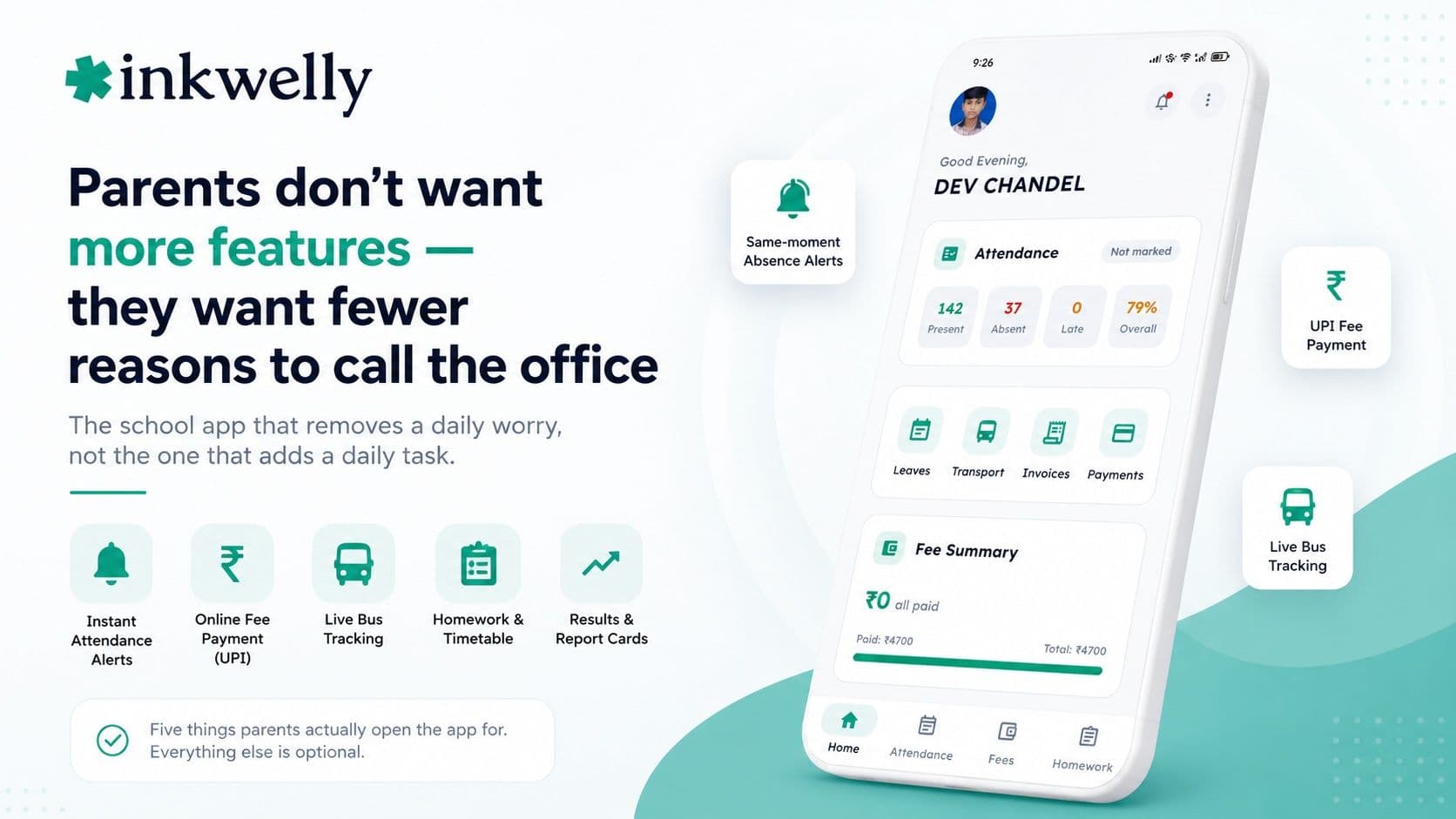
Inkwelly's transport module includes a driver app that runs on an ordinary Android phone: it shares the live location during a trip, marks boarding and drop per stop from a photo roster, has a one-tap SOS button, and records the day's opening and closing odometer. Parents see the bus on a live map and get pickup and drop alerts on WhatsApp; when the driver's phone loses signal, the parent sees last seen rather than a frozen marker. Hardware GPS devices can feed the same live map, so a school can start with phones today and add AIS-140 units on contract buses when the RTO asks. Transport is part of the single price — every module included, ₹49–₹199 per student per year — with go-live the next working day, ₹0 data migration and a 90-day pilot with a pro-rata refund. For the wider comparison of tracking products, see our guide to the best school bus tracking software in India.
A parent does not need a receiver bolted under a seat. They need to know, at 7:42, whether the bus has crossed the temple road — and to be told plainly when the app does not know.
Decide in two weeks
Sort your buses into two lists: those you own and staff, and those a contractor runs. Ask your RTO one question — is an AIS-140 device required for school buses at fitness renewal in your state? Then run the eight-point demo test above with one driver and one parent. Most schools end up with phones on every bus for boarding and live tracking, and a device only where the contract or the law demands it. The right vendor will help you land there without selling you a box for every seat.
See the driver app on a real phone
A 30-minute demo with a live trip, a parent's WhatsApp alert and the offline test — on your own routes.
Frequently asked questions
8 questionsYes. A driver app on an ordinary Android phone shares the bus's live location while a trip is running, and parents see it on a map with stop alerts. It works well for buses the school owns and staffs. If your state RTO requires an AIS-140 device on school buses, the phone app is an addition to that device, not a replacement.
Roughly 5–15 metres in open sky and 20–50 metres in dense lanes or under flyovers — comparable to a hardware unit. For knowing which stop the bus is at, that is plenty, since stops are usually hundreds of metres apart. Good apps also let the driver correct a stop by hand when the satellite fix is weak.
Continuous location sharing is heavy: a two-hour run can use a noticeable share of a mid-range phone's battery. Plug the phone into the bus's dashboard socket with a ₹300 cable and the problem disappears. Sharing stops when the trip ends, so the phone is not draining all day.
The phone keeps its satellite fix but cannot send it. A well-built app tells the parent 'driver offline — last seen at 7:41' within about a minute and resumes when the network returns. Avoid any product whose map keeps showing a moving bus after the signal is gone.
No. AIS-140 is a hardware standard: a certified device with an emergency button that reports to the state's tracking backend. Where your state applies it to school buses, you need the device. The driver app adds boarding, parent alerts and attendant tools on top of it, and both can appear on one map.
Hardware GPS, usually. The bus and driver belong to the operator, so the school cannot rely on a personal phone being charged and on duty. A device bolted to the bus is the school's independent record. Add the driver app for boarding marks if the operator agrees.
With the right platform, yes: 'bus is 5 minutes away', 'boarded', 'dropped' and 'trip started' can arrive as WhatsApp messages, which parents read far more reliably than app notifications. Ask to receive one on your own number during the demo.
Yes. The driver app on an Android phone and a hardware GPS device both feed the same live map, so a school can use phones on its own buses and devices on contract buses. Transport is included in Inkwelly's single per-student price, with no separate per-bus charge.