Run the school uniform and book store like a shop, not a register
Uniforms, books, stationery and bags are the busiest counter in a school for two weeks a year and the most ignored for fifty. This guide explains what a school store system must do — catalogue, stock, procurement, kits, billing, exchanges, dues, reports — and where the compliance line on "buy from us" actually sits.
Why school uniform and book store software is a separate problem
The first Monday of April at a 1,200-student school in Jaipur: a queue of parents outside the store room, a teacher pulled off duty to hand out Class 4 kits, sizes written on a sheet, ₹2,400 collected in cash per child into a steel box, a receipt book with carbon copies, and 40 size-28 shirts that turn out to be size 26. By Friday the store has sold ₹18 lakh of goods and nobody can say how much stock is left, how many families still owe, or which vendor's invoice for the shirts is unpaid. In June the CA gets a single line in Tally: "Store sales — April".
The thesis: a school store is a shop with a roster
A school store is a retail shop whose customers are already in the school's database, whose demand is known child by child in January, and whose peak is two weeks long. School uniform and book store software that treats it as an inventory tab of the ERP misses the retail half; software that treats it as a generic POS misses the roster half. You need both, and you need the money kept apart from fees.
What a school store system has to do
The list is longer than it looks because the store touches procurement, stock, the parent, the fee office and the CA. Each item below is a job somebody at the school is already doing on paper.
- A catalogue organised the way parents buy — by class and by size: the Class 6 book set, the summer shirt in sizes 24–44, the house T-shirt in four colours, the KG bag.
- Kits — "Class 4 starter kit" as one line that is really nine items, so a parent buys once and the stock moves nine times.
- Targeting by class — a Class 2 parent should not see the Class 9 lab coat, and the store should not sell a Class 9 book set to a Class 2 child by mistake.
- Stock as a ledger, not a number — every receipt, sale, return, transfer and write-off is a dated line, so the count in March can be traced back to April.
- Reorder points and low-stock alerts — before the size-32 trousers run out in the second week, not after.
- Procurement from vendors — a requisition, a purchase order, a goods receipt that puts the stock in, and the vendor's invoice against it, so the CA can see what is owed to whom.
- Session-start distribution — issue the kit to all 90 children of Class 4 in one action, on credit if the school collects later, with one order per child.
- POS billing at the counter — scan or search, take cash, UPI, card or bank transfer, print a receipt and a tax invoice or bill of supply with GST computed per line.
- Online ordering for parents — order and pay in the app, collect at the store with a pickup QR, so the April queue moves to March.
- Returns and size exchanges — a size swap should restock the returned size and issue the new one, without a refund and without a manual stock edit.
- Dues per student — what each family still owes the store, with reminders, kept separate from academic fee dues so a store balance never blocks a report card.
- Reports — fast and slow movers, stock valuation, class-wise kit status, vendor-wise purchases, and a GST summary the CA can file from.
- Verifiable invoices — a QR on the printed invoice that a parent or an auditor can scan to confirm it is genuine.
The compliance line: convenience, not compulsion
This is the part vendors skip. CBSE's Affiliation Bye-Laws frame schools as community service, not commercial establishments. The Board's April 2017 advisory told affiliated schools not to sell books, stationery, uniforms and bags on the premises, and its June 2018 circular clarified that a school may run a tuck shop for parents' convenience but cannot compel purchase from it, or from a single named vendor. The Delhi Directorate of Education has issued the same direction repeatedly, and district administrations from Indore to Ludhiana have used prohibitory orders against "buy from this shop only". Several state fee-regulation acts carry similar language. The practical rule for a school store is simple: publish the uniform specification and the book list so any parent can buy elsewhere, price the store fairly, never tie admission or results to a store purchase, and keep store money on its own rail. A store that can prove all four on paper is a convenience; one that cannot is a complaint waiting to happen.
How to test school store software in a demo
- Build the Class 4 kit with nine items and sell it once; check that nine stock lines moved.
- Sell a size-28 shirt, then exchange it for size 30 — the ledger should show a return-restock and a fresh issue, and the parent should pay only the difference, if any.
- Receive a vendor delivery of 200 shirts against a purchase order with 20 short, and see whether the shortfall stays open.
- Distribute kits to a whole class on credit and then look at one child's store dues, separately from fee dues.
- Print a tax invoice for a ₹3,100 order with a ₹2,600 blazer and a ₹500 tie and check that GST is 18% on the blazer and 5% on the tie — the September 2025 rate change put apparel above ₹2,500 per piece in the 18% slab.
- Run a low-stock report and ask which sizes will run out first based on last April.
- Ask a parent to order from home on their phone and collect with a QR at the counter.
- Close the day's store cash and ask where that figure lands in the school's money book.
The kinds of options you will run into
Retail POS software built for uniform shops — RetailCore, Lightspeed and similar — is excellent at sizes, barcodes and billing and has no idea which child is in which class. School ERPs with an inventory or store module — MasterSoft, MyClassboard, Vidyalaya, Skolaro, MSchool and others — know the roster and vary widely on retail depth: some are asset registers with a sales tab, some are real storefronts. And the incumbent in most schools is a register, a receipt book and a Tally entry, which costs nothing and answers no question after April. The test is whether the software can answer "how many Class 6 families have not collected their book set" and "how many size-30 trousers are left" from the same screen.
What it costs, and what it earns
Uniform retail POS software runs ₹6,000–₹30,000 a year per counter; ERP store modules are usually add-ons at ₹10–₹40 per student per year or a flat ₹20,000–₹75,000 a year; all-inclusive platforms bundle the store into the per-student price. Set that against the store's own economics: a 1,000-student school moving ₹1,500–₹3,500 of uniforms and books per child handles ₹15–₹35 lakh a year through the store, and the two usual leaks — unbilled cash and dead stock in wrong sizes — are each commonly 3–8% of that. Software that prevents one dead-stock season pays for itself several times over. Remember GST: printed textbooks are exempt, notebooks and most stationery moved to nil in September 2025, and uniforms are 5% up to ₹2,500 per piece and 18% above, so the invoice engine has to handle mixed rates on one bill.
Where Inkwelly fits
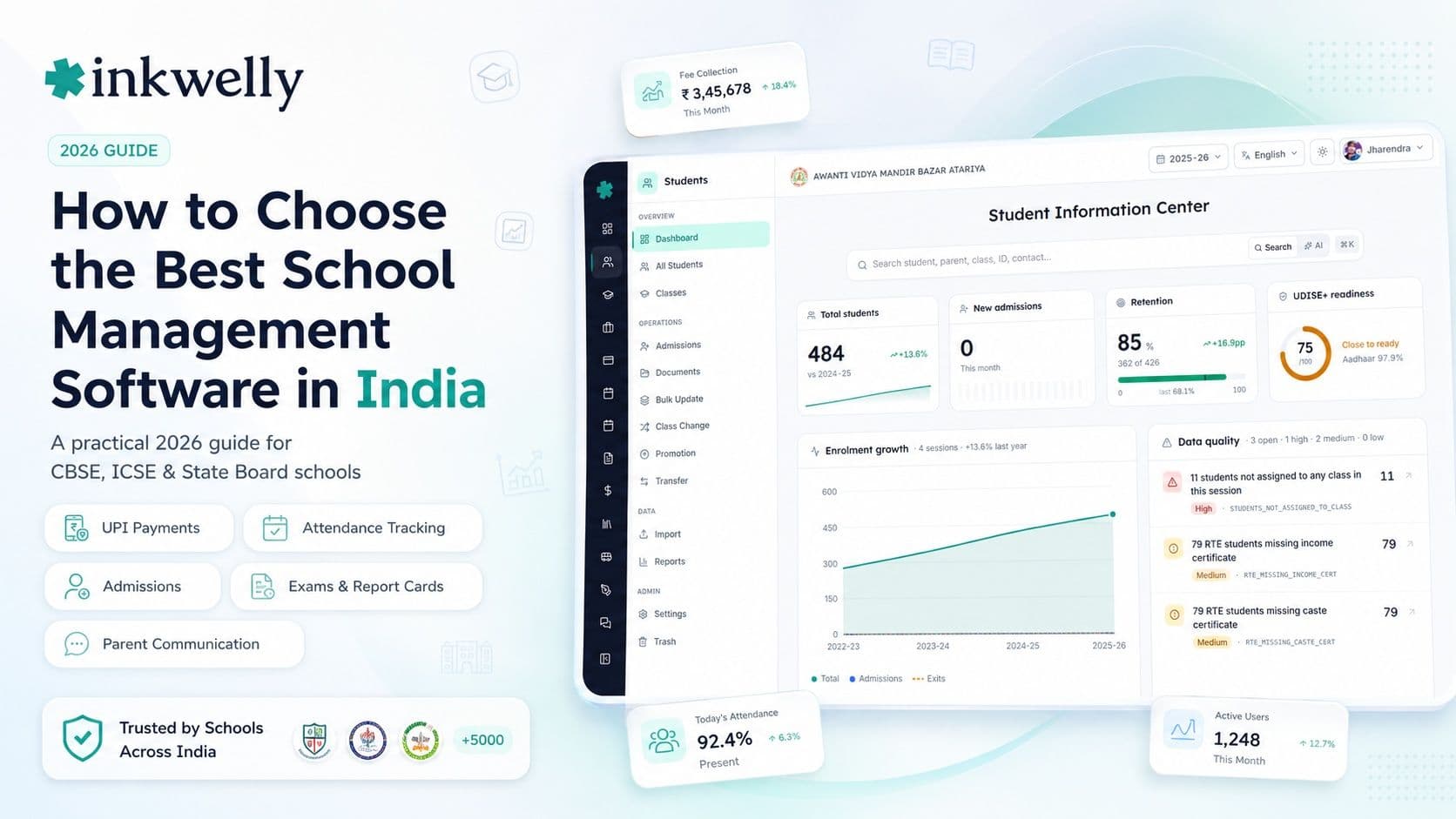
Inkwelly's school store is a real shop with the school's roster behind it: a catalogue by category, product and size variant, kits built from variants, and targeting rules so each class sees only its own items. Stock is an append-only ledger with locations, transfers, audits and low-stock reports; procurement runs supplier → requisition → purchase order → goods receipt. Sales come through the parent app with a pickup QR, the POS counter, or a session-start distribution that issues a kit to a whole class on credit as one order per child. Returns and size exchanges restock automatically, refunds go through approval, and every invoice carries a verification QR. Store money runs on its own rail beside student fees, with per-student dues, reminders, and sales, valuation and GST reports; store collections flow into the school's money book automatically, and each child's purchases sit in their student record. All of it is included in the ₹49–₹199 per student per year price, live the next working day, with ₹0 data migration and a 90-day pilot with a pro-rata refund.
The school store is a ₹20 lakh shop that opens for two weeks a year. Run it on a register and those will always be the two worst weeks.
Decide in two weeks
Take last April's store as the test case. Load the catalogue and the opening stock, re-run the busiest three days through the candidate software with real orders, and then ask it the three questions the register could not answer: what is left by size, who still owes, and what did we buy from whom. Then read the CBSE circulars and confirm that your published book list and uniform specification let a parent walk past the store without penalty. If the software answers the three questions and your paperwork passes the fourth, you are ready for the next session.
See the school store with your own catalogue
Frequently asked questions
8 questionsIt is software that runs the in-school shop for uniforms, books, stationery and bags: a catalogue by class and size, stock and reorder levels, vendor procurement, session-start kit distribution, counter and online billing with GST invoices, returns and size exchanges, per-student dues and reports. It is a retail system that knows the school roster.
A CBSE school may run a tuck shop or store for parents' convenience, but CBSE's April 2017 advisory and June 2018 circular, along with the Affiliation Bye-Laws' no-commercialisation principle, say it cannot compel parents to buy from the school or from a single named vendor. Publish the uniform specification and book list, keep prices fair, and never tie admission or results to store purchases.
Treat every size as its own stock line with its own reorder point, sell against the size, and handle a swap as a return that restocks the old size plus a fresh issue of the new one. Software should do this without a refund and without anyone editing stock counts by hand, so the size-wise count stays true through April.
Inventory or asset software tracks what the school owns — benches, projectors, lab equipment — and where it is. A school store sells goods to families: it needs a catalogue, pricing, kits, billing, GST invoices, exchanges and per-student dues on top of stock. Many ERPs offer the first and call it the second.
Retail POS software for uniform shops costs ₹6,000–₹30,000 a year per counter. School ERP store modules are typically add-ons at ₹10–₹40 per student per year or ₹20,000–₹75,000 a year flat. All-inclusive platforms such as Inkwelly include the store in ₹49–₹199 per student per year. Against a store turnover of ₹15–₹35 lakh for a 1,000-student school, the software cost is small.
After the September 2025 rate revision, uniforms and other apparel are taxed at 5% up to ₹2,500 per piece and 18% above; printed textbooks are exempt; notebooks, exercise books and most stationery moved to nil. A school store invoice therefore often carries mixed rates on one bill, and the billing software must compute GST per line.
Keep them separate. Store purchases are a convenience the family chose; academic fees are the school's core dues. Mixing them invites disputes and can put the school on the wrong side of CBSE and state directions against tying results or certificates to purchases. Good software shows both for a child but tracks and reminds on each separately.
The efficient pattern is a session-start distribution: build the class kit, issue it to the whole class in one action as one order per child (on credit if the school collects later), hand over against a list or QR, and let parents settle by cash, UPI or online. Stock moves once per item per child and the dues list is ready the same day.